Quick Answer
Rheumatoid arthritis (RA) versus osteoarthritis (OA) is a NEET PG staple — and DMARD choice + safety monitoring drive most of the marks.
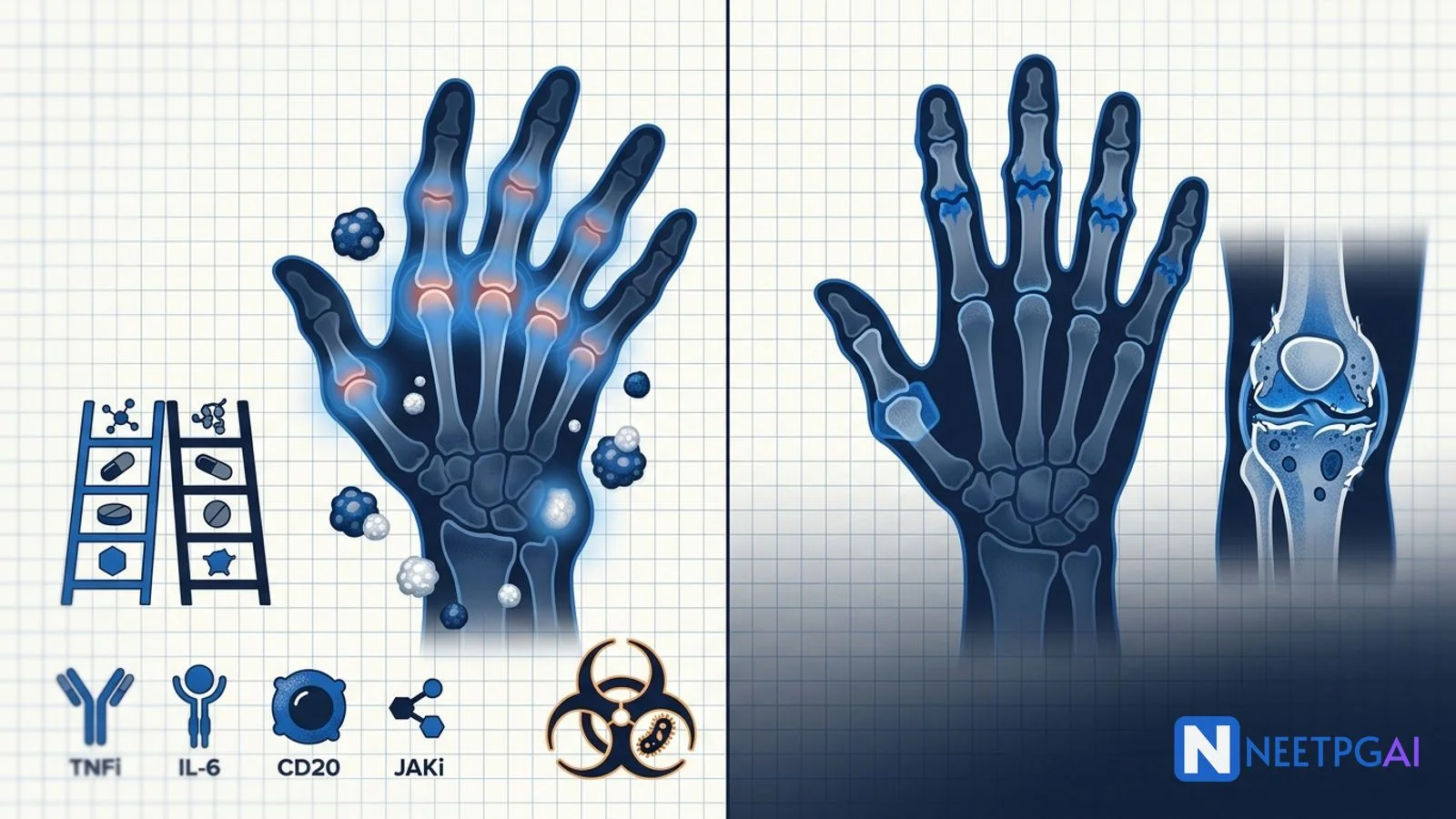
- RA vs OA — RA is symmetric small-joint (MCP, PIP, wrist) with more than 1 hour morning stiffness + systemic features + marginal erosions. OA is DIP (Heberden), PIP (Bouchard), knee, hip, first CMC with less than 30 min stiffness + osteophytes + subchondral sclerosis.
- RA autoantibodies — Anti-CCP (95% specific) more than RF; HLA-DR4 shared epitope.
- 2010 ACR/EULAR criteria — score 6 of 10 across joint count, serology, acute phase, duration.
- Methotrexate — first-line csDMARD; weekly PO/SC + folic acid; watch LFTs / CBC / creatinine; contraindicated in pregnancy + liver disease.
- TNF inhibitors — infliximab, adalimumab, etanercept; screen for TB + HBV + HCV + HIV before start; India LTBI prevalence 25–40% makes this non-negotiable.
- JAK inhibitors — tofacitinib, baricitinib, upadacitinib; cardiovascular + malignancy black-box warning; herpes zoster risk.
- Treat-to-target — remission or low disease activity by DAS28/CDAI/SDAI; escalate every 3 months if target unmet.
Rheumatoid arthritis and osteoarthritis together account for a large fraction of the NEET PG medicine paper's musculoskeletal marks. This NEETPGAI deep dive covers the RA vs OA differential table you can bank on, the 2010 ACR/EULAR criteria, the full csDMARD → bDMARD → tsDMARD ladder with the safety flags examiners test, and the India-specific tuberculosis screening protocol every biologic prescriber must know.
Pair this with the anti-tubercular drugs guide for LTBI regimens used before biologic initiation.
Rheumatoid arthritis vs osteoarthritis — the anchor differential
| Feature | Rheumatoid arthritis | Osteoarthritis |
|---|
| Age of onset | 30–60 years | Above 50 years |
| Sex ratio | 3:1 female | Slight female predominance |
| Joint pattern | Symmetric small joints — MCP, PIP, wrist, MTP | DIP (Heberden), PIP (Bouchard), first CMC, knee, hip, spine |
| Morning stiffness | More than 1 hour, improves with movement | Less than 30 min, worse with use |
| Systemic features | Fatigue, fever, weight loss, nodules, ILD, Sicca, vasculitis, Felty | None (mechanical only) |
| Serology | RF + anti-CCP positive | Negative |
| Acute phase reactants | ESR, CRP raised | Normal |
| Radiograph | Symmetric narrowing, marginal erosions, juxta-articular osteopenia | Asymmetric narrowing, osteophytes, subchondral sclerosis, subchondral cysts |
| Bloods | Normocytic anaemia of chronic disease, mild leukocytosis | Normal |
Pathophysiology snapshot
- RA — chronic autoimmune synovitis driven by T-helper cells, B-cell autoantibody production (RF, anti-CCP), TNF-alpha, IL-6 and IL-17 → hyperplastic pannus that erodes cartilage and bone. Strong genetic association with HLA-DR4 (shared epitope). Smoking and periodontal disease (Porphyromonas gingivalis) trigger anti-CCP formation via citrullination.
- OA — imbalance between cartilage matrix synthesis and degradation; chondrocyte dysregulation with matrix metalloproteinase upregulation; some low-grade inflammation. Primary (idiopathic) vs secondary (post-traumatic, inflammatory arthritis, metabolic, dysplastic).
Rheumatoid arthritis — diagnosis
2010 ACR/EULAR classification criteria
Applied to any patient with clinical synovitis of at least one joint not better explained by another disease. Score of 6 or more from 10 possible = definite RA.
| Domain | Points |
|---|
| Joint involvement | 1 large joint = 0; 2–10 large = 1; 1–3 small = 2; 4–10 small = 3; more than 10 (at least 1 small) = 5 |
| Serology | RF and anti-CCP negative = 0; low positive = 2; high positive (more than 3x ULN) = 3 |
| Acute-phase reactants | Both CRP and ESR normal = 0; either abnormal = 1 |
| Symptom duration | Less than 6 weeks = 0; 6 weeks or more = 1 |
- Anti-CCP — specificity approximately 95%; sensitivity approximately 70%. Present years before clinical disease.
- RF — positive in 70–80% of RA but also in Sjögren, HCV, endocarditis, elderly asymptomatic; less specific.
- Ultrasound / MRI — synovial hypertrophy, effusion, erosions earlier than X-ray.
Extra-articular manifestations
| System | Manifestation |
|---|
| Skin | Rheumatoid nodules (extensor surfaces — olecranon; RF-positive; methotrexate can worsen) |
| Lung | Interstitial lung disease (usually UIP pattern), rheumatoid nodules, pleural effusion (low glucose, low pH — mimics empyema), bronchiectasis, Caplan syndrome (RA + pneumoconiosis) |
| Eye | Keratoconjunctivitis sicca (secondary Sjögren), episcleritis, scleritis |
| Heart | Accelerated atherosclerosis (leading cause of death in RA), pericarditis, valve nodules |
| Vasculitis | Cutaneous nailfold infarcts, mononeuritis multiplex |
| Haem | Felty syndrome — RA + splenomegaly + neutropenia; increased lymphoma risk |
| Renal | Amyloidosis (AA), analgesic nephropathy |
| Neuro | Atlanto-axial subluxation — cervical spine instability; check before anaesthesia |
Rheumatoid arthritis — management
Modern RA care is a treat-to-target discipline — set a target (remission or low disease activity), measure disease activity at every visit (DAS28, CDAI, SDAI), and escalate therapy every 3 months until the target is met.
Step 1 — bridge therapy
- NSAIDs — for symptom control; not disease-modifying.
- Short-course glucocorticoids — prednisolone 5–10 mg/day for bridging while DMARDs take effect; taper as soon as possible. Intra-articular steroid for flares.
Step 2 — conventional synthetic DMARDs (csDMARDs)
| Drug | Notes |
|---|
| Methotrexate (first-line — anchor drug) | Weekly PO/SC 15–25 mg with folic acid 5 mg on non-MTX days; monitor CBC, LFTs, creatinine every 8–12 weeks; contraindicated in pregnancy (teratogenic — abortifacient), liver disease, significant renal impairment, alcohol; pneumonitis is a rare severe reaction |
| Leflunomide | Alternative or add-on; long half-life (weeks); cholestyramine washout for pregnancy planning; teratogenic; monitor LFTs, BP |
| Sulfasalazine | Useful in mild disease and pregnancy; monitor CBC, LFTs; G6PD deficiency caution |
| Hydroxychloroquine | Mild disease and combination therapy; retinal toxicity — screen at baseline and annually after 5 years; safe in pregnancy |
Triple therapy — methotrexate + sulfasalazine + hydroxychloroquine — non-inferior to methotrexate + TNF inhibitor in some trials (TEAR, RACAT); a cost-effective option relevant to India.
Step 3 — biologic DMARDs (bDMARDs)
Used when csDMARDs fail. Combine with methotrexate for better efficacy and reduced immunogenicity.
| Class | Drug | Key issues |
|---|
| TNF-alpha inhibitor | Infliximab (IV, chimeric), Adalimumab (SC, human), Etanercept (SC, receptor fusion), Golimumab, Certolizumab | TB reactivation — screen with IGRA/Mantoux + CXR before start; HBV / HCV / HIV screen; demyelinating disease (avoid in MS); heart failure (avoid in class III/IV); paradoxical psoriasis |
| IL-6 receptor inhibitor | Tocilizumab, Sarilumab | Neutropenia, hyperlipidaemia (statin), hepatotoxicity, GI perforation (avoid in diverticular disease); useful in giant cell arteritis too |
| B-cell depleter | Rituximab (anti-CD20) | Hepatitis B reactivation (fulminant hepatitis reported); PML rarely; infusion reactions |
| T-cell co-stimulation blocker | Abatacept (CTLA-4-Ig) | Better tolerated; lower TB risk (still screen) |
Step 4 — targeted synthetic DMARDs (tsDMARDs)
- JAK inhibitors — tofacitinib, baricitinib, upadacitinib, filgotinib.
- FDA black-box warning based on the ORAL Surveillance trial — increased major adverse cardiovascular events, malignancy (including lung cancer), venous thromboembolism, and all-cause mortality vs TNF inhibitors in RA patients over 50 with at least one cardiovascular risk factor.
- Herpes zoster reactivation risk (vaccinate before start where feasible with the non-live Shingrix vaccine).
- Reserve for patients failing TNFi or with contraindication; discuss cardiovascular risk in shared decision-making.
Non-pharmacologic and surgical
- Physiotherapy — range of motion, strengthening.
- Occupational therapy — joint protection, splints.
- Surgery — joint replacement for end-stage destruction; synovectomy uncommon now.
- Vaccinations before immunosuppression — inactivated influenza, pneumococcal (PCV + PPSV23), Shingrix (non-live varicella zoster); avoid live vaccines during biologic therapy.
Osteoarthritis — management
Non-surgical care first; surgery for end-stage disease.
Non-pharmacologic (foundational)
- Weight loss — every 1 kg lost reduces knee OA symptoms; obesity is the biggest modifiable risk.
- Land-based and aquatic exercise — quadriceps strengthening for knee OA; walking, cycling, swimming.
- Physiotherapy — targeted strengthening, gait retraining.
- Braces, foot orthoses, cane — offload the affected joint.
- Patient education and self-management — pacing, activity modification.
Pharmacologic
- Topical NSAIDs (diclofenac gel) — first-line for knee and hand OA; better safety than oral.
- Oral NSAIDs — short-course; add PPI in GI risk; caution in CKD, hypertension, CV disease. Selective COX-2 (celecoxib) — less GI risk, watch cardiovascular.
- Paracetamol (acetaminophen) — modest efficacy; deprioritised in latest guidelines but reasonable adjunct.
- Topical capsaicin — hand OA.
- Intra-articular glucocorticoid — short-term relief; limit to 3–4 per year per joint; concerns about accelerating cartilage loss with repeated use.
- Intra-articular hyaluronic acid — variable evidence; conditional recommendation.
- Duloxetine — chronic knee OA pain; helpful when central sensitisation contributes.
- Opioids — avoid; no long-term benefit; addiction and fall risk.
- Glucosamine, chondroitin — no consistent evidence; not recommended in current guidelines.
Surgical
- Total joint arthroplasty (TKR / THR) — end-stage disease with disabling pain refractory to conservative care. Modern prostheses last 20+ years in 80%+ of patients.
- Osteotomy — young active patients with unicompartmental disease and malalignment.
- Arthroscopy — no role for pure OA (Moseley trial); reserved for mechanical symptoms suggesting meniscal or loose body.
Juvenile idiopathic arthritis (JIA)
Arthritis of unknown aetiology beginning before 16 years and persisting for at least 6 weeks. Seven ILAR subtypes:
| Subtype | Features |
|---|
| Systemic-onset (Still disease) | Quotidian fever, salmon-pink evanescent rash, arthritis, hepatosplenomegaly, lymphadenopathy, serositis, marked leucocytosis; ferritin very high; risk of macrophage activation syndrome (MAS) |
| Oligoarticular (up to 4 joints in first 6 months) | Commonest; ANA-positive girls; anterior uveitis — needs regular slit-lamp screening every 3–6 months |
| Polyarticular RF-negative | 5 or more joints, similar to adult RA |
| Polyarticular RF-positive | Adolescent girls; adult-type RA |
| Enthesitis-related arthritis | HLA-B27 positive; boys; large lower-limb joints; can evolve to ankylosing spondylitis |
| Psoriatic | Psoriasis or family history + arthritis; nail pitting, dactylitis |
| Undifferentiated | Doesn't fit above |
- Management — NSAIDs, intra-articular steroid, methotrexate (first-line DMARD), biologics (adalimumab, etanercept, anakinra + canakinumab for systemic JIA).
- Anterior uveitis screening — regular slit-lamp exam; uveitis can be asymptomatic until vision loss.
Other high-yield inflammatory arthritides
Spondyloarthritides
| Condition | Features |
|---|
| Ankylosing spondylitis | HLA-B27, young men, inflammatory low back pain (worse rest / better activity), sacroiliitis, syndesmophytes, bamboo spine; NSAIDs first-line, TNFi if refractory; anterior uveitis, aortitis, apical fibrosis |
| Psoriatic arthritis | 5 patterns (asymmetric oligoarthritis, symmetric polyarthritis, DIP predominant, arthritis mutilans, spondylitis); nail pitting; dactylitis (sausage digit); "pencil-in-cup" deformity |
| Reactive arthritis | Post-Chlamydia or GI (Shigella, Salmonella, Yersinia, Campylobacter) infection; oligoarthritis + urethritis + conjunctivitis; keratoderma blennorrhagicum; circinate balanitis |
| Enteropathic | IBD-associated |
Crystal arthropathies
Covered in depth in the gout and hyperuricemia guide.
NEET PG MCQ traps
- Symmetric small-joint arthritis + more than 1 hour morning stiffness = RA.
- DIP arthritis — think OA (Heberden), psoriatic, gout — never RA (RA classically spares DIP).
- Anti-CCP — 95% specific; more specific than RF; present pre-clinically.
- HLA-DR4 shared epitope — RA susceptibility marker.
- Methotrexate — teratogenic; folic acid supplementation; hold in pregnancy planning.
- Sulfasalazine — safe in pregnancy; G6PD caution.
- Hydroxychloroquine — retinal toxicity; annual screening after 5 years.
- Rheumatoid nodules — RF-positive; methotrexate can paradoxically increase them.
- Felty syndrome — RA + splenomegaly + neutropenia.
- Caplan syndrome — RA + pneumoconiosis.
- RA cervical spine — atlanto-axial subluxation; C-spine imaging before intubation.
- TNF inhibitor — screen for latent TB before start (Mantoux 5 mm or more or IGRA); rule out active TB with CXR.
- Rituximab — screen and cover for HBV reactivation.
- JAK inhibitors — cardiovascular + malignancy + VTE + zoster warning.
- Adult-onset Still disease — quotidian fever, salmon rash, high ferritin; MAS complication.
- JIA oligoarticular ANA-positive — anterior uveitis; slit-lamp screening every 3–6 months.
- Ankylosing spondylitis — HLA-B27; young man; inflammatory back pain; syndesmophytes and bamboo spine; anterior uveitis.
- Psoriatic arthritis — dactylitis; "pencil-in-cup" on X-ray; nail pitting.
- Reactive arthritis — can't see (conjunctivitis), can't pee (urethritis), can't climb a tree (arthritis).
- OA knee — first-line topical NSAIDs + exercise + weight loss; TKR for end-stage.
India context
- DMARD access under PMJAY — Ayushman Bharat covers csDMARDs and some biologics through empanelled hospitals; biosimilars have expanded access.
- Biosimilars — India is a global leader — adalimumab, etanercept, infliximab, rituximab biosimilars widely available at a fraction of originator prices, transforming RA care affordability.
- TB screening before biologics — non-negotiable given India's LTBI prevalence (~25–40% of adults). IGRA preferred over Mantoux where available.
- Hepatitis screening — HBsAg, anti-HBc, anti-HCV, HIV before biologic initiation.
- Vaccination — inactivated influenza + PCV / PPSV23 + Shingrix before starting biologics or tsDMARDs; live vaccines contraindicated on treatment.
- Indian Rheumatology Association (IRA) guidance broadly aligned with EULAR; adapted for cost and TB burden.
- Home-based physiotherapy and community-based rehabilitation increasingly used given specialist scarcity.
- JIA management — paediatric rheumatology remains under-served; often shared care between paediatricians and adult rheumatologists.
Frequently asked questions
How do you clinically distinguish rheumatoid arthritis from osteoarthritis?
The two are separated on five axes. (1) Age — RA peaks between 30 and 60, OA is more common after 50. (2) Joint pattern — RA is a symmetric, small-joint arthritis of MCPs, PIPs, wrists and MTPs; OA affects DIPs (Heberden nodes) and PIPs (Bouchard nodes), the first CMC joint, knees, hips and spine. (3) Morning stiffness — RA gives 1 hour or more of morning stiffness that improves with movement; OA gives less than 30 minutes and stiffness that gets worse with use. (4) Systemic features — RA has fatigue, low-grade fever, weight loss, rheumatoid nodules, ILD, keratoconjunctivitis sicca, and vasculitis; OA is a mechanical joint disease with no systemic features. (5) Radiographs — RA shows symmetric joint-space narrowing with marginal erosions and juxta-articular osteopenia; OA shows asymmetric joint-space narrowing with osteophytes, subchondral sclerosis and subchondral cysts.
What are the 2010 ACR/EULAR criteria for RA diagnosis?
The 2010 ACR/EULAR criteria assign points across four domains and require at least 6 out of 10 for definite RA in a patient with clinical synovitis of at least one joint not explained by another disease. Domain 1 (joint involvement, 0 to 5 points) — 1 large joint = 0, 2 to 10 large joints = 1, 1 to 3 small joints = 2, 4 to 10 small joints = 3, more than 10 joints with at least 1 small = 5. Domain 2 (serology, 0 to 3 points) — negative RF and anti-CCP = 0, low-positive RF or anti-CCP = 2, high-positive (more than 3 times upper limit of normal) = 3. Domain 3 (acute-phase reactants, 0 to 1 point) — normal CRP and ESR = 0, abnormal = 1. Domain 4 (duration, 0 to 1 point) — less than 6 weeks = 0, 6 weeks or more = 1. Anti-CCP has approximately 95 percent specificity and is more specific than rheumatoid factor, which can be positive in Sjogren, hepatitis C, endocarditis and elderly asymptomatic people.
Why must you screen for tuberculosis before starting a TNF inhibitor in India?
TNF-alpha is critical for granuloma maintenance in latent tuberculosis. Blocking TNF with infliximab, adalimumab, etanercept, golimumab or certolizumab reactivates latent TB — the greatest risk is in the first 6 months and infliximab carries the highest risk. In India, where latent TB prevalence in adults is estimated at 25 to 40 percent, screening before biologic initiation is mandatory. Standard screening is (1) history and physical examination for active TB, (2) chest X-ray, (3) tuberculin skin test (Mantoux — induration of 5 mm or more considered positive in patients about to start biologics) or interferon-gamma release assay (IGRA) — IGRA is preferred because it does not cross-react with BCG. If latent TB is confirmed, complete a full LTBI regimen (isoniazid 6 to 9 months, or 3HP for 12 weeks, or 4R for 4 months) and start biologics after at least 4 weeks of TB therapy. Hepatitis B, hepatitis C and HIV screening are also part of the standard pre-biologic workup.
What is the current treat-to-target strategy in rheumatoid arthritis?
Treat-to-target (T2T) is the modern paradigm for RA management. The target is clinical remission (or low disease activity if remission is not feasible), measured objectively by validated tools such as DAS28, CDAI or SDAI, at every visit — typically every 1 to 3 months while disease is active and every 6 to 12 months once controlled. If the target is not met, therapy is escalated in a defined sequence — start methotrexate (with short-term glucocorticoid bridge), assess at 3 months, escalate to combination csDMARDs, then to a bDMARD or tsDMARD if csDMARDs fail. Escalation is not optional if the target is not reached — this is the discipline that transformed RA outcomes over the past two decades and separates modern rheumatology from earlier symptom-managed care.
When should knee replacement be considered in osteoarthritis?
Total knee replacement (TKR) is considered when a patient has advanced radiographic osteoarthritis (Kellgren-Lawrence grade 3 or 4), disabling knee pain that limits activities of daily living, and inadequate response to a sustained trial of non-operative therapy — weight loss, physiotherapy focused on quadriceps strengthening, oral or topical NSAIDs, intra-articular corticosteroid injections, and where appropriate hyaluronic acid injections. Age alone is not a contraindication — modern prostheses last 20 years or more in more than 80 percent of patients. Patient-specific contraindications include active infection anywhere in the body, uncontrolled cardiovascular disease, and unaddressed opioid use. Prehabilitation (strengthening before surgery), spinal anaesthesia, multimodal analgesia (avoiding opioid-heavy protocols), and early mobilisation (day-of-surgery walking) are the current standards, with enhanced recovery after surgery (ERAS) protocols producing hospital stays of 2 to 3 days at most Indian tertiary centres.
This content is for educational purposes for NEET PG exam preparation. It is not a substitute for professional medical advice, diagnosis, or treatment. Clinical information has been reviewed by qualified medical professionals.
Written by: NEETPGAI Editorial Team
Reviewed by: Pending SME Review
Last reviewed: July 2026