Quick Answer
Reproductive physiology is a 3 to 4 question topic in NEET PG Physiology plus OBG. Lock these:
- HPG axis — pulsatile GnRH → LH + FSH → oestradiol + progesterone; negative and positive feedback.
- Menstrual cycle — follicular (days 1-13), ovulation (day 14 LH surge), luteal (days 15-28).
- Two-cell two-gonadotropin theory — theca (LH, androgens) + granulosa (FSH, aromatase to oestrogens).
- Endometrium — menstrual (1-5), proliferative (6-14, oestrogen), secretory (15-28, progesterone).
- Menopause — 12 months amenorrhoea; FSH greater than 30, oestradiol less than 20; Indian mean age about 46 to 48 years.
- hCG — doubles every 48 to 72 hours; sustains corpus luteum until placenta takes over at 8 to 10 weeks.
- COC — suppresses ovulation, thickens cervical mucus, thins endometrium.
Reproductive physiology is a favourite NEET PG topic because it spans Physiology, OBG, Endocrinology, and Pharmacology in a single hormonal axis. Mastering the hypothalamic-pituitary-gonadal (HPG) axis and the two-cell two-gonadotropin theory unlocks MCQs on infertility, contraception, PCOS, menopause, and early pregnancy. This NEETPGAI deep dive walks through the menstrual cycle, puberty, menopause, male HPG axis, and pregnancy hormonal physiology with India-specific context.
Pair this guide with the pharyngeal arch embryology deep dive for OBG-embryology overlap.
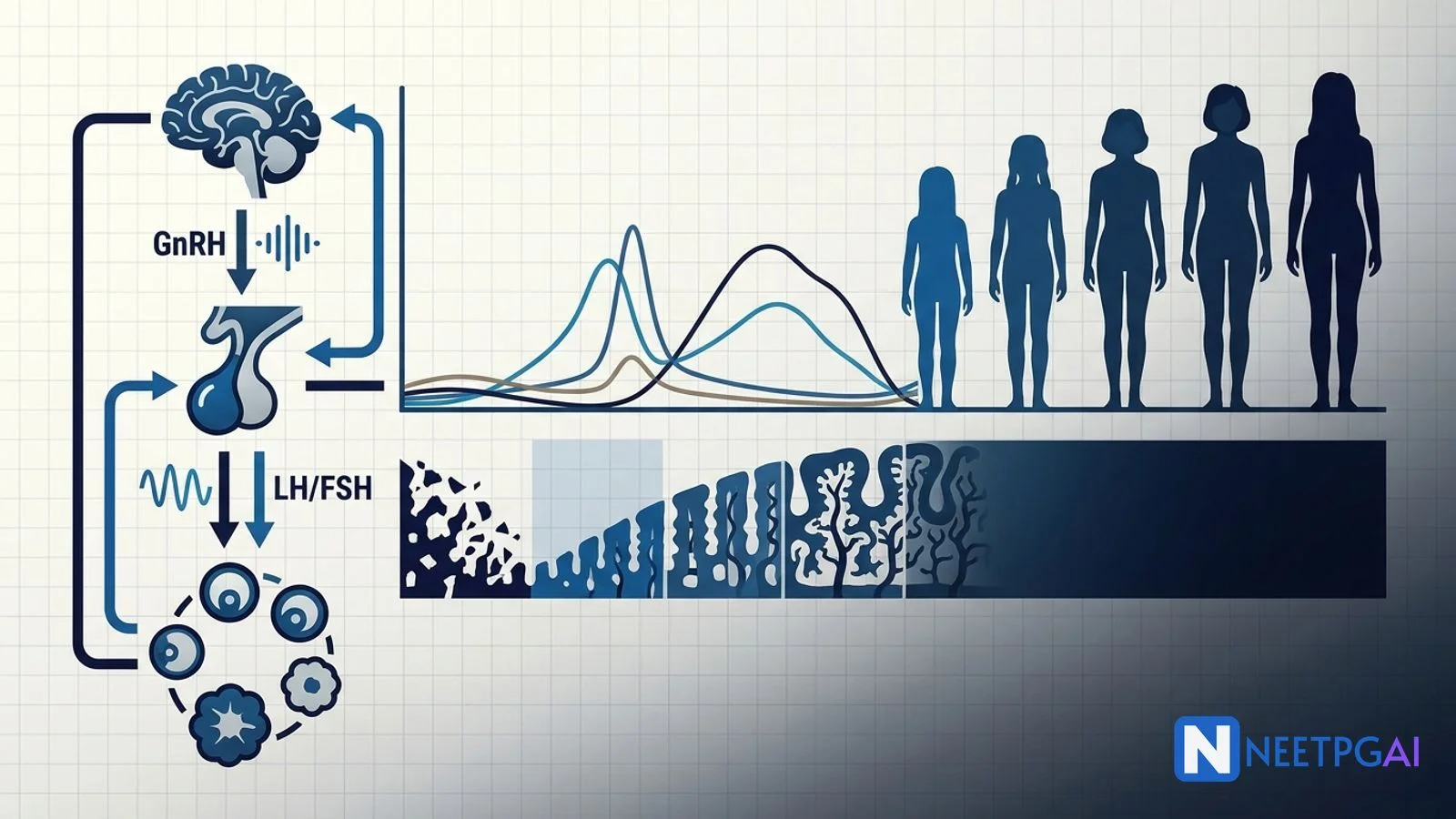
The hypothalamic-pituitary-gonadal (HPG) axis
The HPG axis is a three-tier neuroendocrine hierarchy.
- Hypothalamus — GnRH-secreting neurons in the arcuate and preoptic nuclei release GnRH in pulses into the hypophyseal portal circulation. Pulsatility is essential — continuous GnRH (or long-acting GnRH agonists) desensitises the pituitary and paradoxically suppresses gonadotropins (basis of leuprolide use in prostate cancer and central precocious puberty).
- Anterior pituitary — GnRH stimulates gonadotroph cells to release LH and FSH.
- Gonads — ovaries or testes produce sex steroids (oestradiol, progesterone, testosterone) and peptides (inhibin B, AMH) that feedback on the pituitary and hypothalamus.
Feedback is dominantly negative (steroids and inhibin suppress GnRH and gonadotropins). Uniquely in females, sustained high oestradiol flips into positive feedback at the pituitary in the late follicular phase — the trigger for the LH surge.
The menstrual cycle — ovarian and endometrial
The menstrual cycle averages 28 days (normal 21 to 35). Two parallel cycles run in synchrony — the ovarian cycle (follicular, ovulation, luteal) and the endometrial cycle (menstrual, proliferative, secretory).
Follicular phase (days 1 to 13)
- FSH rises early — recruits a cohort of antral follicles for growth.
- Around day 5 to 7, dominant follicle selection — the follicle with the most FSH receptors and highest aromatase activity wins; others undergo atresia.
- Dominant follicle secretes oestradiol and inhibin B. Rising oestradiol suppresses FSH (negative feedback) — this narrows the recruitment to a single follicle.
- Endometrium is in the proliferative phase — oestrogen-driven glandular and stromal proliferation, straight glands, thin functional layer.
Ovulation (about day 14)
- Oestradiol crosses a threshold (about 200 pg/mL sustained for 48 hours) → positive feedback at the pituitary → massive LH surge (and a smaller FSH surge).
- Peak LH occurs about 24 to 36 hours before ovulation.
- LH surge triggers — resumption of meiosis I in the oocyte, follicular wall enzymatic breakdown (collagenases, prostaglandins), luteinisation of granulosa cells.
- Ovulation occurs about 36 hours after the LH surge peak — the secondary oocyte (arrested in metaphase II) is released.
Luteal phase (days 15 to 28)
- Corpus luteum forms from the collapsed follicle — granulosa cells luteinise and produce progesterone (and some oestradiol).
- Progesterone peaks around day 21 (mid-luteal) — measurement of day 21 progesterone confirms ovulation (level over 3 ng/mL, often over 10).
- Endometrium is in the secretory phase — coiled glands, glycogen-rich secretions, spiral arteries; primed for implantation.
- Without pregnancy, the corpus luteum regresses by day 26 to 28 → progesterone and oestrogen fall → endometrial shedding = menstruation.
- With pregnancy, hCG from the trophoblast rescues the corpus luteum.
The two-cell two-gonadotropin theory
Ovarian oestradiol synthesis requires cooperation between two cell types:
| Cell | Receptor | Enzymes | Function |
|---|
| Theca cell | LH receptor | CYP17 (17-alpha-hydroxylase, 17,20-lyase); no aromatase | LH drives cholesterol → pregnenolone → androstenedione and testosterone |
| Granulosa cell | FSH receptor | CYP19 (aromatase); no CYP17 | FSH drives androgens (from theca) → oestrone and oestradiol |
Theca cells make androgens but cannot aromatise them. Granulosa cells can aromatise but cannot make androgens. Neither cell makes oestrogen alone — cooperation is essential. Explains why aromatase inhibitors (letrozole) reduce oestrogen and are used for ovulation induction in PCOS and adjuvant therapy in postmenopausal breast cancer.
Hormone profile across the cycle
| Hormone | Follicular | Ovulation | Luteal |
|---|
| FSH | Early rise | Small surge | Low (inhibin feedback) |
| LH | Low baseline | Massive surge | Low (progesterone feedback) |
| Oestradiol | Rising to a pre-ovulatory peak | Peaks 24 to 36 hours before LH | Second smaller rise from corpus luteum |
| Progesterone | Low | Beginning to rise | Peaks day 21 (over 10 ng/mL) |
| Inhibin B | Rises with follicle growth | High | Falls |
| Inhibin A | Low | Low | Rises with corpus luteum |
Puberty — Tanner staging
Puberty is the transition from reproductive dormancy to fertility. Order of events in females:
- Thelarche (breast bud) — age 8 to 13, first sign of puberty.
- Adrenarche / pubarche (pubic and axillary hair) — follows thelarche.
- Growth spurt — earlier in females, peaks around Tanner 3.
- Menarche (first menstrual period) — age 12 to 13 globally; Indian mean age 12.4 years (NFHS-5 data). Menarche follows peak height velocity.
Tanner staging grades breast (B1 to B5), pubic hair (PH1 to PH5), and genital development (in males, G1 to G5) — used for staging normal, precocious, and delayed puberty.
- Precocious puberty — secondary sexual characteristics before age 8 in females or 9 in males. Central (GnRH-dependent, common in females — idiopathic; leuprolide treats) or peripheral (GnRH-independent — McCune-Albright, CAH, HCG-secreting tumour).
- Delayed puberty — no secondary sex characteristics by age 13 in females or 14 in males, or no menarche by age 15. Constitutional delay is commonest; hypergonadotropic hypogonadism (Turner XO, Klinefelter XXY) or hypogonadotropic hypogonadism (Kallmann syndrome — anosmia; functional from anorexia, athletics).
Menopause and perimenopause
Menopause — permanent cessation of menstruation confirmed retrospectively after 12 consecutive months of amenorrhoea, at a median age of 51 years globally and 46 to 48 years in India (about 3 years earlier).
Hormonal profile
- FSH greater than 30 IU/L — inhibin B loss removes feedback.
- LH also elevated.
- Oestradiol less than 20 pg/mL — depleted follicles.
- AMH undetectable — ovarian reserve exhausted.
Perimenopause
Menopausal transition — usually 4 to 8 years before menopause. Cycles become irregular, anovulatory; unopposed oestrogen from anovulatory cycles increases endometrial hyperplasia risk.
Clinical features
- Vasomotor symptoms — hot flushes, night sweats (80 percent of women).
- Genitourinary syndrome of menopause (GSM) — vaginal dryness, dyspareunia, urinary urgency.
- Osteoporosis — accelerated bone loss (2 to 3 percent per year for 5 to 7 years).
- Cardiovascular — loss of oestrogen cardioprotection, dyslipidaemia.
- Mood, cognitive symptoms — variable.
Management
- Hormone therapy (HT) — combined oestrogen and progestin for women with a uterus; oestrogen alone for hysterectomised. Effective for vasomotor symptoms and GSM; balance benefits against breast cancer and VTE risk (Women's Health Initiative). Use lowest effective dose for shortest duration.
- Non-hormonal — SSRIs and SNRIs, gabapentin, clonidine for vasomotor symptoms; vaginal moisturisers or local oestrogen for GSM.
Premature ovarian insufficiency (POI) — menopause before age 40 (1 percent of women). Causes — Turner syndrome (XO), FMR1 premutation, autoimmune polyglandular syndrome, chemotherapy or radiotherapy, familial. Workup — karyotype, FMR1, autoantibodies. Hormone therapy is standard until the average age of natural menopause.
Male HPG axis
- Hypothalamic GnRH pulses → anterior pituitary LH and FSH.
- LH acts on Leydig cells (interstitial) → testosterone synthesis.
- FSH acts on Sertoli cells (seminiferous tubules) → supports spermatogenesis, produces inhibin B (feedback on FSH) and androgen-binding protein.
- Testosterone feedback — negative on hypothalamus and pituitary.
- DHT — potent androgen formed from testosterone by 5-alpha-reductase (mostly type II) in prostate, hair follicles, external genitalia. Responsible for prostate growth (benign prostatic hyperplasia, prostate cancer), male-pattern baldness, sebaceous activity. Finasteride and dutasteride are 5-alpha-reductase inhibitors.
Hormonal physiology of pregnancy
- Human chorionic gonadotropin (hCG) — from syncytiotrophoblast from about day 8. Doubles every 48 to 72 hours in early normal pregnancy. Binds LH receptors on corpus luteum. Beta-hCG is the pregnancy-test target. Levels peak at 8 to 10 weeks and fall.
- Luteoplacental shift — corpus luteum sustains progesterone until 8 to 10 weeks; placenta takes over steroidogenesis after that.
- Progesterone — placental. Maintains myometrial quiescence, uterine vascular remodelling, breast development.
- Oestriol — the placenta uses fetal adrenal DHEA-S as substrate. Rising oestriol is a marker of fetal wellbeing; a fall may indicate anencephaly or placental insufficiency.
- Human placental lactogen (hPL) — placental. Insulin resistance, lipolysis, mobilises fatty acids for maternal energy and glucose for fetus. Contributes to gestational diabetes.
- Prolactin — anterior pituitary; rises through pregnancy; suppressed lactation by high oestrogen until oestrogen falls postpartum, when milk let-down begins.
Contraception mechanisms (physiology-focused recap)
| Method | Mechanism |
|---|
| Combined oral contraceptive (COC) | Oestrogen suppresses FSH → no dominant follicle; progestin blocks LH surge → no ovulation; thickens cervical mucus; thins endometrium |
| Progestin-only pill (POP) | Thickens cervical mucus (primary); variable ovulation suppression |
| Depot medroxyprogesterone (DMPA) | Suppresses ovulation; long-acting injectable every 3 months |
| Levonorgestrel IUS (Mirena) | Local progestin — thins endometrium, thickens cervical mucus; may suppress ovulation in some cycles |
| Copper IUD | Foreign-body inflammatory reaction, spermicidal, hostile endometrium; NO hormonal effect |
| Emergency contraception (levonorgestrel 1.5 mg or ulipristal 30 mg) | Delays or inhibits ovulation if taken before LH surge; less effective after |
India-specific context
- Indian menarche mean age — 12.4 years (NFHS-5); urban earlier than rural.
- Indian menopause mean age — 46 to 48 years (about 3 years earlier than global mean; lifestyle, nutrition, parity may contribute).
- POI workup priority — karyotype (Turner), FMR1 premutation, TPO and adrenal antibodies.
- PCOS burden — 10 to 20 percent Indian women of reproductive age; letrozole first-line for ovulation induction.
- Anaemia in pregnancy — high Indian prevalence; affects labour outcomes, birth weight.
- National family planning programme — COC, POP, DMPA (Antara programme), Cu-IUD, LNG-IUS, sterilisation.
NEET PG MCQ traps
- GnRH pulsatility essential — continuous GnRH desensitises pituitary (leuprolide use).
- Two-cell two-gonadotropin theory — theca (LH + androgens), granulosa (FSH + aromatase to oestrogens).
- Aromatase inhibitors (letrozole) — reduce oestrogen; ovulation induction in PCOS; adjuvant in postmenopausal breast cancer.
- Follicular phase — dominant follicle selection around day 5 to 7.
- LH surge triggered by rising oestradiol (positive feedback) — mid-cycle.
- Ovulation about 36 hours after LH surge peak.
- Corpus luteum — makes progesterone (peak day 21).
- Day 21 progesterone confirms ovulation (over 3 ng/mL).
- Menstruation — corpus luteum regression → progesterone withdrawal.
- Menarche mean age India — 12.4 years.
- Tanner stages — B1-5, PH1-5.
- Central precocious puberty — leuprolide treatment.
- Kallmann syndrome — hypogonadotropic hypogonadism + anosmia (KAL1 gene).
- Menopause — 12 months amenorrhoea; FSH over 30; mean age India 46 to 48.
- POI — before age 40; karyotype + FMR1 workup.
- hCG doubles every 48 to 72 hours; peaks 8 to 10 weeks.
- Luteoplacental shift — 8 to 10 weeks.
- hPL — insulin resistance in pregnancy; gestational diabetes risk.
- Oestriol — placenta + fetal adrenal; marker of fetal wellbeing.
- Male HPG — LH → Leydig → testosterone; FSH → Sertoli → spermatogenesis + inhibin B.
- 5-alpha-reductase — testosterone to DHT; finasteride blocks.
- COC — suppresses ovulation (primary), thickens mucus, thins endometrium.
- POP — cervical mucus thickening primary.
- DMPA — every 3 months; suppresses ovulation.
- Cu-IUD — no hormones; foreign body + spermicidal.
Frequently asked questions
How does the two-cell two-gonadotropin theory explain oestrogen production?
The two-cell two-gonadotropin theory explains ovarian oestradiol synthesis by cooperation between theca and granulosa cells. Theca cells have LH receptors and CYP17 (17-alpha-hydroxylase and 17,20-lyase) but lack aromatase — LH drives conversion of cholesterol to androstenedione and testosterone. Androgens diffuse into granulosa cells, which have FSH receptors and CYP19 (aromatase) but lack CYP17 — FSH drives conversion of theca-derived androgens to oestrone and oestradiol. Neither cell can make oestrogen alone; cooperation is essential.
What triggers ovulation and how does the LH surge work?
Ovulation is triggered by the mid-cycle LH surge (with a smaller FSH surge). Rising oestradiol from the dominant follicle crosses a threshold (about 200 pg/mL sustained for 48 hours) and flips negative feedback into positive feedback at the anterior pituitary, causing a massive LH release. Peak LH occurs about 24 to 36 hours before ovulation. LH surge triggers resumption of meiosis I in the primary oocyte, follicular wall enzymatic breakdown (collagenases, prostaglandins), and luteinisation of granulosa cells. Ovulation follows about 36 hours after the LH surge peak, releasing a secondary oocyte arrested in metaphase II.
What defines menopause and what is the hormonal profile?
Menopause is the permanent cessation of menstruation confirmed retrospectively after 12 consecutive months of amenorrhoea in the absence of other causes. Mean age is about 51 years globally and 46 to 48 years in India (about 3 years earlier). Hormonal profile — FSH rises above 30 IU/L (loss of inhibin B from granulosa cells removes FSH feedback), LH also rises, oestradiol drops below 20 pg/mL (loss of ovarian follicles), and AMH is undetectable. Perimenopause is the transition years before, with erratic cycles. Premature ovarian insufficiency (POI) is menopause before age 40 — evaluate for karyotype, FMR1 premutation, autoimmune polyglandular syndrome.
How does hCG sustain early pregnancy?
Human chorionic gonadotropin (hCG) is produced by syncytiotrophoblast cells of the developing placenta from about day 8 after conception. It binds to LH receptors on the corpus luteum, preventing its regression at the expected end of the luteal phase — the corpus luteum continues to produce progesterone until about 8 to 10 weeks, when the placenta takes over steroidogenesis (luteoplacental shift). Serum hCG doubles every 48 to 72 hours in normal early pregnancy; slower rise or plateau suggests ectopic or non-viable pregnancy. Beta-hCG is the pregnancy test target because it is more specific than the alpha subunit (shared with LH, FSH, TSH).
How does combined oral contraceptive pill (COC) prevent pregnancy?
Combined oral contraceptive (COC) pills prevent pregnancy through three main mechanisms. First, oestrogen (ethinyl estradiol) suppresses FSH release, preventing follicular development and dominant follicle selection. Second, progestin suppresses the LH surge, blocking ovulation — the primary contraceptive effect. Third, progestin thickens cervical mucus (reduces sperm penetration) and thins the endometrium (reduces implantation receptivity). Pearl index with perfect use is less than 1 per 100 woman-years. Missing pills, drug interactions (rifampicin, phenytoin, carbamazepine — enzyme inducers), and vomiting or diarrhoea reduce efficacy.
This content is for educational purposes for NEET PG exam preparation. It is not a substitute for professional medical advice, diagnosis, or treatment. Clinical information has been reviewed by qualified medical professionals.
Written by: NEETPGAI Editorial Team
Reviewed by: Pending SME Review
Last reviewed: July 2026