Quick Answer
Nucleotide metabolism is a NEET PG biochemistry mainstay because every enzyme deficiency maps to a named disease.
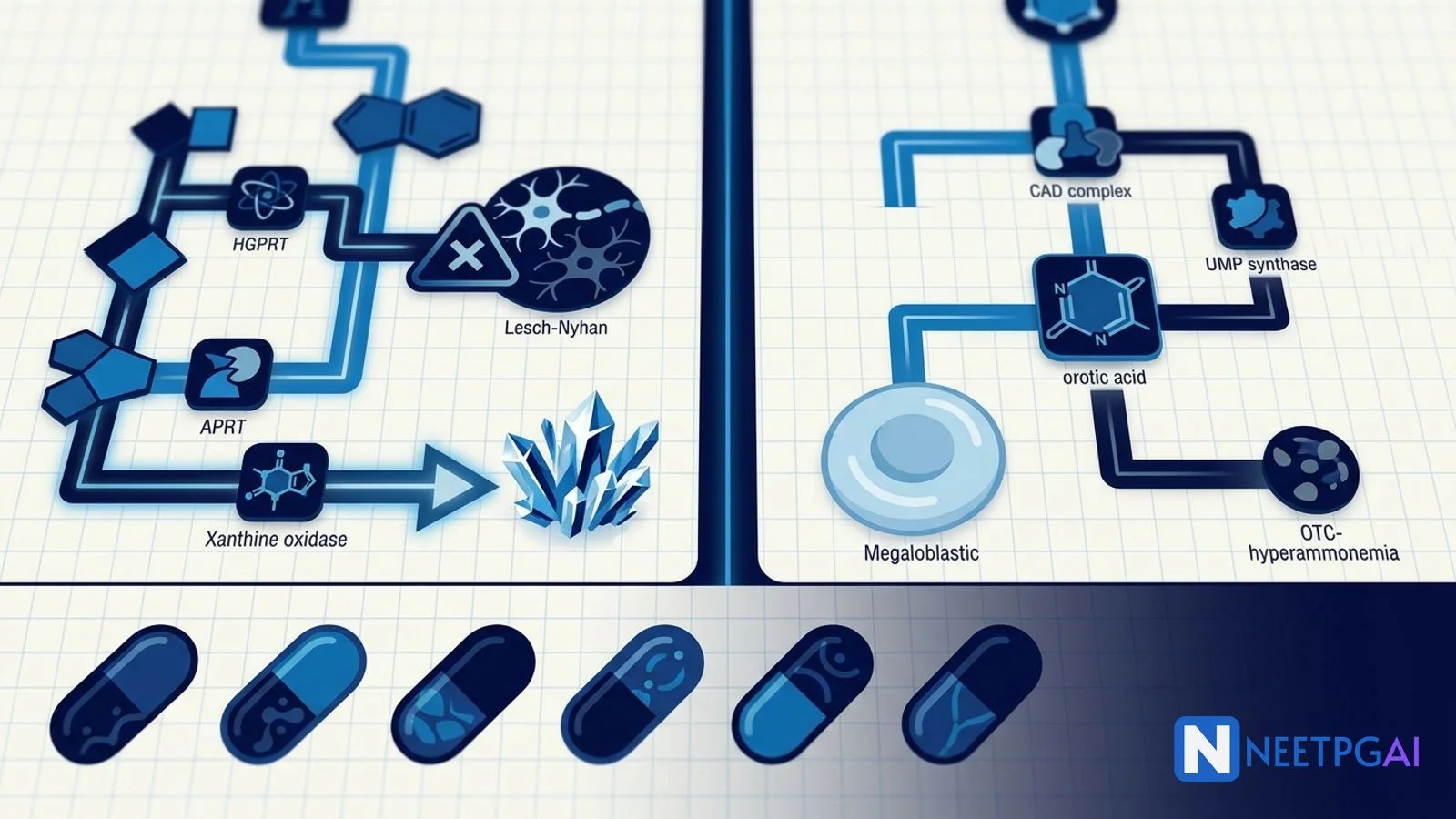
- Purine synthesis — de novo from PRPP plus amino acids (hepatic, brain); salvage via HGPRT and APRT.
- Purine catabolism — hypoxanthine and guanine to xanthine to uric acid (humans lack functional uricase).
- Lesch-Nyhan — X-linked HGPRT deficiency; self-mutilation, hyperuricaemia, intellectual disability.
- ADA deficiency — SCID from dATP toxicity to lymphocytes; PNP deficiency causes selective T-cell defect.
- Pyrimidine synthesis — cytoplasmic; carbamoyl phosphate plus aspartate; assembled first then attached to ribose.
- Orotic aciduria — UMP synthase deficiency; megaloblastic anaemia; treat with oral uridine. Contrast OTC deficiency (urea cycle, hyperammonaemia).
- Antimetabolite drugs — MTX (DHFR), 5-FU (thymidylate synthase), 6-MP/azathioprine (purine analogues, TPMT metabolism), capecitabine (5-FU prodrug).
Nucleotide metabolism is where biochemistry maps most cleanly onto disease — every enzyme has a syndrome, every syndrome has a drug. NEET PG examiners love this domain because a single vignette can test enzymology, X-linked inheritance patterns, drug mechanism and chemotherapy toxicity.
This NEETPGAI deep dive covers purine and pyrimidine pathways, the classic inborn errors and the antimetabolite chemotherapy that exploits them. Pair it with the lipoprotein metabolism guide for the other high-yield biochemistry block.
Purine synthesis
De novo pathway — begins in the cytoplasm of liver, brain and immune cells. Ribose-5-phosphate plus ATP forms 5-phosphoribosyl-1-pyrophosphate (PRPP) via PRPP synthetase. PRPP is the committed precursor. Sequential addition of nitrogen and carbon from glutamine, glycine, aspartate, N10-formyl-THF and CO2 builds the purine ring on the ribose scaffold, producing inosine monophosphate (IMP) — the branch point.
IMP is then converted to AMP (adding aspartate) or GMP (via xanthosine monophosphate, IMP dehydrogenase and GMP synthetase). AMP and GMP feedback-inhibit their own branches at IMP; PRPP amidotransferase (the first committed step) is inhibited by both.
Twelve high-energy phosphate bonds are consumed per purine — energetically expensive.
Salvage pathway — recycles bases from nucleic-acid turnover. Two key enzymes:
- HGPRT (hypoxanthine-guanine phosphoribosyltransferase) — converts hypoxanthine to IMP and guanine to GMP. Loss = Lesch-Nyhan.
- APRT (adenine phosphoribosyltransferase) — adenine to AMP. Deficiency causes 2,8-dihydroxyadenine kidney stones (rare).
Salvage is metabolically cheap and dominant in brain, blood and gut where de novo capacity is limited.
Purine catabolism
AMP is deaminated to IMP, then to inosine, then to hypoxanthine. Guanine is deaminated to xanthine. Both hypoxanthine (via xanthine oxidase) and xanthine converge on uric acid. Humans (and higher primates) lack a functional uricase gene — so uric acid, the terminal purine catabolite, accumulates and can precipitate as sodium urate monohydrate crystals in joints (gout) or in urinary tract (uric acid stones, urate nephropathy).
Allopurinol and febuxostat inhibit xanthine oxidase, blocking uric acid formation and shunting to more soluble hypoxanthine and xanthine. Rasburicase (recombinant uricase) is used in tumour lysis syndrome to convert uric acid to soluble allantoin.
Purine metabolic disorders — high-yield
Lesch-Nyhan syndrome — X-linked recessive complete HGPRT deficiency. Boys present in infancy: developmental delay, extrapyramidal features (choreoathetosis, dystonia), progressive intellectual disability and — pathognomonic — compulsive self-mutilation (lip and finger biting). Hyperuricaemia leads to gout and tophi in childhood plus urate nephropathy. Treat: allopurinol; supportive; protective devices; behavioural management. Carriers detected via HPRT1 gene testing.
PRPP synthetase overactivity — gain-of-function; juvenile gout and hyperuricaemia.
Adenosine deaminase (ADA) deficiency — autosomal recessive; causes SCID. Deoxyadenosine accumulates and is phosphorylated to dATP, which inhibits ribonucleotide reductase and is selectively toxic to lymphocytes (both T and B). Infants present with severe recurrent infections, failure to thrive, absent lymphoid tissue. Treatment: PEG-ADA enzyme replacement, HLA-matched HSCT, or gene therapy (Strimvelis was the first EMA-approved autologous ex-vivo gene therapy).
Purine nucleoside phosphorylase (PNP) deficiency — accumulates dGTP, selectively T-cell toxic (B cells relatively spared). Recurrent viral and opportunistic infections; autoimmune features.
Gout — hyperuricaemia (over 6.8 mg/dL solubility threshold) plus urate crystal deposition. Podagra (first MTP) is classic. Under-excretion (90 percent) more common than over-production. Risk factors: obesity, alcohol (especially beer), fructose-sweetened drinks, thiazides and loop diuretics, cyclosporine, renal impairment. Treat acute attack with NSAID, colchicine or steroid; long-term urate-lowering with allopurinol (start low, titrate to target under 6 mg/dL; screen for HLA-B*5801 in South-East Asian and Han Chinese populations for SJS risk) or febuxostat.
Pyrimidine synthesis
Unlike purines, pyrimidines are assembled first, then attached to ribose. Cytoplasmic. Begins with carbamoyl phosphate (from cytoplasmic CPS-II, distinct from mitochondrial CPS-I of the urea cycle) plus aspartate to form carbamoyl aspartate (via aspartate transcarbamoylase). Sequential steps by the multifunctional CAD enzyme (CPS-II, ATCase, dihydroorotase) produce dihydroorotate, then orotic acid.
Orotic acid is then attached to PRPP by orotate phosphoribosyltransferase and decarboxylated by orotidylate decarboxylase (both activities in the bifunctional UMP synthase) to yield UMP — the pyrimidine branch point. UMP is phosphorylated to UDP and UTP, and CTP synthetase (using glutamine) produces CTP.
Thymidylate (dTMP) — deoxyuridine monophosphate (dUMP) plus N5,N10-methylene-THF, catalysed by thymidylate synthase (TS), generating dihydrofolate. DHFR then regenerates tetrahydrofolate to complete the cycle — the vulnerability targeted by methotrexate.
Regulation: ATP activates CPS-II; UTP feedback-inhibits it; PRPP activates it.
Pyrimidine catabolism
Cytosine deaminates to uracil, then reduced and cleaved to beta-alanine. Thymine is degraded to beta-aminoisobutyrate. Both are water-soluble and excreted without accumulation problems — hence no gout-like disease from pyrimidine excess.
Pyrimidine metabolic disorders
Hereditary orotic aciduria — autosomal recessive UMP synthase deficiency. Presents in first months: megaloblastic anaemia unresponsive to B12 and folate, failure to thrive and marked orotic aciduria WITHOUT hyperammonaemia. Treat: oral uridine (bypasses the block; feeds directly into UMP pool).
OTC deficiency — X-linked urea-cycle defect (ornithine transcarbamylase). Excess carbamoyl phosphate spills from mitochondria to cytoplasm and feeds pyrimidine synthesis, so orotic acid accumulates. Features: hyperammonaemia (encephalopathy, vomiting), high orotic acid, low BUN, NO megaloblastic anaemia. Contrast with orotic aciduria (no ammonia problem, has anaemia). Treat: protein restriction, ammonia scavengers (sodium benzoate, phenylacetate), arginine, dialysis in crisis.
Dihydropyrimidine dehydrogenase (DPD) deficiency — impairs pyrimidine catabolism. Usually asymptomatic until 5-fluorouracil exposure produces catastrophic toxicity — the strongest argument for pre-emptive DPYD genotyping before 5-FU or capecitabine chemotherapy.
Antimetabolite drugs — clinical bridge
Antimetabolites exploit the nucleotide pathways to kill rapidly dividing cells (cancer, activated lymphocytes, parasites).
Methotrexate — dihydrofolate reductase (DHFR) inhibitor. Depletes THF, blocking thymidylate and de novo purine synthesis. Used in acute lymphoblastic leukaemia, osteosarcoma, choriocarcinoma, ectopic pregnancy, rheumatoid arthritis, psoriasis, IBD (Crohn), sarcoidosis. Toxicities: myelosuppression, mucositis, hepatotoxicity, pulmonary fibrosis, nephrotoxicity (crystallises in tubules at high doses; alkalinise urine and hydrate). Leucovorin (folinic acid) rescue bypasses DHFR and rescues normal cells after high-dose MTX. Pregnancy category X — teratogenic.
5-Fluorouracil (5-FU) — converted intracellularly to F-dUMP, which forms a covalent ternary complex with thymidylate synthase and N5,N10-methylene-THF, blocking dTMP synthesis. Used in colorectal, gastric, breast, head-and-neck cancers. Capecitabine is the oral prodrug. Toxicities: myelosuppression, mucositis, hand-foot syndrome, cardiotoxicity (coronary vasospasm), diarrhoea. DPD deficiency dramatically raises toxicity.
6-Mercaptopurine (6-MP) and azathioprine — purine analogues; converted to thioguanine nucleotides (TGN) which incorporate into DNA and inhibit purine synthesis. Used in ALL maintenance (6-MP), IBD and autoimmune disease (azathioprine). Metabolism via TPMT (thiopurine methyltransferase) — reduced-activity variants (about 10 percent heterozygous, 0.3 percent deficient) cause dangerous myelotoxicity on standard doses. Genotyping is guideline-recommended before starting; adoption in Indian practice is patchy. Allopurinol co-administration inhibits xanthine oxidase-mediated inactivation of 6-MP — dose must be reduced by 75 percent.
Hydroxyurea — ribonucleotide reductase inhibitor; used in sickle cell disease, chronic myeloid leukaemia, essential thrombocythaemia, polycythaemia vera.
Cytarabine (ara-C) — pyrimidine analogue (cytidine); incorporated into DNA causing chain termination. Used in AML induction ("7+3" with anthracycline).
Gemcitabine — cytidine analogue; pancreatic and other cancers.
NEET PG MCQ traps
- PRPP — committed precursor of both purine and pyrimidine salvage; feedback-regulated at PRPP amidotransferase.
- Purine synthesis — ring built on ribose; pyrimidine — ring built first, then attached.
- HGPRT deficiency — Lesch-Nyhan; X-linked; self-mutilation; hyperuricaemia.
- APRT deficiency — 2,8-dihydroxyadenine kidney stones.
- ADA deficiency — SCID; dATP inhibits ribonucleotide reductase.
- PNP deficiency — selective T-cell defect.
- Xanthine oxidase — inhibited by allopurinol and febuxostat.
- Rasburicase — recombinant uricase for tumour lysis syndrome.
- Humans lack functional uricase — explains gout susceptibility.
- UMP synthase deficiency — orotic aciduria; megaloblastic anaemia; treat with uridine.
- OTC deficiency — X-linked urea cycle; orotic aciduria PLUS hyperammonaemia; NO anaemia.
- MTX mechanism — DHFR inhibition; leucovorin rescue.
- 5-FU mechanism — F-dUMP ternary complex with thymidylate synthase.
- DPD deficiency — catastrophic 5-FU toxicity; screen with DPYD genotyping.
- 6-MP plus allopurinol — reduce 6-MP dose by 75 percent (xanthine oxidase inhibition).
- TPMT variants — dangerous myelotoxicity with standard azathioprine dose.
- Hydroxyurea — ribonucleotide reductase inhibitor; sickle cell disease raises HbF.
- Cytarabine — AML induction with anthracycline (7+3).
- CPS-I vs CPS-II — mitochondrial urea cycle vs cytoplasmic pyrimidine synthesis.
- Ectopic pregnancy — single-dose IM methotrexate 50 mg/m2 with beta-hCG monitoring.
India-specific context
- Gout burden — rising with urbanisation, dietary shifts and metabolic syndrome; allopurinol widely available; febuxostat use growing but expensive.
- HLA-B*5801 — high prevalence in South-East Asian and Han Chinese populations for allopurinol-induced SJS/TEN; testing is guideline-recommended but not universally accessible in Indian practice.
- Thiopurine safety — IBD and ALL commonly treated with azathioprine or 6-MP without TPMT testing — a real safety gap examiners increasingly probe.
- Methotrexate — mainstay of RA and psoriasis in Indian rheumatology; folic acid supplementation to reduce toxicity is standard.
- Newborn screening — inborn errors of nucleotide metabolism are captured only in a few tertiary programmes; expansion under national newborn screening advocacy.
Frequently asked questions
What is the enzyme deficient in Lesch-Nyhan syndrome and what are its features?
Lesch-Nyhan syndrome is an X-linked recessive complete deficiency of hypoxanthine-guanine phosphoribosyltransferase (HGPRT), the salvage enzyme that reincorporates hypoxanthine and guanine into IMP and GMP. Loss of salvage overloads de novo synthesis and catabolism, driving marked hyperuricaemia. Features: intellectual disability, self-mutilation (fingers, lips), choreoathetosis, dystonia, gouty arthritis and urate nephropathy. Treatment is supportive plus allopurinol for hyperuricaemia.
Why does adenosine deaminase (ADA) deficiency cause severe combined immunodeficiency?
ADA deaminates adenosine to inosine in purine catabolism. Its deficiency accumulates adenosine and its phosphorylated derivative dATP, which are selectively toxic to lymphocytes — they inhibit ribonucleotide reductase and induce apoptosis. Both T and B cell populations fall, producing SCID. Treatment options include enzyme-replacement pegademase, bone-marrow transplantation, and gene therapy (Strimvelis was the first EMA-approved autologous ex-vivo gene therapy).
What is the difference between hereditary orotic aciduria and OTC deficiency?
Both present with orotic acid in urine but are distinct. Hereditary orotic aciduria is a pyrimidine-synthesis defect — deficiency of UMP synthase — presenting with megaloblastic anaemia unresponsive to B12/folate, failure to thrive and orotic aciduria WITHOUT hyperammonaemia; treated with oral uridine. OTC (ornithine transcarbamylase) deficiency is an X-linked urea-cycle defect where excess carbamoyl phosphate spills into pyrimidine synthesis; features include orotic aciduria PLUS hyperammonaemia and NO megaloblastic anaemia.
How do methotrexate and 5-fluorouracil work?
Methotrexate inhibits dihydrofolate reductase (DHFR), depleting tetrahydrofolate needed for thymidylate and purine synthesis, so cells cannot make DNA. Rescue with leucovorin (folinic acid) bypasses DHFR. 5-Fluorouracil is converted to F-dUMP, which forms a covalent ternary complex with thymidylate synthase and its methyl-donor cofactor N5,N10-methylene-THF, halting dTMP synthesis. Both are S-phase-specific antimetabolites used across oncology, autoimmune disease and (for MTX) obstetrics.
Why is TPMT testing recommended before starting azathioprine or 6-mercaptopurine?
Thiopurine methyltransferase (TPMT) inactivates the active metabolite 6-thioguanine nucleotides. Reduced-activity TPMT variants (about 10 percent heterozygous, 0.3 percent deficient in most populations) cause dangerous accumulation, producing severe myelosuppression on standard doses. Genotyping or phenotyping is standard-of-care in Western guidelines but adoption in India is limited by cost and awareness — a real clinical-safety gap NEET PG examiners increasingly test.
This content is for educational purposes for NEET PG exam preparation. It is not a substitute for professional medical advice, diagnosis, or treatment. Clinical information has been reviewed by qualified medical professionals.
Written by: NEETPGAI Editorial Team
Reviewed by: Pending SME Review
Last reviewed: September 2026