NEETPGAI
FeaturesNEET PGFMGEINI-CETBlogPricing
Log inStart Free
NEETPGAI

AI-powered NEET PG preparation platform. Master all 19 subjects with adaptive MCQs, AI tutoring, and spaced repetition.

Product

  • Features
  • Subjects
  • Previous Year Questions
  • NEET PG Preparation
  • FMGE Preparation
  • INI-CET Preparation
  • Compare
  • Pricing
  • Blog

Features

  • Adaptive MCQ Practice
  • AI Tutor
  • Mock Tests
  • Spaced Repetition

Resources

  • Blog
  • Study Guides
  • NEET PG Updates
  • Contact & support

Legal

  • Privacy Policy
  • Terms of Service

Stay updated

© 2026 NEETPGAI. All rights reserved.
    Practice 1,181+ Biochemistry MCQs
    Free signup · Full bank · Detailed explanations
    Start Free
    SubjectsBiochemistry
    Pre-clinicalAI-powered

    Biochemistry for NEET PG 2026

    Free practice + topic-wise study material with AI explanations.

    45 daysto NEET PG 2026
    Exam date: 30 Aug 2026
    Your prep stageIntensive Revision
    Foundation
    180+ days
    Deep Study
    90-180 days
    Revision
    30-90 days
    Final Sprint
    <30 days

    Daily mock tests. Focus on high-yield topics and PYQs.

    1. 1Prioritise the 30 high-yield topics — they account for ~70% of Biochemistry questions every year.
    2. 2Practice 1,181+ topic-tagged MCQs with detailed AI explanations to build pattern recognition.
    3. 3Use SM-2 spaced repetition — wrong answers auto-schedule for review at expanding intervals.
    4. 4Revise PYQs from the last 5 years to spot recurring themes and adjust your priorities.
    5. 5Take subject-wise mock tests every 2 weeks to benchmark recall under exam conditions.
    Start Free PracticeGenerate AI Study Plan

    Biochemistry at a glance

    Live from MCQ bank
    1,181practice MCQs
    Updated daily as new questions are SME-approved.
    30HYhigh-yield topics
    ~70% of NEET PG Biochemistry marks come from these.
    48total topics
    Across 10 canonical systems.
    100% free — unlimited MCQs and real PYQs, no credit card.
    About Biochemistry in NEET PG

    What you need to know about Biochemistry

    Quick answer

    Biochemistry for NEET PG 2026 is the study of metabolic pathways, enzyme kinetics, and molecular biology as they underpin clinical disease — carrying an approximate 8% paper weightage (roughly 14-16 questions in a 200-question paper). The exam does not test rote definitions; it tests pathway-level reasoning, such as identifying which enzyme deficiency raises ammonia to 380 μmol/L or distinguishing Complex IV from Complex II deficiency by clinical and lab findings. Focus your energy on the top 12 high-yield topics — Glycolysis through Cholesterol Synthesis — because these alone account for the majority of Biochemistry marks year after year. Map every pathway to a named disease: Pyruvate Kinase deficiency to haemolytic anaemia, HMG-CoA Reductase inhibition to statins, and Glucose-6-Phosphate Dehydrogenase deficiency to the Pentose Phosphate Pathway. Revise Michaelis-Menten kinetics numerically — know that Km reflects affinity inversely and that competitive inhibitors raise apparent Km without changing Vmax. Spaced-repetition tools like NEETPGAI, which hosts 612 approved Biochemistry practice questions, compress the revision cycle to 7-10 days.

    What Biochemistry Tests in NEET PG 2026

    Biochemistry in NEET PG 2026 is not a memory subject — it is a reasoning subject dressed in molecular language. The 48 syllabus topics spread across 10 body systems test your ability to trace a metabolic block upstream and downstream, predict the lab finding, and match it to a clinical presentation. A question about a 3-day-old with hyperammonaemia (NH3 > 380 μmol/L) and low citrulline is not asking you to recall a definition; it is asking you to run the Urea Cycle forward in your head and identify the deficient enzyme by the pattern of accumulated and depleted intermediates.

    Clinical Intersections You Cannot Ignore

    Biochemistry intersects directly with Paediatrics (inborn errors of metabolism — PKU, MSUD, OTC deficiency), Internal Medicine (lactic acidosis, diabetic ketoacidosis, statin pharmacology), and Haematology (G6PD deficiency, Pyruvate Kinase deficiency). The Electron Transport Chain and Oxidative Phosphorylation Uncouplers topic connects to toxicology (cyanide poisoning blocks Complex IV; 2,4-DNP uncouples ATP synthesis). These cross-subject links are exactly where NEET PG 2026 setters place their hardest distractors.

    Syllabus Shape

    Of the 48 topics, roughly 60% of marks historically come from 12 high-yield areas. Metabolism of carbohydrates (Glycolysis, TCA Cycle, Gluconeogenesis, Pentose Phosphate Pathway, Cori Cycle) forms the single largest cluster — expect 5-6 questions from this cluster alone. Lipid metabolism (Fatty Acid Oxidation, Cholesterol Synthesis and HMG-CoA Reductase regulation) and enzyme kinetics (Michaelis-Menten, competitive vs. non-competitive inhibition) together contribute another 4-5 questions. Molecular biology topics — blotting techniques, PCR, restriction enzymes — appear as 1-2 questions and are best handled through a single focused revision rather than repeated deep study.

    Common Misconceptions

    Many aspirants treat Biochemistry as a subject to finish once during the MBBS internship year and never revisit. That approach fails because NEET PG 2026 questions are scenario-based: you need to recall that the Cori Cycle shuttles lactate from muscle to liver for gluconeogenesis, and simultaneously know that this cycle is disrupted in severe liver disease. A second misconception is over-investing in molecular biology (Southern, Northern, Western blotting) at the expense of metabolic pathways — the marks ratio does not justify that trade-off. Prioritise pathways first, molecular biology second.

    Free PDF · NEET PG 2026

    Biochemistry High-Yield One-Liners

    200 textbook-style one-liners auto-extracted from approved Biochemistry MCQ explanations. Drop your email and we'll send the PDF — no spam, you can reply to unsubscribe.

    Highest-yield topics

    Biochemistry — focus areas that win the most marks

    These 12 topics historically carry a disproportionate share of Biochemistry questions on NEET PG. Tap any to start practising — the Biochemistry filter is pre-selected for you.

    Carbohydrate Metabolism

    Glycolysis

    Start practising

    Carbohydrate Metabolism

    TCA Cycle

    Start practising

    Carbohydrate Metabolism

    Gluconeogenesis

    Start practising

    Carbohydrate Metabolism

    Pentose Phosphate Pathway

    Start practising

    Carbohydrate Metabolism

    Lactate Metabolism and Cori Cycle

    Start practising

    Carbohydrate Metabolism

    Glycolytic Enzyme Regulation and Deficiencies

    Start practising

    Energetics and Bioenergetics

    Electron Transport Chain

    Start practising

    Energetics and Bioenergetics

    Oxidative Phosphorylation Uncouplers

    Start practising

    Energetics and Bioenergetics

    Enzyme Kinetics — Michaelis-Menten

    Start practising

    Energetics and Bioenergetics

    Enzyme Inhibition Types

    Start practising

    Lipid Metabolism

    Fatty Acid Oxidation

    Start practising

    Lipid Metabolism

    Cholesterol Synthesis and Regulation

    Start practising

    Preparation strategy

    How to prepare Biochemistry — tactics that work

    Five repeatable tactics that NEET PG toppers consistently use for Biochemistry. Below: a deeper play-by-play.

    Build a strong foundation

    Read each high-yield topic from one standard textbook before opening any question bank.

    Practice in tight loops

    After every chapter, attempt 20–30 topic-tagged MCQs while the concepts are still fresh.

    Schedule spaced reviews

    Push wrong answers into SM-2 review queues — short, frequent, expanding intervals beat marathon revisions.

    Mine the last 5 years of PYQs

    Map every PYQ to its parent topic. Recurring themes are louder signal than weightage tables.

    Stress-test with mock tests

    A subject-wise mock every fortnight surfaces blind spots before the real exam does.

    Biochemistry Preparation Strategy for NEET PG 2026

    Time Budget

    • Total dedicated time: 18-22 hours for first pass; 8-10 hours for each subsequent revision cycle.
    • Daily rhythm during active preparation: 45-60 minutes of Biochemistry, 5 days a week. Do not club it with another heavy-theory subject like Physiology on the same day.
    • Weekly rhythm: Cover one metabolic cluster per week (e.g., Week 1 = Carbohydrate metabolism — Glycolysis + TCA + Gluconeogenesis + PPP + Cori Cycle). Attempt 30-40 NEETPGAI practice questions at the end of each week to test retention before moving on.

    Primary Textbook

    • *Vasudevan & Sreekumari — Textbook of Biochemistry for Medical Students (9th Indian edition):* This is your anchor. Chapters 8-12 cover carbohydrate metabolism in the sequence NEET PG expects. Read the pathway diagrams, not just the text — draw them from memory at least twice.

    Supplementary Resource

    • Harper's Illustrated Biochemistry (31st edition), Chapters 17-22: Use this selectively for Electron Transport Chain, Oxidative Phosphorylation, and Fatty Acid Oxidation — Harper's diagrams for these topics are clearer than most Indian editions.

    High-Yield Topic Tactics

    • Glycolysis and Glycolytic Enzyme Deficiencies: Know all 10 steps, the 3 irreversible enzymes (Hexokinase, PFK-1, Pyruvate Kinase), and their allosteric regulators. Pyruvate Kinase deficiency causes haemolytic anaemia — this is a direct NEET PG 2026 target.
    • Cholesterol Synthesis and Regulation: HMG-CoA Reductase is the rate-limiting enzyme; statins are competitive inhibitors. Know that SREBP-2 upregulates LDL receptors when intracellular cholesterol falls — this links pharmacology to biochemistry in a single question stem.
    • Enzyme Kinetics — Michaelis-Menten: Memorise the double-reciprocal (Lineweaver-Burk) plot patterns. Competitive inhibition: Km increases, Vmax unchanged. Non-competitive: Vmax decreases, Km unchanged. Uncompetitive: both decrease. NEET PG 2026 will give you a graph and ask you to identify the inhibitor type.
    • Electron Transport Chain and Uncouplers: Cyanide and CO block Complex IV (Cytochrome c oxidase). 2,4-DNP and thermogenin (UCP-1) uncouple the proton gradient without blocking electron flow — ATP synthesis falls but O2 consumption rises. This distinction appears in toxicology-flavoured Biochemistry questions.
    • Urea Cycle and Hyperammonaemia: Map each enzyme to its subcellular location (CPS-I is mitochondrial; ASS and ASL are cytosolic). OTC deficiency is X-linked and the most common urea cycle disorder — low citrulline + high orotic acid is the diagnostic fingerprint.

    Mistakes to Avoid

    • Do not skip the Pentose Phosphate Pathway assuming it is low-yield — G6PD deficiency questions appear almost every year and require you to know both the oxidative and non-oxidative phases.
    • Do not memorise blotting techniques as isolated facts. Anchor each technique to a clinical use: Southern blot → DNA/gene detection (sickle cell disease); Northern blot → mRNA; Western blot → protein (HIV confirmatory test).
    • Do not attempt Biochemistry questions without drawing the pathway first during practice — this habit prevents the "I knew it but got confused" error.

    Revision Rhythm

    • Revision 1 (Day 15): Re-draw all 12 high-yield pathway maps from memory. Flag gaps.
    • Revision 2 (Day 30): Solve 50 mixed NEETPGAI questions under timed conditions (1 minute per question). Review only wrong answers.
    • Revision 3 (Day 45 onward): One-page summary cards per topic — use these in the final 2 weeks before NEET PG 2026.

    Put this into a 30-minute session today

    We'll pre-select Biochemistry and serve a mixed difficulty set.

    Try a 10-MCQ set
    Syllabus map
    Biochemistry — full topic list
    48 topics across 10 systems · 30 marked high-yield
    • GlycolysisHigh-yield
    • TCA CycleHigh-yield
    • GluconeogenesisHigh-yield
    • Glycogen MetabolismModerate
    • Pentose Phosphate PathwayHigh-yield
    • Fructose and Galactose MetabolismModerate
    • Lactate Metabolism and Cori CycleHigh-yield
    • Glycolytic Enzyme Regulation and DeficienciesHigh-yield
    • Electron Transport ChainHigh-yield
    • Oxidative Phosphorylation UncouplersHigh-yield
    • Enzyme Kinetics — Michaelis-MentenHigh-yield
    • Enzyme Inhibition TypesHigh-yield
    • Fatty Acid OxidationHigh-yield
    • Cholesterol Synthesis and RegulationHigh-yield
    • Lipoprotein Metabolism and DyslipidemiasHigh-yield
    • Ketone Body MetabolismHigh-yield
    • Phospholipid and Sphingolipid MetabolismModerate
    • Urea CycleHigh-yield
    • Transamination and DeaminationModerate
    • Phenylalanine and Tyrosine MetabolismHigh-yield
    • Sulphur-Containing Amino AcidsModerate
    • Urea Cycle Defects and HyperammonemiaHigh-yield
    • Homocysteine Metabolism and Cobalamin DefectsModerate
    • Water-Soluble Vitamins — B ComplexHigh-yield
    • Vitamin C — Functions and DeficiencyModerate
    • Fat-Soluble Vitamins — A, D, E, KHigh-yield
    • Coenzymes Derived from VitaminsModerate
    • DNA Replication and RepairHigh-yield
    • Transcription and RNA ProcessingHigh-yield
    • TranslationModerate
    • Gene Regulation — OperonsModerate
    • PCR and Blotting TechniquesHigh-yield
    • Sequencing and CRISPRModerate
    • Lysosomal Storage DisordersHigh-yield
    • Glycogen Storage DisordersHigh-yield
    • PorphyriasModerate
    • Amino Acidurias — PKU, Alkaptonuria, Maple SyrupHigh-yield
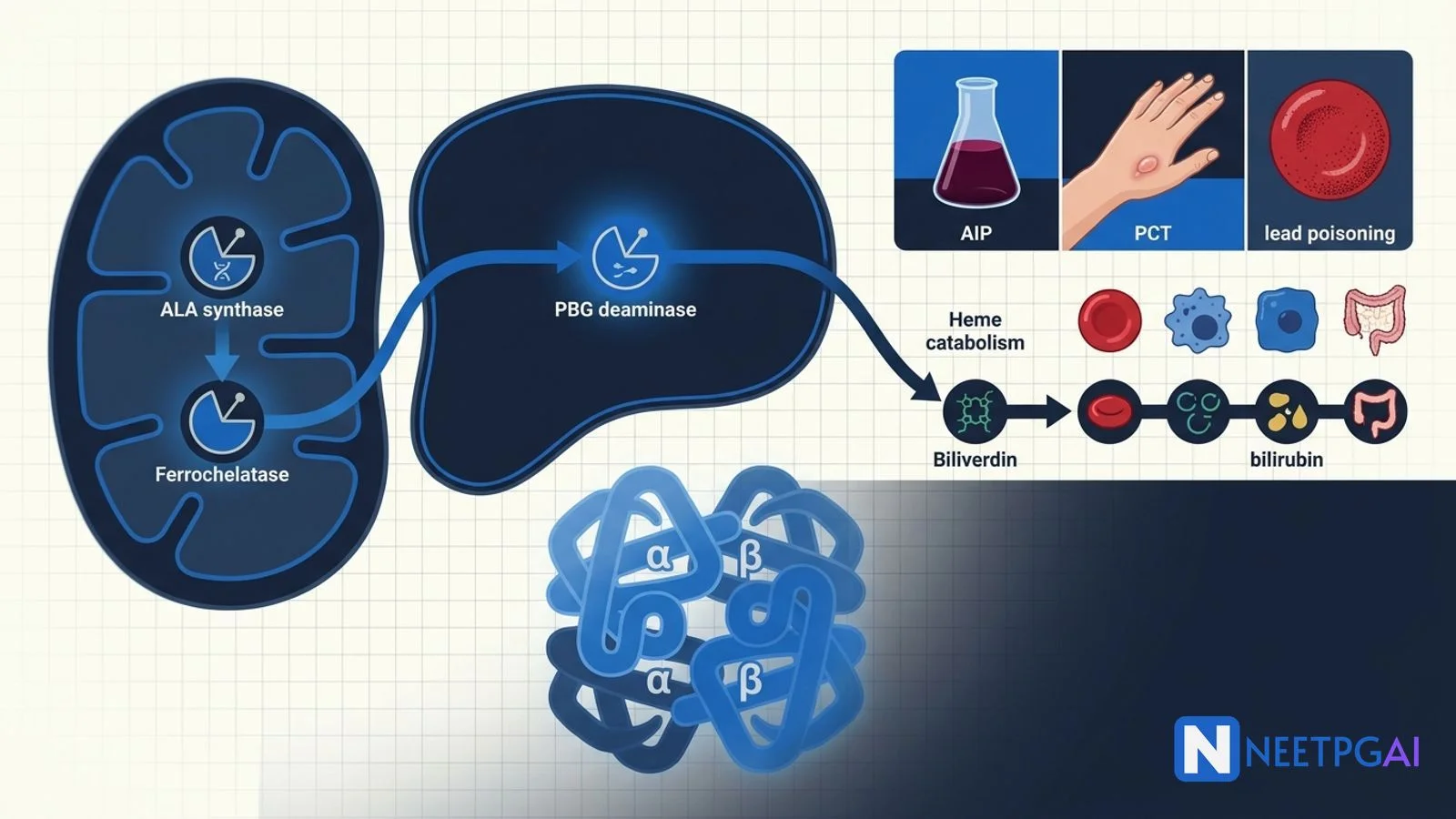
    • Heme Synthesis and PorphyriasHigh-yield
    • Maple Syrup Urine Disease — Pathophysiology and ManagementModerate
    • Purine Metabolism and GoutHigh-yield
    • Pyrimidine MetabolismModerate
    • Tumor Markers — Clinical RelevanceHigh-yield
    • Collagen Structure and DisordersHigh-yield
    • Protein Structure — Primary to QuaternaryModerate
    • Enzyme ClassificationLow-yield
    • Second Messengers — cAMP, IP3, DAGHigh-yield
    • Insulin SignallingModerate
    • Nuclear Hormone Receptor SignallingLow-yield
    Today's NEET PG Biochemistry MCQ

    Test yourself in 60 seconds

    New question every day
    Tumor Markers — Clinical Relevancemedium

    Which tumor marker is most specific for hepatocellular carcinoma and is produced by malignant hepatocytes but not by cirrhotic liver tissue?

    See the options, answer & explanation

    The full question — answer choices, correct answer, and AI explanation — is free the moment you sign in.

    Sign in to revealCreate free account
    Study guides

    Biochemistry study guides

    5 in-depth Biochemistry guides curated for NEET PG aspirants.
    1 / 2
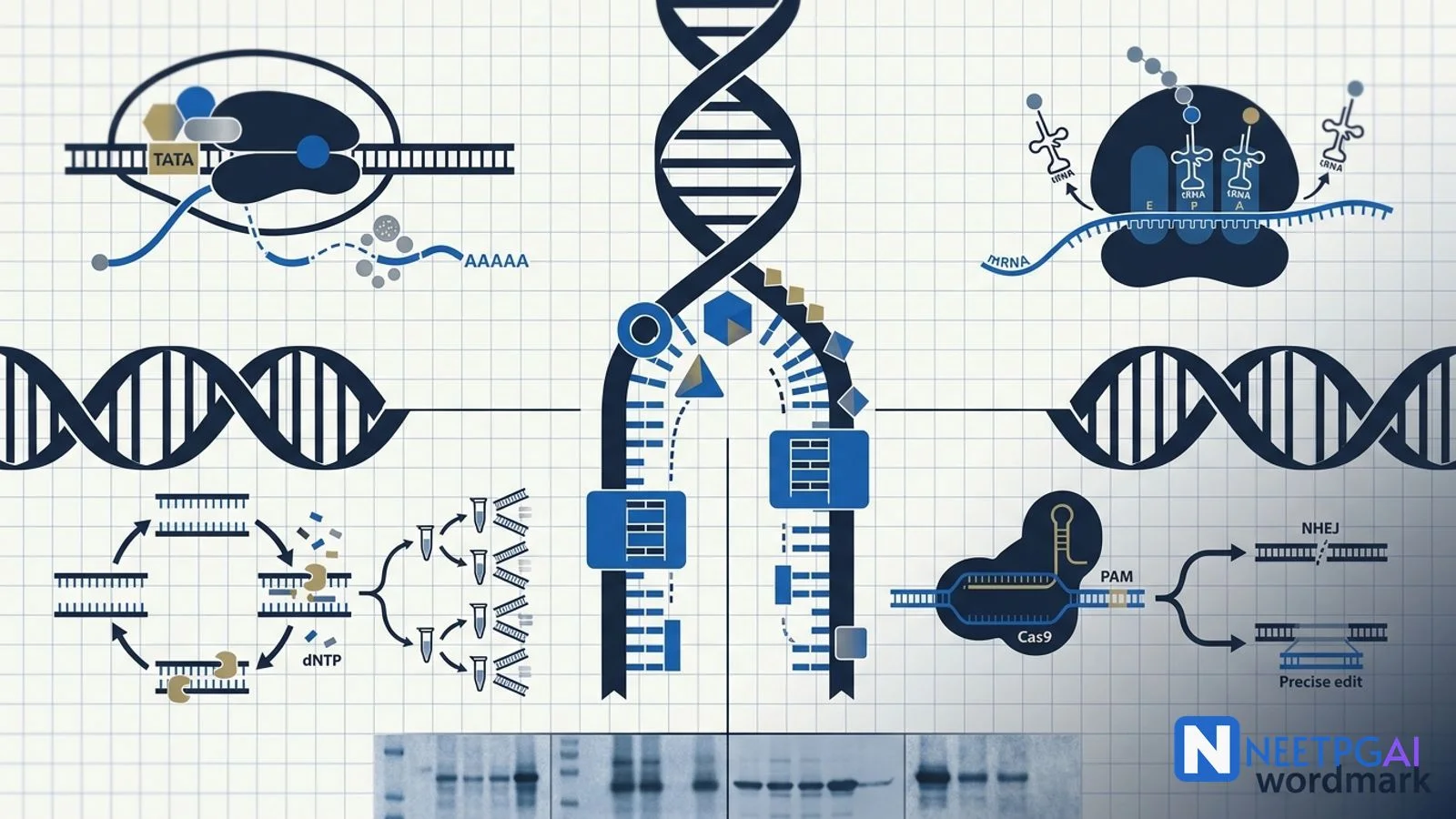
    Molecular Biology — DNA Replication, PCR & CRISPR NEET PG 2026
    4 Jul 2026molecular biologyDNA replication

    Molecular Biology — DNA Replication, PCR & CRISPR NEET PG 2026

    Master DNA replication, transcription, translation, PCR, sequencing, blotting and CRISPR-Cas9 mechanisms for NEET PG 2026 biochemistry and molecular biology MCQs.

    Read more
    Lipid & Amino Acid Metabolism and IEM for NEET PG 2026
    14 May 2026lipid metabolismamino acid metabolism

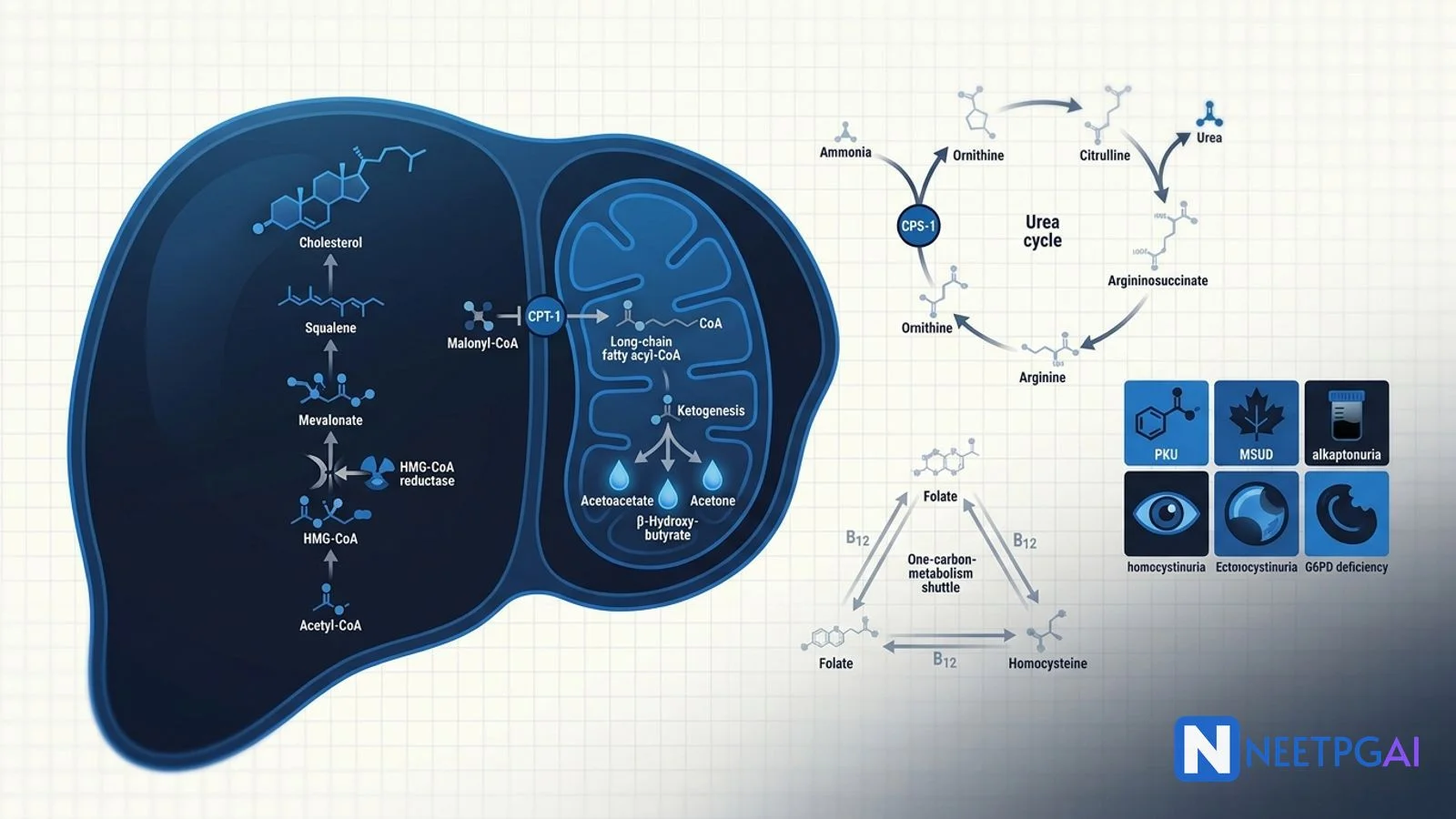
    Lipid & Amino Acid Metabolism and IEM for NEET PG 2026

    Master cholesterol, beta-oxidation, ketogenesis, urea cycle, transamination, PKU, MSUD, homocystinuria, G6PD and one-carbon metabolism for NEET PG 2026.

    Read more
    Carbohydrate Metabolism — Glycolysis, TCA, ETC for NEET PG 2026
    7 May 2026carbohydrate metabolismglycolysis

    Carbohydrate Metabolism — Glycolysis, TCA, ETC for NEET PG 2026

    Master glycolysis, gluconeogenesis, glycogen metabolism, TCA cycle, ETC, oxidative phosphorylation, PPP, and G6PD deficiency for NEET PG 2026 biochemistry.

    Read more
    biochemistry
    Free AI tutor trial · No card required

    Stuck on a Biochemistry concept? Ask the AI tutor.

    Trained on standard textbooks (Harrison's, Robbins, KD Tripathi, BD Chaurasia, Bailey & Love). Drop your email — we'll send a one-tap link to start asking questions. 3 free messages per day, ongoing.

    • Cite-anchored answers (chapter + page when applicable)
    • Mermaid diagrams and clinical pearls inline
    • NEET PG-tuned, never generic ChatGPT

    Why aspirants choose NEETPGAI for Biochemistry

    AI-first preparation built specifically for the NEET PG question pattern.

    Textbook-quality AI explanations

    Every Biochemistry MCQ comes with a detailed Claude-authored explanation citing standard references (Harrison's, Bailey & Love, Robbins, Park's etc.) — never a one-line answer key.

    SM-2 spaced repetition

    Wrong answers auto-schedule for review at expanding intervals (1d → 3d → 7d → 21d). Most aspirants need only half the practice volume to retain the same recall.

    PYQ-aligned question patterns

    Every Biochemistry question is generated against the NMC syllabus and validated against the last 5 years of NEET PG / INI-CET previous year questions.

    24/7 AI Tutor for Biochemistry doubts

    Stuck on a tricky topic? Ask the AI Tutor anytime — it answers in seconds with diagrams, mnemonics, and clinical pearls tailored to NEET PG.

    Ready to test yourself?

    Test your Biochemistry knowledge with AI-powered MCQs and detailed explanations — no signup required to try.

    Practice Biochemistry MCQs

    Biochemistry preparation FAQs

    Common questions from NEET PG aspirants preparing Biochemistry.

    Sources & references
    1. NEETPGAI PYQ and Practice Question Database — Biochemistry module (N = 612 approved questions)
    2. NMC NEET PG 2026 Syllabus — Biochemistry section (48 topics across 10 systems)
    3. Vasudevan DM, Sreekumari S, Vaidyanathan K — Textbook of Biochemistry for Medical Students, 9th edition (Jaypee Brothers, New Delhi)
    4. Harper's Illustrated Biochemistry, 31st edition — Chapters 17-22: Bioenergetics, ETC, Fatty Acid Oxidation (McGraw-Hill)
    5. Lehninger Principles of Biochemistry, 7th edition — Chapter 19: Oxidative Phosphorylation and Photophosphorylation (W.H. Freeman)

    Ready to master Biochemistry?

    Sign up free and practice all 1181+ MCQs with AI-powered explanations tailored to your performance.

    Create Free Account