Quick Answer
Dental and oral emergencies appear in 2–3 NEET PG questions per paper across ENT, Surgery, Forensic Medicine, and Emergency Medicine. The high-yield framework:
- Dental abscess — usually mandibular molar; manage with drainage, antibiotics, and root canal or extraction.
- Ludwig's angina — bilateral submandibular cellulitis; airway emergency; awake fibre-optic intubation or tracheostomy.
- Oral cancer — OSCC dominant; tobacco/alcohol/HPV/areca nut. Premalignant lesions: leukoplakia, erythroplakia (highest risk), OSF.
- TMJ disorders — myofascial pain commonest; dislocation reduced manually with downward and backward pressure.
- Salivary gland tumours — pleomorphic adenoma most common; Warthin in smokers; mucoepidermoid most common malignant.
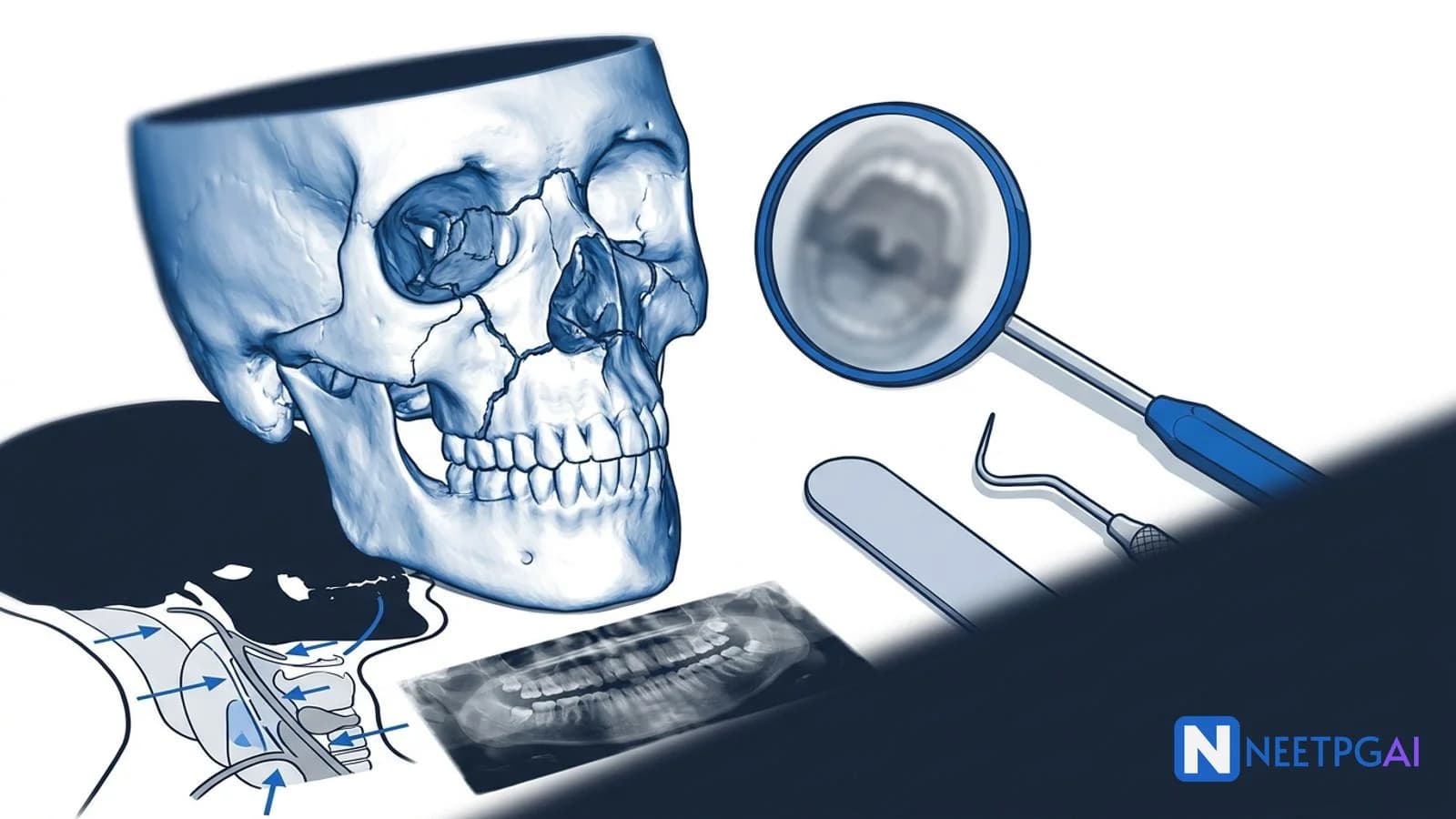
- Le Fort fractures — I (horizontal), II (pyramidal), III (craniofacial dysjunction).
- Avulsed tooth — replant within 60 min; transport in milk/HBSS; flexible splint 1–2 weeks.
Orofacial emergencies sit at the intersection of dentistry, ENT, maxillofacial surgery, and emergency medicine — making them a perennial favourite on NEET PG. Examiners can frame the same patient (a young adult with a swollen face after a third-molar extraction) as a Surgery question (Ludwig's angina), an ENT question (deep neck space infection), or an Anesthesia question (difficult airway). Mastering the cross-cutting concepts — anatomy of the deep neck spaces, premalignant oral lesions in the Indian context, and the Le Fort classification — is what separates a 99-percentile candidate from average.
This NEETPGAI ultimate guide consolidates the highest-yield orofacial topics into the diagnostic, imaging, and management algorithms NEET PG 2027 examiners are most likely to test. Pair with daily MCQs on the ENT subject hub and the oral cavity tumours guide for full surgical-oncology coverage.
Dental abscess and odontogenic infections
Most odontogenic infections originate from periapical or periodontal disease, with mixed flora — predominantly Streptococcus viridans, Peptostreptococcus, and Prevotella anaerobes.
Periapical abscess
- Severe localised toothache, percussion tenderness, swelling.
- Diagnosis: clinical + periapical radiograph.
- Treatment: incision and drainage, root canal therapy or extraction, oral amoxicillin-clavulanate or clindamycin (penicillin allergy).
Pericoronitis
Inflammation around a partially erupted tooth (typically lower third molar). Local irrigation, chlorhexidine, NSAIDs, and operculectomy or extraction.
Spread to deep neck spaces
Untreated odontogenic infection spreads predictably along fascial planes:
| Tooth | Most likely space |
|---|
| Maxillary anterior | Canine space |
| Maxillary premolar/molar | Buccal space, infratemporal |
| Mandibular anterior | Submental |
| Mandibular premolar | Sublingual |
| Mandibular molar (above mylohyoid) | Sublingual |
| Mandibular molar (below mylohyoid) | Submandibular → parapharyngeal → retropharyngeal → mediastinum |
Ludwig's angina — the airway emergency
Ludwig's angina is rapidly progressive bilateral cellulitis of the submandibular, sublingual, and submental spaces — almost always from a second or third mandibular molar.
Clinical features
- Bilateral submandibular swelling that is tense, indurated, "woody."
- Tongue elevation and protrusion.
- Trismus, drooling, dysphagia.
- Dyspnea and airway compromise.
- Fever, tachycardia, malaise.
Imaging
- CT neck with contrast — extent of infection, gas in tissues, abscess collections.
- Avoid lying the patient flat for imaging until airway is secure.
Management
- Airway first — never delay intubation. Awake fibre-optic intubation is preferred; surgical airway (cricothyroidotomy or tracheostomy) if intubation fails.
- Empirical IV antibiotics — ampicillin-sulbactam, ceftriaxone + metronidazole, or piperacillin-tazobactam. Add clindamycin or vancomycin in MRSA risk.
- Surgical drainage — under GA when airway is secured. Bilateral submandibular incisions through the deep cervical fascia.
- Source control — extract the offending tooth.
- ICU monitoring — risk of mediastinitis, descending necrotising fasciitis, septic shock.
Oral premalignant lesions — the India context
India accounts for one-third of global oral cancer cases, driven by tobacco chewing, smoking, alcohol, and areca nut. Recognising premalignant lesions early is critical.
| Lesion | Appearance | Malignant transformation |
|---|
| Leukoplakia | White patch that cannot be wiped off, no other diagnosis | 5–20% |
| Erythroplakia | Red velvety patch | Up to 90% (highest) |
| Speckled/erythroleukoplakia | Mixed red-white | High |
| Oral submucous fibrosis (OSF) | Burning, blanching, fibrosis, trismus, areca nut chewing | 7–13% |
| Lichen planus (oral) | Wickham striae, atrophic, erosive variants | 1–2% |
| Actinic cheilitis | Crusted, scaly lower lip | 6–10% |
Any non-resolving white or red oral lesion for >2 weeks needs biopsy. OSF requires immediate cessation of areca nut and intralesional steroids/hyaluronidase; advanced cases need myotomy.
Oral squamous cell carcinoma (OSCC)
The most common oral malignancy. India ranks first globally in age-standardised incidence in men due to gutka and tobacco habits.
Risk factors
- Tobacco (smoked or chewed) — synergistic with alcohol.
- Areca nut and betel quid.
- HPV-16 (especially oropharyngeal SCC; better prognosis than HPV-negative).
- Sun exposure (lip cancer).
- Poor oral hygiene, chronic dental trauma.
Clinical presentation
- Non-healing ulcer with raised everted edges.
- Indurated mass.
- Trismus.
- Cervical lymphadenopathy.
- Most commonly affects the lateral border of the tongue, followed by the floor of the mouth and gingivobuccal sulcus.
Workup
- Biopsy (incisional from the most representative area).
- Imaging: contrast-enhanced CT or MRI for tumour and nodal extent; PET-CT for distant spread.
- Panendoscopy (rule out synchronous primaries).
- Pre-treatment dental clearance.
Staging — AJCC 8th edition
Now incorporates depth of invasion (DOI) and extranodal extension (ENE) — a major change.
- T1 ≤2 cm and DOI ≤5 mm.
- T2 ≤2 cm with DOI 5–10 mm OR 2–4 cm with DOI ≤10 mm.
- T3 >4 cm or DOI >10 mm.
- T4a invades adjacent structures (cortex of mandible, maxillary sinus, skin).
- T4b masticator space, pterygoid plates, skull base, encases ICA.
Treatment
- Early stage (I/II): single-modality — surgery (preferred in India) or radiotherapy.
- Locally advanced (III/IV): combined-modality — surgery + adjuvant radiation ± chemotherapy.
- Neck dissection — selective (levels I–III) for cN0; modified radical for cN+.
- Adjuvant indications: positive margins, ENE, multiple positive nodes, perineural invasion.
- Concurrent cisplatin chemoradiation for ENE or positive margins.
- Targeted/immunotherapy (cetuximab, pembrolizumab, nivolumab) in metastatic/recurrent.
TMJ disorders
The temporomandibular joint is the most-used joint in the body and a source of pain in 5–12% of adults.
Myofascial pain dysfunction
- Most common TMJ disorder.
- Female predominance, stress and bruxism associations.
- Pre-auricular pain, jaw fatigue, clicking.
- Management: reassurance, soft diet, NSAIDs, occlusal splint, stress management, physiotherapy. Surgery rarely needed.
TMJ dislocation
Anterior dislocation when condyle moves anterior to the articular eminence.
- Common after wide opening (yawning, dental procedure).
- Patient cannot close mouth.
- Reduction: thumbs (wrapped) on lower molars, fingers grasping mandibular angle; downward and backward pressure.
- Recurrent: may need eminectomy or autologous blood injection.
Internal derangement
Disc displacement with or without reduction. MRI is gold standard for soft-tissue assessment. Management: splint, arthrocentesis, arthroscopy, open surgery in refractory.
Salivary gland tumours
| Tumour | Frequency | Typical site | Notes |
|---|
| Pleomorphic adenoma | Most common overall | Parotid (superficial lobe) | Slow-growing, painless, benign; superficial parotidectomy |
| Warthin tumour (papillary cystadenoma lymphomatosum) | Second most common benign | Parotid, lower pole | Bilateral in 10%; smoking-associated; older men |
| Mucoepidermoid carcinoma | Most common malignant overall | Parotid, minor glands | Low/intermediate/high grade |
| Adenoid cystic carcinoma | Most common malignant in submandibular and minor glands | Submandibular, palate | Perineural spread; poor long-term prognosis |
| Acinic cell carcinoma | Low-grade | Parotid | Bilateral in some |
Parotidectomy and the facial nerve
The facial nerve runs through the parotid, dividing it into superficial and deep lobes. Identification at the tragal pointer or posterior belly of digastric is critical. Frey syndrome (gustatory sweating from auriculotemporal nerve regeneration into sweat glands) is a classic late complication.
Le Fort fractures and maxillofacial trauma
René Le Fort's 1901 cadaver studies remain the framework for mid-face fracture classification.
- Le Fort I — Horizontal fracture above the apices of teeth, separating the alveolar process from the maxilla. "Floating palate." Result of low-velocity force to upper lip.
- Le Fort II — Pyramidal fracture through the nasal bones, medial orbital wall, infraorbital rim, and pterygoid plates. "Dish-face deformity," CSF rhinorrhea possible.
- Le Fort III — Craniofacial dysjunction. Fracture line through nasofrontal suture, orbits, and zygomaticofrontal suture. Entire mid-face is mobile relative to the cranium. Often associated with skull base fracture, CSF leak, dural injury.
Management principles
- Airway and C-spine first (ATLS).
- CT face with 3D reconstruction is gold standard.
- Open reduction and internal fixation (ORIF) with mini-plates.
- Restore occlusion (intermaxillary fixation as needed).
- Address concurrent orbital, frontal, and mandibular fractures.
- Antibiotic prophylaxis if open or sinus involvement; tetanus prophylaxis.
Mandibular fractures
The second most common facial fracture (after nasal). Common sites: condyle, angle (especially with impacted third molar), body, parasymphysis. ORIF with miniplates; closed reduction with arch bars and IMF for select condylar fractures.
Zygomatic complex fractures
"Tripod" or "quadripod" pattern. Look for periorbital ecchymosis, infraorbital paresthesia (V2), trismus from coronoid process impingement, diplopia from orbital floor blowout. Reduce via Gillies temporal approach or open reduction.
Avulsed permanent tooth — emergency dental management
An avulsed permanent tooth is a true dental emergency. Outcome depends on:
- Time outside socket — replant within 60 min; success rate drops 1% per minute.
- Storage medium — milk, saliva, or Hank's Balanced Salt Solution (HBSS) maintain periodontal ligament viability. Avoid water (causes cell lysis).
- Handling — pick up by the crown only; do NOT scrub the root.
Steps
- Locate the tooth; rinse gently in saline or milk.
- Replant immediately if possible (parent or first-aider can do this).
- If replantation not possible, transport in milk/HBSS.
- Stabilise with a flexible splint (composite + wire) for 7–14 days.
- Endodontic treatment within 7–10 days for closed-apex teeth; open-apex teeth may revascularise.
- Tetanus prophylaxis; systemic antibiotics (amoxicillin or doxycycline if >12 yr).
Primary (deciduous) avulsed teeth are NOT replanted (risk to permanent tooth bud).
High-yield NEET PG MCQ traps
- Highest malignant potential — erythroplakia (up to 90%).
- Most common salivary gland tumour — pleomorphic adenoma (parotid).
- Most common malignant salivary tumour — mucoepidermoid (overall); adenoid cystic in submandibular/minor.
- Le Fort III feature — craniofacial dysjunction; CSF rhinorrhea common.
- Ludwig's angina airway — never lay flat; awake fibre-optic intubation preferred.
- OSF and areca nut — pathognomonic Indian premalignant lesion; immediate areca cessation.
- Avulsed tooth medium — milk or HBSS; never water.
- Frey syndrome — gustatory sweating after parotidectomy (auriculotemporal nerve).
- TMJ dislocation reduction — downward then backward.
- HPV-16 oropharyngeal SCC — better prognosis than tobacco-related.
Recent updates and Indian context
- AJCC 8th edition for OSCC — depth of invasion (DOI) and extranodal extension (ENE) reshape T and N staging.
- WHO Head and Neck Tumours 5th edition (2022) — refined classification of OPMDs (oral potentially malignant disorders) and salivary gland tumours.
- CheckMate 651 (2024) and KEYNOTE-689 (2024): immunotherapy moving into earlier-stage HNSCC.
- Indian context: ICMR-NCDIR data show oral cancer is the No. 1 cancer in Indian men, with mean diagnosis age dropping into the late 30s due to gutka. The TMC (Tata Memorial Centre) protocols form the de facto Indian standard for management.
- National Oral Health Programme (NOHP, MoHFW) runs district-level screening at primary health centres; questions on its structure have appeared on FMGE and INI-CET.
Frequently asked questions
What is Ludwig's angina?
Ludwig's angina is a rapidly progressive, bilateral cellulitis of the submandibular, sublingual, and submental spaces, typically arising from a second or third mandibular molar dental infection. The tongue is pushed upward and backward, threatening the airway. Treatment is urgent airway control (often awake fibre-optic intubation or tracheostomy) plus IV broad-spectrum antibiotics and surgical drainage.
Which oral lesion has the highest malignant potential?
Erythroplakia has the highest malignant transformation rate of all oral premalignant lesions — up to 90%. Leukoplakia transforms in 5 to 20% of cases. Oral submucous fibrosis (common in India due to areca nut chewing) has a 7 to 13% transformation rate. Any non-resolving red or red-and-white patch in the mouth needs biopsy.
What is the most common salivary gland tumour?
Pleomorphic adenoma is the most common salivary gland tumour overall and the most common in the parotid (around 70 to 80% of parotid tumours). It is a benign mixed tumour but has malignant transformation risk if untreated. Treatment is superficial parotidectomy with facial nerve preservation. Warthin tumour is the second most common — bilateral in 10%, smoking-associated.
Describe the Le Fort fracture classification.
Le Fort I is a horizontal fracture separating the alveolar process from the maxilla, producing a free-floating palate. Le Fort II is a pyramidal fracture through the maxilla, infraorbital rim, and nasal bones — gives a 'dish-face' deformity. Le Fort III is craniofacial dysjunction, separating the entire mid-face from the cranium through the zygomatic arches and orbital floors.
What is the management of an avulsed permanent tooth?
Time is critical. Pick up by the crown, never the root. Rinse gently with saline, milk, or saliva — do NOT scrub. Replant immediately if possible. If not, transport in milk, saliva, or HBSS (Hank's Balanced Salt Solution) — NOT water. Stabilise with a flexible splint for 1 to 2 weeks. Prognosis drops by 1% per minute outside the socket.
This content is for educational purposes for NEET PG exam preparation. It is not a substitute for professional medical advice, diagnosis, or treatment. Clinical information has been reviewed by qualified medical professionals.
Written by: NEETPGAI Editorial Team
Reviewed by: Pending SME Review
Last reviewed: April 2026