NEETPGAI
FeaturesBlogComparePricing
Log inStart Free
NEETPGAI

AI-powered NEET PG preparation platform. Master all 19 subjects with adaptive MCQs, AI tutoring, and spaced repetition.

Product

  • Features
  • Subjects
  • Previous Year Questions
  • Compare
  • Pricing
  • Blog

Features

  • Adaptive MCQ Practice
  • AI Tutor
  • Mock Tests
  • Spaced Repetition

Resources

  • Blog
  • Study Guides
  • NEET PG Updates
  • Contact & support

Legal

  • Privacy Policy
  • Terms of Service

Stay updated

© 2026 NEETPGAI. All rights reserved.
    Practice 1,084+ ENT MCQs
    Free signup · Full bank · Detailed explanations
    Start Free
    SubjectsENT
    Clinical
    AI-powered

    ENT for NEET PG 2026

    Free practice + topic-wise study material with AI explanations.

    90 daysto NEET PG 2026
    Exam date: 30 Aug 2026
    Your prep stageRevision Phase
    Foundation
    180+ days
    Deep Study
    90-180 days
    Revision
    30-90 days
    Final Sprint
    <30 days

    Rapid revision of all subjects. 2 mock tests per week.

    1. 1Prioritise the 19 high-yield topics — they account for ~70% of ENT questions every year.
    2. 2Practice 1,084+ topic-tagged MCQs with detailed AI explanations to build pattern recognition.
    3. 3Use SM-2 spaced repetition — wrong answers auto-schedule for review at expanding intervals.
    4. 4Revise PYQs from the last 5 years to spot recurring themes and adjust your priorities.
    5. 5Take subject-wise mock tests every 2 weeks to benchmark recall under exam conditions.
    Start Free PracticeGenerate AI Study Plan

    ENT at a glance

    Live from MCQ bank
    1,084practice MCQs
    Updated daily as new questions are SME-approved.
    19
    HY
    high-yield topics
    ~70% of NEET PG ENT marks come from these.
    30total topics
    Across 6 canonical systems.
    100% free — unlimited MCQs and real PYQs, no credit card.
    About ENT in NEET PG

    What you need to know about ENT

    Quick answer

    ENT in NEET PG 2026 covers the ear, nose, throat, and related head-neck structures — it carries approximately 8% of the paper (range 6–10%), meaning you can expect 10–13 questions directly from this subject. The exam tests applied clinical reasoning: reading an audiogram, staging a cholesteatoma, identifying Carhart's notch in otosclerosis, or choosing the correct surgical approach for a Juvenile Nasopharyngeal Angiofibroma. You will not get away with rote definitions — questions are anchored in a clinical vignette and demand you link a sign (e.g., Schwartze sign, Hitselberger sign) to a diagnosis and then to a management step. Prioritise the 12 high-yield topics — CSOM with cholesteatoma, Meniere disease, and epistaxis management alone account for a disproportionate share of PYQs. Allocate 3–4 weeks of focused study and revisit every 10 days using spaced repetition. Spaced-repetition tools like NEETPGAI (572 approved ENT questions) compress the revision cycle to 7–10 days.

    ENT in NEET PG 2026 tests your ability to translate anatomical knowledge into clinical decision-making across 30 syllabus topics spread over 6 body systems: the external ear, middle ear, inner ear, nose and paranasal sinuses, pharynx and larynx, and head-neck oncology. A typical question gives you a vignette — a pregnant woman with progressive bilateral hearing loss and a 15 dB air-bone gap, or a 48-year-old with recurrent sinusitis failing antibiotics — and asks you to name the diagnosis, interpret the investigation, or select the next management step. Pure recall questions are rare after 2022; pattern recognition tied to a clinical context is the norm.

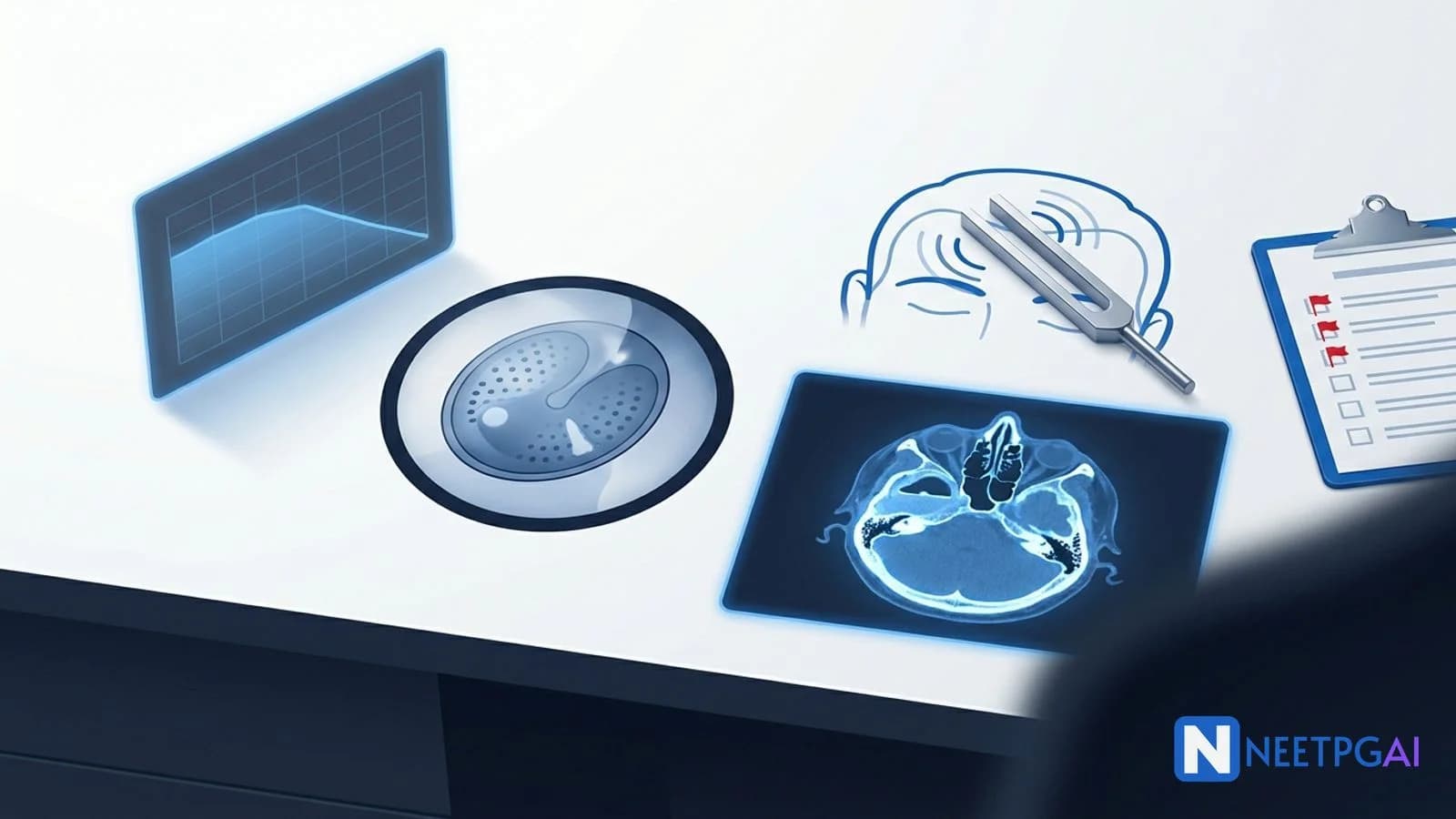
    The subject intersects directly with your MBBS internship postings. You will have managed acute otitis media in paediatric OPD, packed an anterior bleed in casualty, and assisted in tonsillectomies. That clinical exposure is your anchor — use it. The pathophysiology of Meniere disease (endolymphatic hydrops), the tuning-fork battery (Rinne, Weber, Absolute Bone Conduction), and the audiogram patterns for conductive vs sensorineural hearing loss are tested repeatedly because they bridge basic science and bedside practice.

    The syllabus shape is front-loaded toward the ear (roughly 40% of ENT PYQs), followed by the nose and sinuses (30%), and the throat and larynx (30%). Within the ear, Chronic Suppurative Otitis Media — especially the unsafe/atticoantral type with cholesteatoma — is the single most tested cluster. Within the nose, Juvenile Nasopharyngeal Angiofibroma (JNA) and epistaxis management (Kiesselbach's plexus, Little's area, posterior pack vs endoscopic ligation) are perennial favourites. Within the throat, peritonsillar abscess and its surgical timing relative to quinsy tonsillectomy appear almost every cycle.

    A common misconception is treating ENT as a "short subject" that can be covered in 3–4 days before the exam. The 30-topic syllabus includes audiogram interpretation, which requires practice with actual tracings, not just text descriptions. Another misconception is ignoring foreign body aspiration in children — the right main bronchus is the adult default, but in children under 2 years the angle is more symmetric, making left-sided lodgement a tested exception. Carhart's notch at 2 kHz on bone conduction is a classic trap: it looks sensorineural but is a mechanical artefact of otosclerosis, a purely conductive disease.

    Free PDF · NEET PG 2026

    ENT High-Yield One-Liners

    200 textbook-style one-liners auto-extracted from approved ENT MCQ explanations. Drop your email and we'll send the PDF — no spam, you can reply to unsubscribe.

    Highest-yield topics

    ENT — focus areas that win the most marks

    These 12 topics historically carry a disproportionate share of ENT questions on NEET PG. Tap any to start practising — the ENT filter is pre-selected for you.

    External and Middle Ear

    Acute Suppurative Otitis Media

    Start practising

    External and Middle Ear

    Chronic Suppurative Otitis Media

    Start practising

    External and Middle Ear

    Cholesteatoma

    Start practising

    External and Middle Ear

    Otosclerosis

    Start practising

    Inner Ear and Hearing

    Hearing Loss Types — Conductive vs Sensorineural

    Start practising

    Inner Ear and Hearing

    Audiogram Interpretation

    Start practising

    Inner Ear and Hearing

    Meniere Disease

    Start practising

    Nose and Paranasal Sinuses

    Acute and Chronic Sinusitis

    Start practising

    Nose and Paranasal Sinuses

    Nasal Polyps

    Start practising

    Nose and Paranasal Sinuses

    Epistaxis — Causes and Management

    Start practising

    Nose and Paranasal Sinuses

    Nasopharyngeal Angiofibroma

    Start practising

    Oral Cavity and Pharynx

    Tonsillitis and Peritonsillar Abscess

    Start practising

    Preparation strategy

    How to prepare ENT — tactics that work

    Five repeatable tactics that NEET PG toppers consistently use for ENT. Below: a deeper play-by-play.

    Build a strong foundation

    Read each high-yield topic from one standard textbook before opening any question bank.

    Practice in tight loops

    After every chapter, attempt 20–30 topic-tagged MCQs while the concepts are still fresh.

    Schedule spaced reviews

    Push wrong answers into SM-2 review queues — short, frequent, expanding intervals beat marathon revisions.

    Mine the last 5 years of PYQs

    Map every PYQ to its parent topic. Recurring themes are louder signal than weightage tables.

    Stress-test with mock tests

    A subject-wise mock every fortnight surfaces blind spots before the real exam does.

    Time budget

    • Allocate 3–4 dedicated weeks during your primary preparation phase, not as a last-minute add-on.
    • Daily target: 1.5–2 hours covering 1 topic + 15–20 PYQ-style questions from NEETPGAI's 572-question ENT bank.
    • Weekly rhythm: 5 days of new content, 1 day of topic-wise revision, 1 day of full mixed ENT mock.

    Primary textbook

    • Diseases of Ear, Nose and Throat by P.L. Dhingra (7th Indian edition) — this is the standard for NEET PG. Read Chapter 10 (CSOM and Cholesteatoma) and Chapter 22 (Otosclerosis) with a pen in hand; draw the audiogram patterns yourself.
    • For surgical anatomy (mastoid, lateral skull base, nasal septum), cross-reference BD Chaurasia's Human Anatomy, Vol. 3 — the temporal bone section is tested in context of mastoidectomy approaches.

    Supplementary source

    • Logan Turner's Diseases of the Nose, Throat and Ear for inner ear physiology and Meniere disease staging — useful for the 1–2 higher-order questions that go beyond Dhingra.

    High-yield topic tactics

    Put this into a 30-minute session today

    We'll pre-select ENT and serve a mixed difficulty set.

    Try a 10-MCQ set
    Syllabus map
    ENT — full topic list
    30 topics across 6 systems · 19 marked high-yield
    • Acute Suppurative Otitis Media
      High-yield
    • Chronic Suppurative Otitis Media
      High-yield
    • Cholesteatoma
      High-yield
    • Otosclerosis
      High-yield
    • Otitis Externa
      Moderate
    • Hearing Loss Types — Conductive vs Sensorineural
      High-yield
    • Audiogram Interpretation
      High-yield
    • Meniere Disease
      High-yield
    • Vestibular Disorders
      Moderate
    • Tinnitus
      Moderate
    • Presbycusis
      Low-yield
    • Allergic Rhinitis
      Moderate
    • Acute and Chronic Sinusitis
      High-yield
    • Nasal Polyps
      High-yield
    • Epistaxis — Causes and Management
      High-yield
    • DNS — Deviated Nasal Septum
      Moderate
    • Nasopharyngeal Angiofibroma
      High-yield
    • Tonsillitis and Peritonsillar Abscess
      High-yield
    • Adenoid Hypertrophy
      Moderate
    • Oral Cavity Carcinoma
      High-yield
    • Nasopharyngeal Carcinoma
      High-yield
    • Laryngeal Carcinoma
      High-yield
    • Vocal Cord Paralysis
      High-yield
    • Acute Laryngotracheobronchitis
      Moderate
    • Tracheostomy — Indications and Complications
      High-yield
    • Foreign Body Airway
      High-yield
    • Deep Neck Space Infections
      Moderate
    • Salivary Gland Tumors
      High-yield
    • Ludwig Angina
      Moderate
    • ENT — General and Mixed Concepts
      Low-yield
    Today's NEET PG ENT MCQ

    Test yourself in 60 seconds

    New question every day
    Tracheostomy — Indications and Complications
    medium

    A 58-year-old male with severe COPD and hypercapnic respiratory failure requires tracheostomy for long-term mechanical ventilation. He develops purulent tracheobronchial secretions with fever 5 days post-operatively. Gram stain shows gram-negative rods. What is the drug of choice for empiric coverage of tracheostomy-associated pneumonia in this patient?

    Tap an option to reveal the answer and AI explanation. New question rotates daily at midnight IST.

    Study guides

    ENT study guides

    4 in-depth ENT guides curated for NEET PG aspirants.
    1 / 2
    Otitis Media and Sinusitis ENT Guide for NEET PG 2026
    28 May 2026
    otitis media
    sinusitis

    Otitis Media and Sinusitis ENT Guide for NEET PG 2026

    Master AOM, OME, CSOM tubotympanic vs atticoantral, cholesteatoma, FESS indications and post-COVID mucormycosis sinusitis for NEET PG 2026.

    Read more
    10 Common Mistakes in ENT NEET PG — And How to Avoid Them
    9 Mar 2026
    mistake guide
    ent

    10 Common Mistakes in ENT NEET PG — And How to Avoid Them

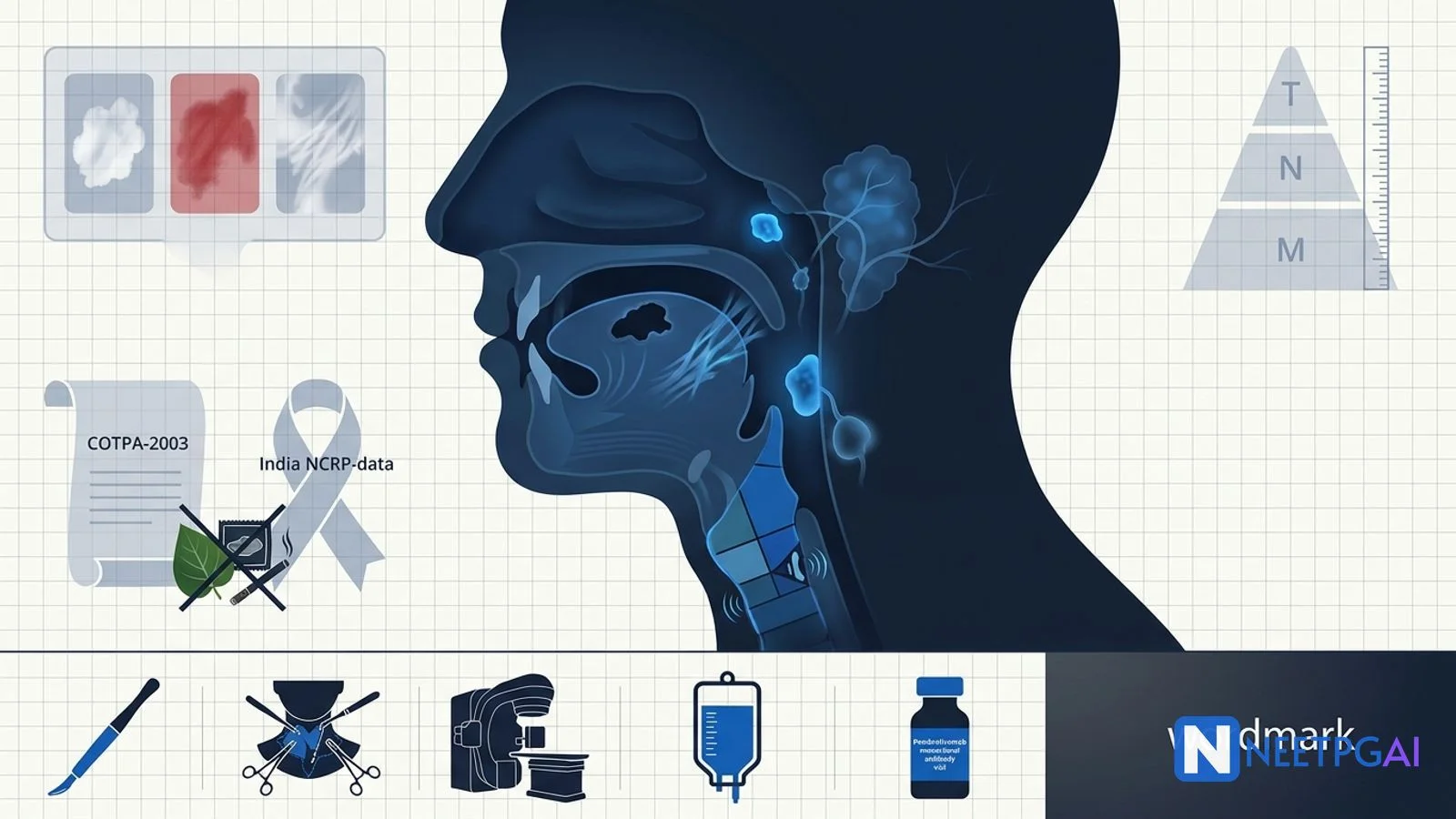
    Avoid the costliest ENT mistakes in NEET PG 2026: Rinne and Weber, audiograms, vertigo causes, epistaxis sites, oral cancer staging, sinusitis CT, croup vs epiglottitis and cholesteatoma.

    Read more
    Dental & Oral Emergencies — Orofacial Surgery for NEET PG 2026
    2 Mar 2026
    ENT
    oral surgery

    Dental & Oral Emergencies — Orofacial Surgery for NEET PG 2026

    Ludwig's angina, oral cancer, salivary gland tumours, TMJ, Le Fort fractures, and maxillofacial emergencies for NEET PG 2026 — diagnosis, imaging, and management.

    Read more
    ent
    Free AI tutor trial · No card required

    Stuck on a ENT concept? Ask the AI tutor.

    Trained on standard textbooks (Harrison's, Robbins, KD Tripathi, BD Chaurasia, Bailey & Love). Drop your email — we'll send a one-tap link to start asking questions. 3 free messages per day, ongoing.

    • Cite-anchored answers (chapter + page when applicable)
    • Mermaid diagrams and clinical pearls inline
    • NEET PG-tuned, never generic ChatGPT

    Why aspirants choose NEETPGAI for ENT

    AI-first preparation built specifically for the NEET PG question pattern.

    Textbook-quality AI explanations

    Every ENT MCQ comes with a detailed Claude-authored explanation citing standard references (Harrison's, Bailey & Love, Robbins, Park's etc.) — never a one-line answer key.

    SM-2 spaced repetition

    Wrong answers auto-schedule for review at expanding intervals (1d → 3d → 7d → 21d). Most aspirants need only half the practice volume to retain the same recall.

    PYQ-aligned question patterns

    Every ENT question is generated against the NMC syllabus and validated against the last 5 years of NEET PG / INI-CET previous year questions.

    24/7 AI Tutor for ENT doubts

    Stuck on a tricky topic? Ask the AI Tutor anytime — it answers in seconds with diagrams, mnemonics, and clinical pearls tailored to NEET PG.

    Ready to test yourself?

    Test your ENT knowledge with AI-powered MCQs and detailed explanations — no signup required to try.

    Practice ENT MCQs

    ENT preparation FAQs

    Common questions from NEET PG aspirants preparing ENT.

    Sources & references
    1. NEETPGAI PYQ Database — ENT Module (N = 572 approved questions, accessed 2025)
    2. NMC NEET PG Competency-Based Syllabus 2026 — ENT Section
    3. Dhingra PL, Dhingra S. Diseases of Ear, Nose and Throat & Head and Neck Surgery, 7th Edition. Elsevier India, 2022.
    4. BD Chaurasia's Human Anatomy, Vol. 3 — Head, Neck and Brain, 9th Edition. CBS Publishers, 2023.
    5. Logan Turner's Diseases of the Nose, Throat and Ear, Head and Neck Surgery, 11th Edition. CRC Press, 2016.

    Ready to master ENT?

    Sign up free and practice all 1084+ MCQs with AI-powered explanations tailored to your performance.

    Create Free Account
    • Cholesteatoma and CSOM (unsafe type): Memorise the triad — foul-smelling scanty discharge, marginal/attic perforation, conductive hearing loss. Know that the treatment is surgery (modified radical mastoidectomy or canal wall down), not prolonged antibiotics. Facial nerve palsy in CSOM = surgical emergency.
    • Otosclerosis: Fix Carhart's notch (2 kHz dip on bone conduction), Schwartze sign (flamingo pink blush through tympanic membrane), and the fact that pregnancy accelerates progression — this is the clinical hook used in vignettes targeting female candidates.
    • Audiogram interpretation: Practice reading at least 20 audiograms. Know the four patterns cold: conductive (air-bone gap, bone normal), sensorineural (both depressed, no gap), mixed, and the cookie-bite pattern of genetic SNHL.
    • Epistaxis management: Little's area (Kiesselbach's plexus, anterior septum) = anterior bleed, managed with silver nitrate cautery or anterior pack. Posterior bleed = Woodruff's plexus, managed with posterior pack or endoscopic sphenopalatine artery ligation. Know the 72-hour pack rule.
    • JNA (Nasopharyngeal Angiofibroma): Adolescent male, unilateral nasal obstruction + epistaxis, bowing of posterior wall of maxillary sinus (Holman-Miller sign on X-ray), staging by Sessions/Radkowski, pre-op embolisation 24–48 hours before surgery.

    Common mistakes to avoid

    • Confusing tuning-fork results: in conductive hearing loss, Rinne is negative (BC > AC), Weber lateralises to the affected ear. In SNHL, Rinne is positive (AC > BC), Weber lateralises to the better ear. Write this out 5 times if needed.
    • Skipping laryngology: hoarseness workup, vocal cord palsy (left RLN palsy = mediastinal pathology), and subglottic stenosis appear in 1–2 questions per paper.
    • Ignoring paediatric ENT: foreign body aspiration, adenoid hypertrophy causing conductive hearing loss, and acute epiglottitis (Haemophilus influenzae type b, "thumb sign" on lateral neck X-ray) are tested.

    Revision rhythm

    • First revision at Day 10 after completing the subject — focus on audiograms and surgical landmarks only.
    • Second revision at Day 21 — full topic sweep using flashcard-style PYQ review on NEETPGAI.
    • Final pre-exam revision: 48-hour sprint covering only the 12 high-yield topics listed in the syllabus.