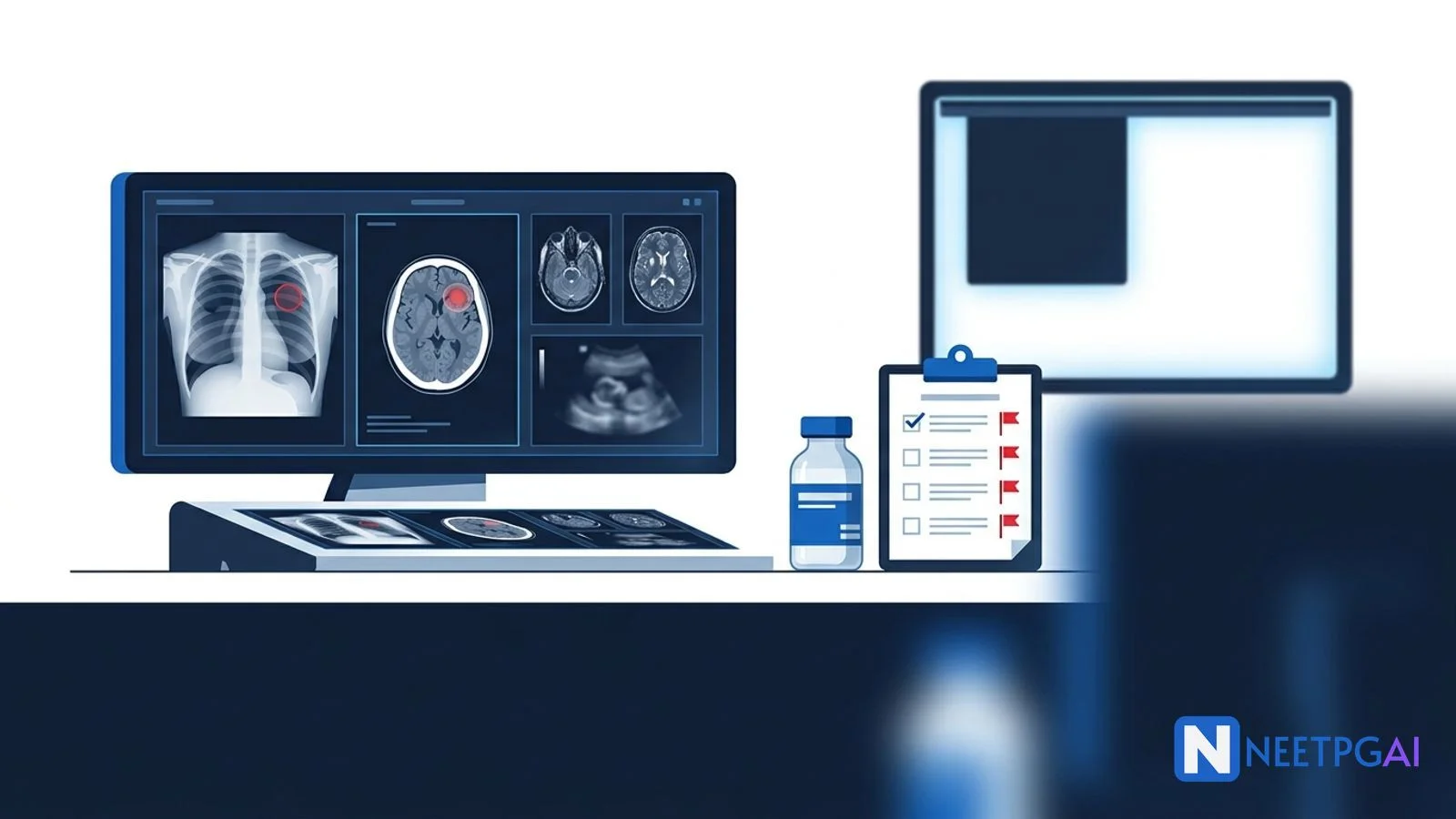
Radiology contributes 8-12 questions to NEET PG (2021-2024 papers) — about half are image-based. The 10 most expensive mistakes cluster around modality choice, pattern recognition, and safety. To protect your marks:
Differentiate ground-glass opacity from consolidation — GGO preserves bronchovascular markings; consolidation has air bronchograms and silhouette sign
Memorize CT blood density timeline — hyperacute hyperdense, isodense at 1 week (the trap), hypodense after 3 weeks
Match MRI sequence to pathology — DWI for acute stroke, FLAIR for MS, GRE/SWI for blood
Apply contrast premedication for prior reactions — Greenberger protocol; check eGFR before iodinated and gadolinium
Use ALARA in pediatrics — keep CT dose as low as reasonably achievable; prefer USG and MRI when feasible
Why radiology mistakes are costly
Unlike text-based questions, radiology MCQs combine pattern recognition with physics fundamentals. A single misclassification cascades — for example, calling a ground-glass pattern "consolidation" leads you to bacterial pneumonia in a likely COVID-19 vignette and gets you 2 questions wrong (the diagnosis and the management).
Mistake 1: Confusing ground-glass opacity with consolidation
What students do: Label any white area on chest imaging as "consolidation" without checking whether bronchovascular markings are preserved.
Why it is wrong: GGO and consolidation have very different differential diagnoses. Mixing them up means a wrong differential and wrong next investigation.
Memory aid: "GGO — Ghost Get Outline" (you can still see vessels). Consolidation = "Cement covers everything."
Mistake 2: Misjudging the age of intracranial hemorrhage on CT
What students do: Call any bright bleed "acute" and any dark bleed "old" without considering the isodense window in the subacute phase.
Why it is wrong: The isodense subacute subdural hematoma (typically 1-3 weeks old) is the highest-yield trap because it can be subtle and is frequently missed in elderly patients.
Correct approach — CT density timeline:
Age
Density
Hounsfield units
Pearl
Hyperacute (<6 hr)
Hyperdense
60-80 HU
May appear heterogeneous (swirl sign = active bleeding)
Acute (1-3 days)
Hyperdense
70-90 HU
Peak density
Subacute early (3-7 days)
Slightly hyperdense to isodense
40-60 HU
Look for mass effect
Subacute late (1-3 weeks)
Isodense to brain
30-40 HU
THE TRAP — easy to miss; look for midline shift, sulcal effacement
Chronic (>3 weeks)
Hypodense
20-25 HU
Near CSF density; may have crescentic shape (subdural)
When the subacute SDH is suspected, MRI is far more sensitive (T1 bright from methemoglobin in subacute phase). NEET PG often pairs an isodense SDH vignette with "best next investigation" = MRI brain.
Mistake 3: Wrong MRI sequence chosen for the pathology
What students do: Default to T2 for everything, missing that DWI is the only sequence that catches hyperacute stroke and FLAIR is the only sequence that reveals subarachnoid hemorrhage in subacute phase.
Why it is wrong: MRI sequence-pathology matching is a recurring NEET PG question. The wrong sequence means missing the diagnosis entirely.
Correct approach — sequence to signal characteristics:
The golden stroke pearl: A patient with acute neurological deficit and a normal CT — order MRI with DWI. DWI lights up within 5-10 minutes of stroke onset, while CT changes typically take 6-24 hours. Restriction on DWI + low ADC = true infarct; high DWI signal with high ADC = T2 shine-through (artifact).
Mistake 4: Misreading USG artifacts as pathology
What students do: Confuse normal USG artifacts (acoustic shadowing, posterior enhancement, reverberation) with pathology, or vice versa.
Why it is wrong: USG questions in NEET PG often test artifact recognition. The artifact IS the diagnostic clue.
Correct approach — common USG artifacts:
Artifact
Cause
Clinical significance
Acoustic shadowing
Strong reflector blocks beam below
Gallstones, renal stones, calcified plaques, gas
Posterior acoustic enhancement
Sound passes more easily through fluid
Cysts (simple or complex), gallbladder, full bladder
Pearl: Acoustic shadowing distinguishes a stone (calcified, casts a shadow) from a polyp (soft tissue, no shadow). Posterior enhancement is the hallmark of fluid-filled simple cysts. The twinkling artifact on color Doppler is highly specific for renal stones, even when shadowing is absent.
Mistake 5: Wrong contrast agent precautions
What students do: Use the same contraindications for iodinated and gadolinium contrast, missing that they have entirely different safety profiles.
Why it is wrong: Contrast safety questions are factual recall and easy marks if memorized correctly.
Correct approach:
Issue
Iodinated (CT)
Gadolinium (MRI)
Anaphylactoid reaction
Mild 1-3%, severe 0.04%
Very rare (<0.01%)
Premedication for prior reaction
Greenberger protocol — prednisolone 50 mg PO at 13, 7, 1 hr + diphenhydramine 50 mg at 1 hr
Same protocol applies
Renal contraindication
Contrast-induced nephropathy if eGFR <30
Nephrogenic systemic fibrosis if eGFR <30 — use Group 2 macrocyclic agents only
Thyroid disease
Avoid in untreated hyperthyroidism (Jod-Basedow)
Safe
Pregnancy
Avoid in 1st trimester unless emergency
Avoid throughout if possible (crosses placenta)
Breastfeeding
Continue feeding; contrast minimally excreted
Continue feeding; minimal excretion
Metformin
Hold for 48 hr post-contrast if eGFR <30 (lactic acidosis risk)
Prednisolone 50 mg orally at 13 hours, 7 hours, and 1 hour before contrast
Diphenhydramine 50 mg orally or IV at 1 hour before contrast
For acute contrast anaphylaxis, treat as standard anaphylaxis: IM adrenaline 0.5 mg, supine with legs up, IV fluids, oxygen, IV antihistamines and steroids.
Mistake 6: Wrong modality choice for the clinical question
What students do: Default to "CT for everything" without considering radiation dose, soft-tissue contrast, or specificity.
Why it is wrong: Modality selection is tested directly. Wrong modality wastes time, exposes patient to unnecessary radiation, or misses the diagnosis.
High-yield modality choices:
Clinical question
First-line
Why
Acute ischemic stroke (within 4.5 hr)
NCCT brain (rule out hemorrhage), then CT angiogram + perfusion
CT first to safely give thrombolysis
Acute SAH
NCCT brain
95% sensitivity within 6 hours
Aortic dissection
CT aortogram
Fast, multiplanar, surgical planning
Pulmonary embolism
CT pulmonary angiogram
Sensitive, specific, fast
Acute abdomen
USG (cheap, no radiation) → CT if non-diagnostic
USG first; CT for occult pathology
Suspected gallstones
USG abdomen
95% sensitivity, no radiation
Renal colic
Non-contrast CT KUB
Best stone detection
Demyelinating disease (MS)
MRI brain + spine with FLAIR + T2 + post-contrast
MRI is the only modality with sufficient sensitivity
Spinal cord compression
MRI spine
Cord and CSF visualization
Pediatric appendicitis
USG first; MRI if equivocal
Avoid radiation
Pregnant with abdominal pain
USG → MRI without gadolinium
Avoid ionizing radiation
Bone tumor characterization
MRI for marrow + soft tissue; CT for cortex
Each shows different aspects
Mistake 7: Misreading ARDS and pulmonary edema patterns
What students do: Call any bilateral chest opacities "ARDS" without checking the cardiac silhouette, distribution, and pleural effusions.
Why it is wrong: Cardiogenic and non-cardiogenic pulmonary edema have overlapping appearances but very different management.
Correct approach:
Feature
Cardiogenic edema
ARDS (non-cardiogenic)
Cardiac silhouette
Enlarged
Normal
Vascular distribution
Upper lobe diversion (cephalization)
Diffuse, peripheral predominance
Pleural effusion
Common
Rare
Septal lines (Kerley B)
Present
Absent
Distribution
Symmetric, perihilar (bat-wing)
Patchy, peripheral, often dependent
PCWP
>18 mmHg
<18 mmHg
Onset
Usually rapid post-MI/AS
Within 7 days of trigger (sepsis, trauma, aspiration)
ARDS Berlin definition: acute onset within 7 days of trigger, bilateral opacities not explained by effusion/atelectasis, not primarily cardiogenic, PaO2/FiO2 <=300 (mild 200-300, moderate 100-200, severe <100) on PEEP >=5.
Mistake 8: Confusing benign and malignant lesion features
What students do: Apply general "irregular = malignant" rules without considering modality-specific features.
Why it is wrong: Benign-malignant differentiation is heavily tested for breast, thyroid, hepatic, and renal lesions.
Calcified (popcorn, central, laminated, diffuse), <6 mm
Spiculated, ground-glass attenuation, >8 mm, growing on follow-up
Mistake 9: Ignoring radiation safety, especially in pediatrics
What students do: Treat radiation dose as an afterthought, missing the ALARA principle and the heightened pediatric sensitivity.
Why it is wrong: Radiation safety questions are recurring NEET PG factual items.
Key facts:
ALARA = As Low As Reasonably Achievable — guiding principle for all radiation exposure
Pediatric sensitivity — children have 2-10× greater radiation sensitivity per unit dose compared to adults due to higher cell turnover and longer remaining lifespan for cancer expression
Effective doses (approximate):
Chest X-ray: 0.02 mSv (= 3 days background)
CT head: 2 mSv
CT chest: 7 mSv
CT abdomen-pelvis: 10 mSv
PET-CT: 25 mSv
Background radiation: 3 mSv/year
Image Gently campaign for pediatric imaging: child-size the dose, image only when necessary, image only the indicated region, eliminate multiphase exams
MRI and USG have NO ionizing radiation — preferred when feasible, especially in children, pregnant women, and repeated imaging
Pregnancy thresholds — fetal dose <100 mGy is associated with very low risk; most diagnostic exams (including CT abdomen with shielding) are below this. Counsel and document, but do not refuse a clinically indicated study.
Pattern 6 — Interventional indications: when to call IR
Frequently Asked Questions
How many radiology questions appear in NEET PG?
Radiology contributes 8-12 questions in NEET PG (2021-2024 analysis), with about half being image-based. Questions are split across modality knowledge (X-ray, CT, MRI, USG, nuclear), pattern recognition (consolidation, ground-glass, infarct ages, MRI sequences), interventional procedures, contrast pharmacology, and radiation safety. Image MCQs reward pattern memory, while modality questions reward physics fundamentals.
How do you tell ground-glass opacity from consolidation on chest X-ray or CT?
Ground-glass opacity (GGO) is increased lung density that does NOT obscure the underlying bronchovascular markings — you can still see vessels and bronchi through it. Consolidation completely obscures vascular markings (silhouette sign positive) and often shows air bronchograms. Causes of GGO: viral pneumonia (COVID-19), pulmonary edema (early), hypersensitivity pneumonitis, alveolar hemorrhage, PCP. Causes of consolidation: bacterial pneumonia, infarct, ARDS late stage, organizing pneumonia, mucinous adenocarcinoma.
How does intracranial hemorrhage age on CT?
Hyperacute (less than 6 hours): hyperdense (60-80 HU) due to packed RBCs and clot retention. Acute (1-3 days): hyperdense, peak density. Subacute early (3-7 days): isodense to brain (dangerous — easy to miss; look for mass effect). Subacute late (1-3 weeks): hypodense. Chronic (more than 3 weeks): hypodense, near CSF density. The trap: an isodense subacute hemorrhage in an elderly patient with subdural collection can be missed if you do not look for midline shift, sulcal effacement, or contralateral compression.
What MRI sequence is best for which pathology?
T1 (fat bright, water dark): anatomy, fat-containing lesions, subacute hemorrhage (methemoglobin bright). T2 (fat dark with FS, water bright): edema, most pathology, CSF-containing lesions. FLAIR (water suppressed): periventricular MS plaques, subarachnoid hemorrhage in subacute phase. DWI (restricted diffusion bright with low ADC): acute ischemic stroke (positive within minutes), abscess, dense cellular tumors. GRE/SWI: blood breakdown products, calcification, microbleeds. The classic stroke pearl: DWI lights up before any CT change — gold standard for hyperacute infarct.
What contrast allergy precautions are essential in radiology?
Iodinated contrast (CT) reactions: mild (urticaria, pruritus) — observe and antihistamine; moderate (bronchospasm, hypotension) — IV fluids, oxygen, hydrocortisone, salbutamol; severe (anaphylaxis) — IM adrenaline 0.5 mg, full anaphylaxis protocol. Premedication for prior reaction: prednisolone 50 mg orally at 13, 7, 1 hour before, plus diphenhydramine 50 mg 1 hour before (Greenberger protocol). Gadolinium (MRI) caution: nephrogenic systemic fibrosis if eGFR below 30 mL/min — use Group 2 macrocyclic agents only. Always check serum creatinine before contrast in diabetics, elderly, and those with renal disease.
This content is for educational purposes for NEET PG exam preparation. It is not a substitute for professional medical advice, diagnosis, or treatment. Clinical information has been reviewed by qualified medical professionals.
Written by: NEETPGAI Editorial Team
Reviewed by: Pending SME Review
Last reviewed: April 2026