Quick Answer
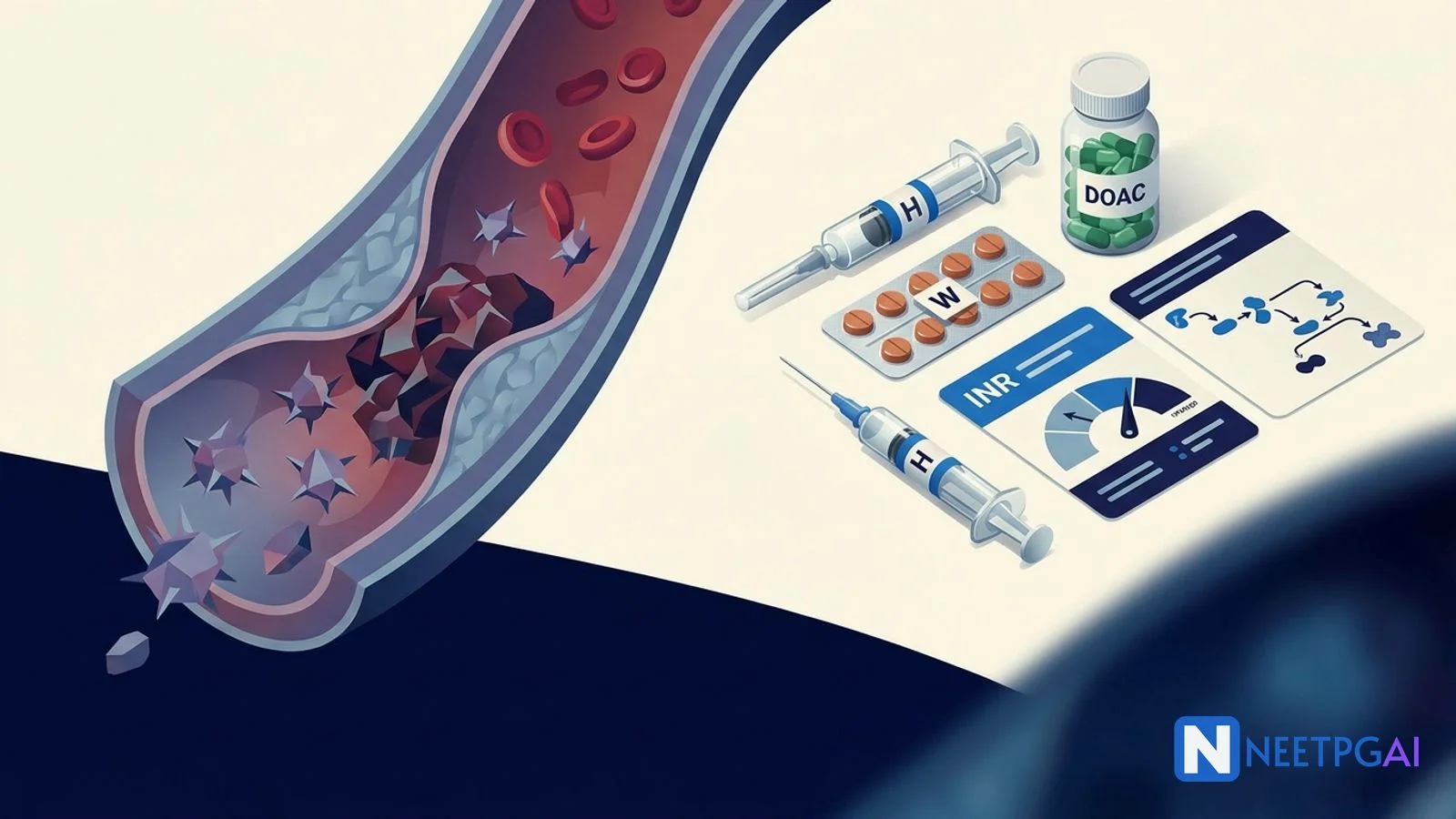
Antiplatelets and anticoagulants contribute 3–4 NEET PG questions per paper. Master these 8 high-yield areas:
- Aspirin — irreversible COX-1 inhibition, low-dose 75 mg for secondary prevention; high-dose only for analgesia
- P2Y12 inhibitors — clopidogrel (prodrug, CYP2C19), prasugrel (prodrug, contraindicated in prior stroke/TIA, age >75, weight <60 kg), ticagrelor (reversible, no activation needed)
- GP IIb/IIIa inhibitors — abciximab, eptifibatide, tirofiban — final common pathway, used periprocedurally in PCI
- Heparins — UFH (binds antithrombin, inhibits IIa = Xa, monitor aPTT), LMWH (preferential Xa, monitor anti-Xa)
- Warfarin — vitamin K epoxide reductase inhibitor, depletes factors II, VII, IX, X + proteins C/S; INR monitoring; bridging needed initially due to protein C drop
- DOACs — dabigatran (IIa), rivaroxaban/apixaban/edoxaban (Xa); no routine monitoring; renal dose adjustment
- Reversal agents — vitamin K + 4F-PCC (warfarin), protamine (heparin), idarucizumab (dabigatran), andexanet alfa (Xa-DOACs)
- HIT — heparin-induced thrombocytopenia type II is a paradoxical thrombotic complication; switch to argatroban or bivalirudin, never to LMWH
Antithrombotic drugs occupy a disproportionately large share of NEET PG pharmacology — typically 3–4 direct questions per paper, plus indirect appearances in cardiology vignettes (ACS, atrial fibrillation, valve replacements), neurology (stroke), and obstetrics (VTE in pregnancy). The challenge is not the volume of drugs but the cross-comparison: examiners prefer questions that contrast UFH vs LMWH, warfarin vs DOAC, or clopidogrel vs ticagrelor in a single stem.
This NEETPGAI deep dive distills the entire antithrombotic landscape into the high-yield mechanisms, monitoring parameters, contraindications, and reversal strategies that actually move NEET PG marks. Pair this with daily MCQ practice on the Pharmacology subject hub and the pharmacology MCQ strategy guide to convert concepts into reflex answers.
Antiplatelet drugs — classification and mechanism
Antiplatelets prevent thrombus formation by inhibiting different steps of the platelet activation cascade. The four major classes act on distinct molecular targets, and understanding which step each drug blocks is the foundation for every clinical question.
Cyclooxygenase inhibitors
Aspirin (acetylsalicylic acid) irreversibly acetylates serine-529 in platelet COX-1, abolishing thromboxane A2 synthesis for the entire platelet lifespan (7–10 days). Because platelets lack nuclei and cannot synthesise new COX, even low doses produce sustained antiplatelet effect.
- Dose: 75–150 mg/day for secondary prevention; 162–325 mg loading dose in ACS
- Indications: Secondary prevention post-MI, stroke, PCI; primary prevention only in selected high-risk patients (USPSTF 2022 narrowed indication)
- Adverse effects: GI bleeding, peptic ulcer, Reye syndrome in children with viral illness, aspirin-exacerbated respiratory disease (Samter triad — asthma, nasal polyps, aspirin sensitivity)
P2Y12 receptor inhibitors
These drugs block ADP-mediated platelet activation and are mandatory partners of aspirin in dual antiplatelet therapy (DAPT) after PCI or in ACS.
| Drug | Activation | Onset | Reversibility | Key NEET PG point |
|---|
| Clopidogrel | Prodrug, CYP2C19 → active thiol | 2–6 hr | Irreversible | CYP2C19 loss-of-function reduces efficacy; check in non-responders |
| Prasugrel | Prodrug, esterase + CYP3A4 | 30 min | Irreversible | CONTRAINDICATED in prior stroke/TIA, age >75, weight <60 kg |
| Ticagrelor | Active drug, no CYP activation | 30 min | Reversible | Causes dyspnea (adenosine effect) and ventricular pauses |
| Cangrelor | IV, ultra-short half-life | Seconds | Reversible | Bridging during PCI when oral agents not feasible |
GP IIb/IIIa inhibitors
These intravenous agents block the final common pathway of platelet aggregation by preventing fibrinogen binding to the GP IIb/IIIa receptor.
- Abciximab — monoclonal antibody fragment, longest binding (24 hr platelet recovery)
- Eptifibatide — cyclic heptapeptide (KGD sequence)
- Tirofiban — non-peptide tyrosine derivative
All three are used periprocedurally in high-risk PCI; thrombocytopenia is the signature adverse effect.
Phosphodiesterase inhibitors
Dipyridamole inhibits PDE and adenosine reuptake, raising cAMP and reducing platelet aggregation. It is now used mostly in fixed-dose combination with aspirin (Aggrenox) for secondary stroke prevention. Cilostazol (PDE3 inhibitor) is approved for intermittent claudication — contraindicated in heart failure.
Heparins — UFH and LMWH
Heparins are indirect thrombin inhibitors that potentiate antithrombin (AT-III) by 1000-fold. The differences between unfractionated heparin (UFH) and low-molecular-weight heparin (LMWH) drive most heparin-related NEET PG questions.
| Feature | UFH | LMWH (enoxaparin, dalteparin) |
|---|
| Molecular weight | 3000–30000 Da | 2000–9000 Da |
| Anti-Xa : anti-IIa ratio | 1:1 | 3:1 to 4:1 (preferential Xa) |
| Route | IV continuous infusion or SC | SC, predictable bioavailability |
| Half-life | 1–2 hr | 4–6 hr |
| Monitoring | aPTT (target 1.5–2.5×) | Anti-Xa only in renal failure, pregnancy, obesity |
| Renal clearance | Reticuloendothelial | Renal — dose adjust if CrCl <30 mL/min |
| Reversal by protamine | 100% | ~60% |
| HIT risk | Higher | Lower |
| Use in pregnancy | Yes | Preferred (no placental transfer) |
Heparin-induced thrombocytopenia (HIT)
HIT type II is an immune-mediated reaction with antibodies against heparin-PF4 complexes, causing platelet activation and paradoxical thrombosis.
- Onset: 5–14 days after heparin exposure (or within 24 hr if prior exposure)
- Diagnosis: 4Ts score (Thrombocytopenia, Timing, Thrombosis, oTher causes), confirmed by serotonin release assay or anti-PF4 ELISA
- Management: STOP all heparin (including LMWH and flushes). Switch to a non-heparin anticoagulant — argatroban (preferred in liver failure: NO, hepatically cleared, use bivalirudin), bivalirudin, or fondaparinux. Warfarin is delayed until platelets recover (>150,000) to avoid warfarin-induced skin necrosis.
Fondaparinux
Synthetic pentasaccharide that selectively inhibits Xa via antithrombin. No HIT risk. Renally cleared — contraindicated if CrCl <30 mL/min. No reversal agent (andexanet alfa is off-label for fondaparinux reversal).
Warfarin — the classic vitamin K antagonist
Warfarin inhibits vitamin K epoxide reductase (VKORC1), depleting reduced vitamin K and impairing γ-carboxylation of clotting factors II, VII, IX, X and the natural anticoagulants protein C and protein S.
Why warfarin needs bridging
Protein C has the shortest half-life (6–8 hr) among vitamin K-dependent factors — shorter even than factor VII (4–6 hr). In the first 24–48 hours of warfarin initiation, protein C falls before procoagulant factors, creating a transient hypercoagulable state. This is why patients with VTE require parenteral anticoagulant overlap until INR is therapeutic for 2 consecutive days.
Monitoring and INR targets
| Indication | Target INR |
|---|
| Atrial fibrillation (non-valvular) | 2.0–3.0 |
| DVT / pulmonary embolism | 2.0–3.0 |
| Mechanical aortic valve (bileaflet) | 2.0–3.0 |
| Mechanical mitral valve | 2.5–3.5 |
| Recurrent VTE on warfarin | 2.5–3.5 |
| Antiphospholipid syndrome (high-risk) | 2.5–3.5 |
Drug interactions (CYP2C9 substrate)
- Increase INR (decrease metabolism): amiodarone, fluconazole, metronidazole, TMP-SMX, fluoroquinolones, omeprazole
- Decrease INR (induce metabolism): rifampin, carbamazepine, phenytoin, St. John's wort, chronic alcohol
Warfarin-induced skin necrosis
Occurs in protein C-deficient patients during the first days of warfarin without heparin overlap — protein C falls faster than procoagulant factors, causing microvascular thrombosis in subcutaneous fat (breast, thigh, buttocks). Treatment: stop warfarin, give vitamin K, fresh frozen plasma or protein C concentrate, and continue heparin.
Direct oral anticoagulants (DOACs)
DOACs are the preferred oral anticoagulants for non-valvular atrial fibrillation and most VTE indications. Their predictable pharmacokinetics eliminate routine INR monitoring.
| Drug | Target | Renal clearance | Dose adjustment | Reversal |
|---|
| Dabigatran | Direct thrombin (IIa) | 80% | Lower if CrCl 15–30 | Idarucizumab |
| Rivaroxaban | Factor Xa | 33% | Lower if CrCl 15–50 | Andexanet alfa |
| Apixaban | Factor Xa | 27% | Lower if 2 of: age ≥80, weight ≤60 kg, Cr ≥1.5 | Andexanet alfa |
| Edoxaban | Factor Xa | 50% | Avoid if CrCl >95 (paradoxically) | Andexanet alfa |
Where DOACs are contraindicated
- Mechanical heart valves — RE-ALIGN trial showed dabigatran was inferior to warfarin (more thromboembolism and bleeding). Warfarin remains standard.
- Moderate to severe mitral stenosis (rheumatic) — exclude from non-valvular AF studies; warfarin still preferred.
- Antiphospholipid syndrome (triple positive) — TRAPS trial: rivaroxaban inferior to warfarin.
- Severe renal impairment — CrCl <15 mL/min for most agents (apixaban has the most data in advanced CKD).
- Pregnancy — all DOACs cross placenta; switch to LMWH.
Reversal of antithrombotic agents — the emergency table
Bleeding patients on antithrombotics generate predictable NEET PG vignettes. Memorise this matched-pairs table.
| Agent | Reversal | Time to effect |
|---|
| Aspirin / clopidogrel | Platelet transfusion (only if life-threatening); DDAVP for uremia | Immediate with transfusion |
| UFH | Protamine sulfate 1 mg per 100 U heparin (max 50 mg) | Minutes |
| LMWH | Protamine — 60% reversal; 1 mg per 1 mg enoxaparin if <8 hr | Minutes |
| Warfarin (INR >10 or bleeding) | 4-factor PCC (preferred over FFP) + IV vitamin K 5–10 mg | PCC: minutes; vitamin K: 6–24 hr |
| Dabigatran | Idarucizumab 5 g IV | Minutes |
| Apixaban / rivaroxaban / edoxaban | Andexanet alfa (specific) or 4F-PCC | Minutes |
| Fondaparinux | 4F-PCC or recombinant factor VIIa (off-label) | Variable |
Andexanet alfa specifics
Recombinant modified factor Xa "decoy" that binds Xa inhibitors with high affinity but lacks catalytic activity. ANNEXA-4 trial showed 82% achieved good or excellent hemostasis. Pro-thrombotic risk is real — reserve for major or life-threatening bleeding.
Antithrombotics in special situations
Pregnancy
- Warfarin is teratogenic (fetal warfarin syndrome — nasal hypoplasia, stippled epiphyses) in the first trimester and causes CNS bleeding in late pregnancy. AVOID throughout — exception: mechanical mitral valve in second trimester at lowest effective dose.
- LMWH is the standard anticoagulant in pregnancy — no placental transfer. Switch to UFH at 36 weeks for delivery flexibility.
- DOACs are contraindicated.
- Aspirin low-dose (75 mg) is safe and indicated for preeclampsia prophylaxis in high-risk pregnancies (start before 16 weeks).
Renal failure
- UFH does not require renal dose adjustment.
- LMWH needs anti-Xa monitoring or dose reduction if CrCl <30; avoid in dialysis.
- DOACs all require dose adjustment; apixaban has the most renal data; dabigatran is most renally cleared (avoid).
- Warfarin is hepatically metabolised — preferred when DOACs are unsafe, but bleeding risk is higher in CKD.
Periprocedural management
- Low bleed risk procedures (cataract, dental cleaning): continue antithrombotics.
- Moderate-high bleed risk: stop DOACs 24–48 hr before (longer if CrCl reduced); stop warfarin 5 days before, target INR <1.5; bridge with LMWH only for high thromboembolic risk (mechanical mitral valve, recent stroke, CHA2DS2-VASc ≥7).
High-yield NEET PG MCQ traps
- "Aspirin resistance" — most common cause is non-compliance, NOT genetic. Rule out before adding more agents.
- Prasugrel age cutoff — contraindicated if age >75, weight <60 kg, or prior stroke/TIA. NEET PG loves this.
- HIT switch — never switch to LMWH; use argatroban (preferred in renal failure) or bivalirudin. Avoid argatroban in liver failure (use bivalirudin instead).
- Protamine paradox — over-dosing protamine causes paradoxical bleeding (intrinsic anticoagulant effect).
- Vitamin K route — IV (rapid, anaphylaxis risk), oral (preferred for non-bleeding INR elevation), SC erratic absorption. Avoid IM (hematoma).
- DOAC + valve trap — dabigatran failed in mechanical valves (RE-ALIGN). Stick with warfarin.
- Ticagrelor and dyspnea — adenosine-mediated, not heart failure. Reassure unless severe.
- Cilostazol contraindication — heart failure (NYHA III–IV) — like other PDE3 inhibitors (milrinone), it increases mortality.
Recent updates and guidelines
- ESC 2024 ACS guidelines — DAPT duration may be shortened to 1–3 months in selected high-bleed-risk patients after PCI, followed by P2Y12 monotherapy.
- AHA/ACC 2023 atrial fibrillation guidelines — LAAO (Watchman) is class IIa for patients with AF and contraindication to long-term anticoagulation.
- CHEST 2022 antithrombotic therapy — apixaban preferred over warfarin for cancer-associated VTE; edoxaban acceptable.
- ISTH 2024 HIT criteria — formally incorporates anti-PF4 ELISA optical density thresholds into diagnostic stratification.
- Indian context — most Indian institutions still use UFH for ACS due to cost; ensure familiarity with both UFH and LMWH protocols for FMGE and INI-CET in addition to NEET PG.
Frequently asked questions
What is the mechanism of action of clopidogrel?
Clopidogrel is a prodrug activated by hepatic CYP2C19 to its active thiol metabolite, which irreversibly blocks the P2Y12 ADP receptor on platelets. The platelet effect lasts the entire 7–10 day platelet lifespan. CYP2C19 loss-of-function variants reduce its efficacy — a high-yield NEET PG concept.
How do I differentiate UFH from LMWH for NEET PG?
UFH binds antithrombin to inhibit both Xa and IIa equally, requires aPTT monitoring, and is reversed fully by protamine. LMWH (enoxaparin) preferentially inhibits Xa, has predictable subcutaneous pharmacokinetics, needs anti-Xa monitoring only in renal failure or pregnancy, and is only partially reversed by protamine.
What is the target INR for warfarin in atrial fibrillation?
Target INR is 2.0–3.0 for non-valvular atrial fibrillation, DVT, and pulmonary embolism. The higher target of 2.5–3.5 applies to mechanical mitral valves and recurrent thromboembolism on therapeutic warfarin. Bridging with heparin is needed only if CHA2DS2-VASc and bleed risk justify it.
Which DOAC has a specific reversal agent?
Dabigatran (direct thrombin inhibitor) is reversed by idarucizumab, a monoclonal antibody fragment. Factor Xa inhibitors apixaban and rivaroxaban are reversed by andexanet alfa, a recombinant decoy Xa molecule. 4-factor PCC is the second-line option when these specific agents are unavailable.
Which antiplatelet is preferred after PCI with drug-eluting stent?
Dual antiplatelet therapy with aspirin plus a P2Y12 inhibitor — ticagrelor or prasugrel preferred over clopidogrel for ACS-PCI per ESC and ACC guidelines. Duration is typically 12 months, then aspirin lifelong. Clopidogrel is reserved for elective PCI or bleeding-risk patients.
This content is for educational purposes for NEET PG exam preparation. It is not a substitute for professional medical advice, diagnosis, or treatment. Clinical information has been reviewed by qualified medical professionals.
Written by: NEETPGAI Editorial Team
Reviewed by: Pending SME Review
Last reviewed: April 2026