
Free practice + topic-wise study material with AI explanations.
Build conceptual clarity. Focus on Pathology, Pharmacology, and PSM.
Quick answer
Pharmacology in NEET PG 2027 tests your ability to translate drug mechanisms into clinical decisions. The paper does not ask you to list side effects in isolation — it places a patient on a specific drug regimen, introduces a complication or a new prescription, and asks you to identify the mechanism, the interaction, or the safest adjunct. The 68 syllabus topics spread across 10 body systems mean you cannot afford to treat any system as optional, but the autonomic nervous system (cholinergic, anticholinergic, adrenergic agonists, alpha and beta blockers) and CNS pharmacology (antiepileptics, anti-Parkinson drugs) together account for a disproportionate share of questions.
The subject intersects directly with clinical practice at every rotation. During your MBBS internship year you will encounter atropine dosing in organophosphate poisoning, levodopa-carbidopa titration in Parkinson's disease, and phenytoin drug interactions in epilepsy management — all of which are live NEET PG question archetypes. Understanding receptor subtypes (M1-M3, alpha-1/alpha-2, beta-1/beta-2) is not academic trivia; it is the reasoning scaffold behind every autonomic drug question.
The syllabus shape rewards a systems-based approach. Start with the foundational pillars — Pharmacokinetics (volume of distribution, half-life, bioavailability, first-pass metabolism) and Pharmacodynamics (Emax, EC50, agonist vs. partial agonist, competitive vs. non-competitive antagonism) — before moving into organ-system pharmacology. These two foundational topics appear as standalone questions and as the explanatory logic inside clinical vignettes across all other topics.
A common misconception is that Pharmacology is a "memory subject." It is not. Questions on Drug Interactions (e.g., enzyme inducers like rifampicin reducing oral contraceptive efficacy, or OCT2 inhibitors elevating metformin plasma levels) require you to apply a mechanistic framework, not recall a list. Similarly, Adverse Drug Reaction classification (Type A through Type F, per WHO nomenclature) is tested in the context of a described clinical scenario, not as a standalone definition. Aspirants who memorise without understanding mechanism consistently lose marks on these applied stems.
200 textbook-style one-liners auto-extracted from approved Pharmacology MCQ explanations. Drop your email and we'll send the PDF — no spam, you can reply to unsubscribe.
These 12 topics historically carry a disproportionate share of Pharmacology questions on NEET PG. Tap any to start practising — the Pharmacology filter is pre-selected for you.
General Principles
Pharmacokinetics
Start practising
General Principles
Pharmacodynamics and Receptor Theory
Start practising
General Principles
Drug Interactions
Start practising
General Principles
Adverse Drug Reactions Classification
Start practising
Autonomic Nervous System
Cholinergic Drugs
Start practising
Autonomic Nervous System
Anticholinergic Drugs
Start practising
Autonomic Nervous System
Adrenergic Agonists
Start practising
Autonomic Nervous System
Beta Blockers
Start practising
Autonomic Nervous System
Alpha Blockers
Start practising
Autonomic Nervous System
Receptor Subtypes and Pharmacological Effects
Start practising
CNS Pharmacology
Antiepileptics
Start practising
CNS Pharmacology
Parkinsonism Drugs
Start practising
Five repeatable tactics that NEET PG toppers consistently use for Pharmacology. Below: a deeper play-by-play.
Build a strong foundation
Read each high-yield topic from one standard textbook before opening any question bank.
Practice in tight loops
After every chapter, attempt 20–30 topic-tagged MCQs while the concepts are still fresh.
Schedule spaced reviews
Push wrong answers into SM-2 review queues — short, frequent, expanding intervals beat marathon revisions.
Mine the last 5 years of PYQs
Map every PYQ to its parent topic. Recurring themes are louder signal than weightage tables.
Stress-test with mock tests
A subject-wise mock every fortnight surfaces blind spots before the real exam does.
Time budget
Primary textbook
Supplementary resource
Daily rhythm
Weekly rhythm
High-yield topic tactics
Mistakes to avoid
Revision rhythm
Put this into a 30-minute session today
We'll pre-select Pharmacology and serve a mixed difficulty set.
A 52-year-old man from Delhi presents with chest pain on exertion for 3 months. He has a 10-year history of type 2 diabetes and hypertension. On examination, BP is 138/88 mmHg. Lipid profile shows: Total cholesterol 285 mg/dL, LDL-C 180 mg/dL, HDL-C 35 mg/dL, Triglycerides 320 mg/dL. ECG shows nonspecific ST changes. Coronary angiography reveals 60% stenosis in the left anterior descending artery. He is started on aspirin, bisoprolol, and lisinopril. Which hyperlipidemic agent is most appropriate as first-line therapy for this patient?
See the options, answer & explanation
The full question — answer choices, correct answer, and AI explanation — is free the moment you sign in.
10 in-depth Pharmacology guides curated for NEET PG aspirants.
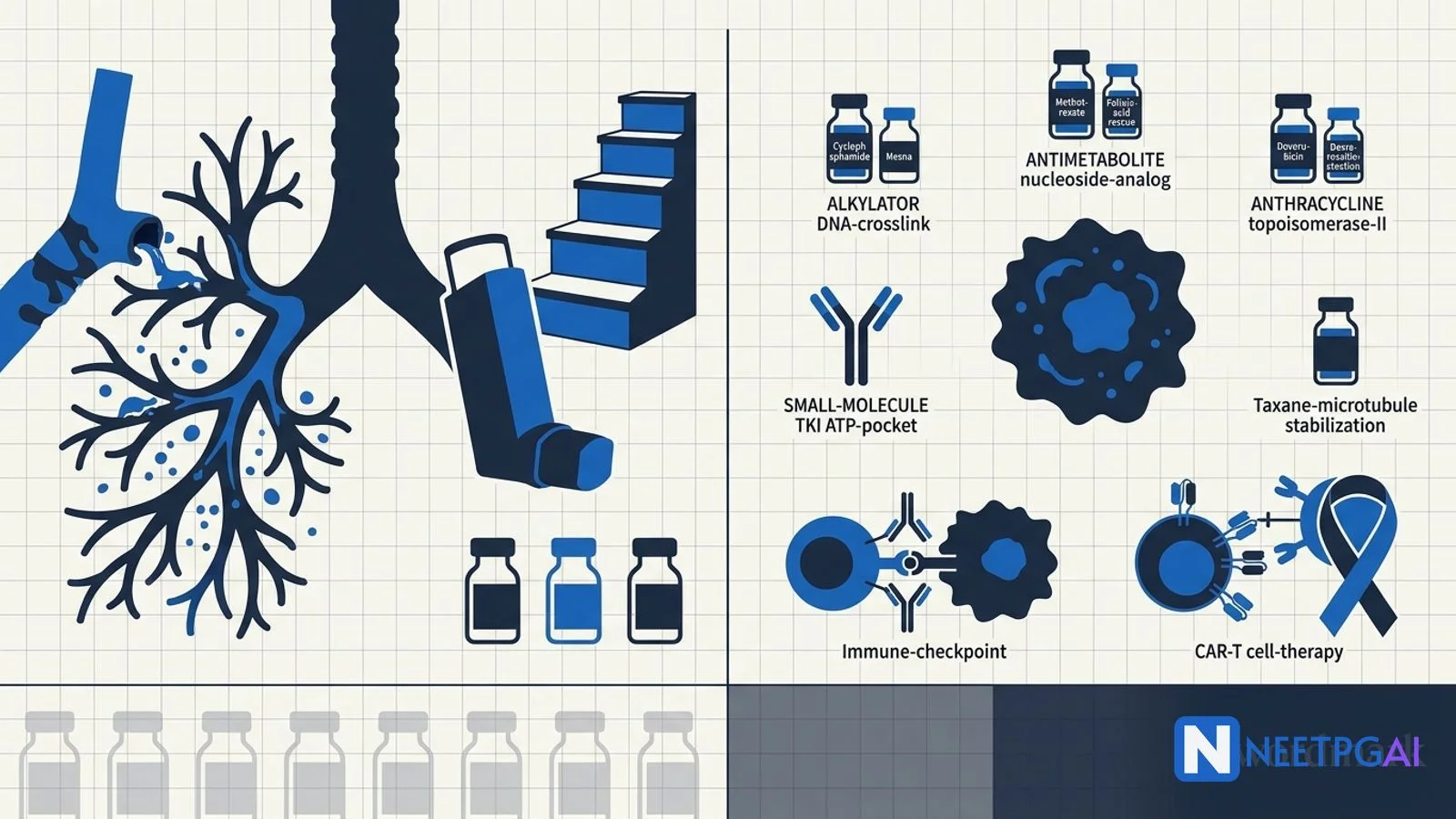
Master SABA, LABA, ICS, GINA 2024 MART, alkylators, taxanes, TKIs, immunotherapy and CAR-T pharmacology for NEET PG 2027 pharmacology MCQs.
Read more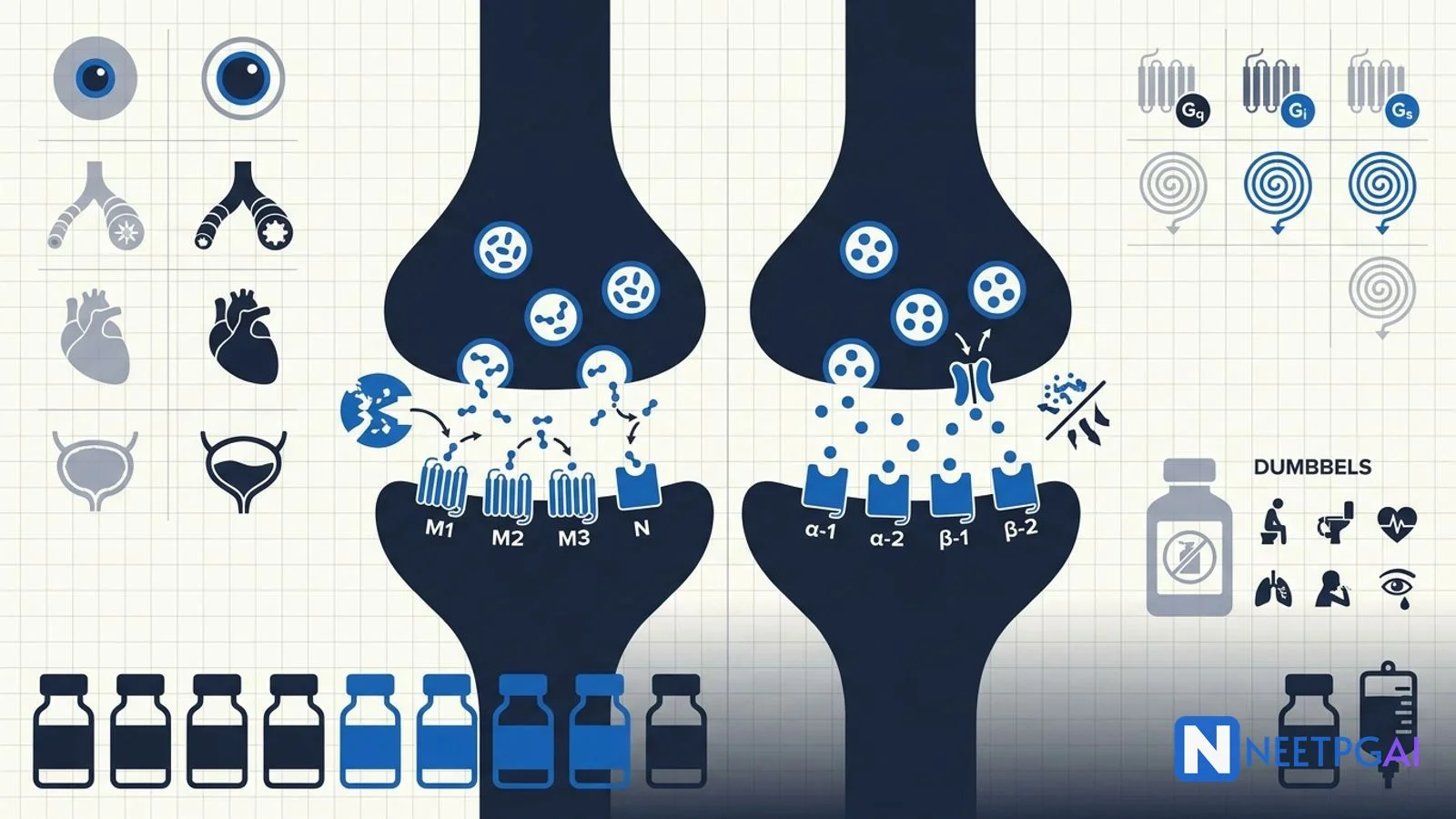
Master cholinergic and adrenergic agonists/antagonists, receptor subtypes, OP poisoning and India pesticide context with NEET PG 2027 pharmacology MCQ traps.
Read more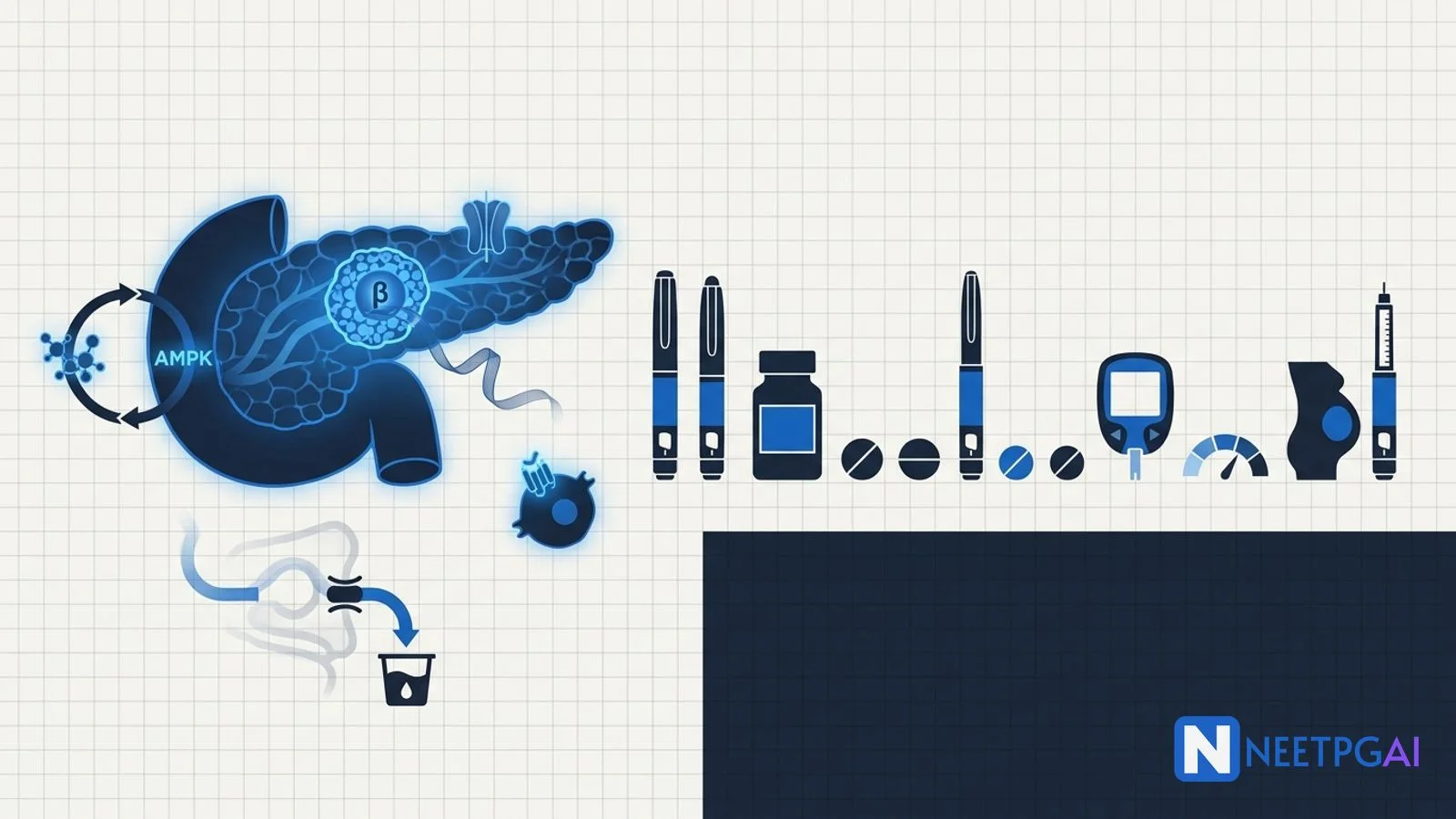
Master antidiabetic pharmacology for NEET PG 2027 — insulins, sulfonylureas, metformin, DPP-4, SGLT2, GLP-1 analogs, ADA 2025 algorithm, ADRs, DOC tables.
Read moreTrained on standard textbooks (Harrison's, Robbins, KD Tripathi, BD Chaurasia, Bailey & Love). Drop your email for a one-tap link to your free account — the full 28,000+ MCQ bank, real previous-year questions, mock tests, revision and analytics, at no cost. The AI Tutor is part of Pro.
AI-first preparation built specifically for the NEET PG question pattern.
Every Pharmacology MCQ comes with a detailed Claude-authored explanation citing standard references (Harrison's, Bailey & Love, Robbins, Park's etc.) — never a one-line answer key.
Wrong answers auto-schedule for review at expanding intervals (1d → 3d → 7d → 21d). Most aspirants need only half the practice volume to retain the same recall.
Every Pharmacology question is generated against the NMC syllabus and validated against the last 5 years of NEET PG / INI-CET previous year questions.
Stuck on a tricky topic? Ask the AI Tutor anytime — it answers in seconds with diagrams, mnemonics, and clinical pearls tailored to NEET PG.
Ready to test yourself?
Test your Pharmacology knowledge with AI-powered MCQs and detailed explanations — no signup required to try.
Common questions from NEET PG aspirants preparing Pharmacology.
Sign up free and practice all 2395+ MCQs with AI-powered explanations tailored to your performance.
Create Free Account