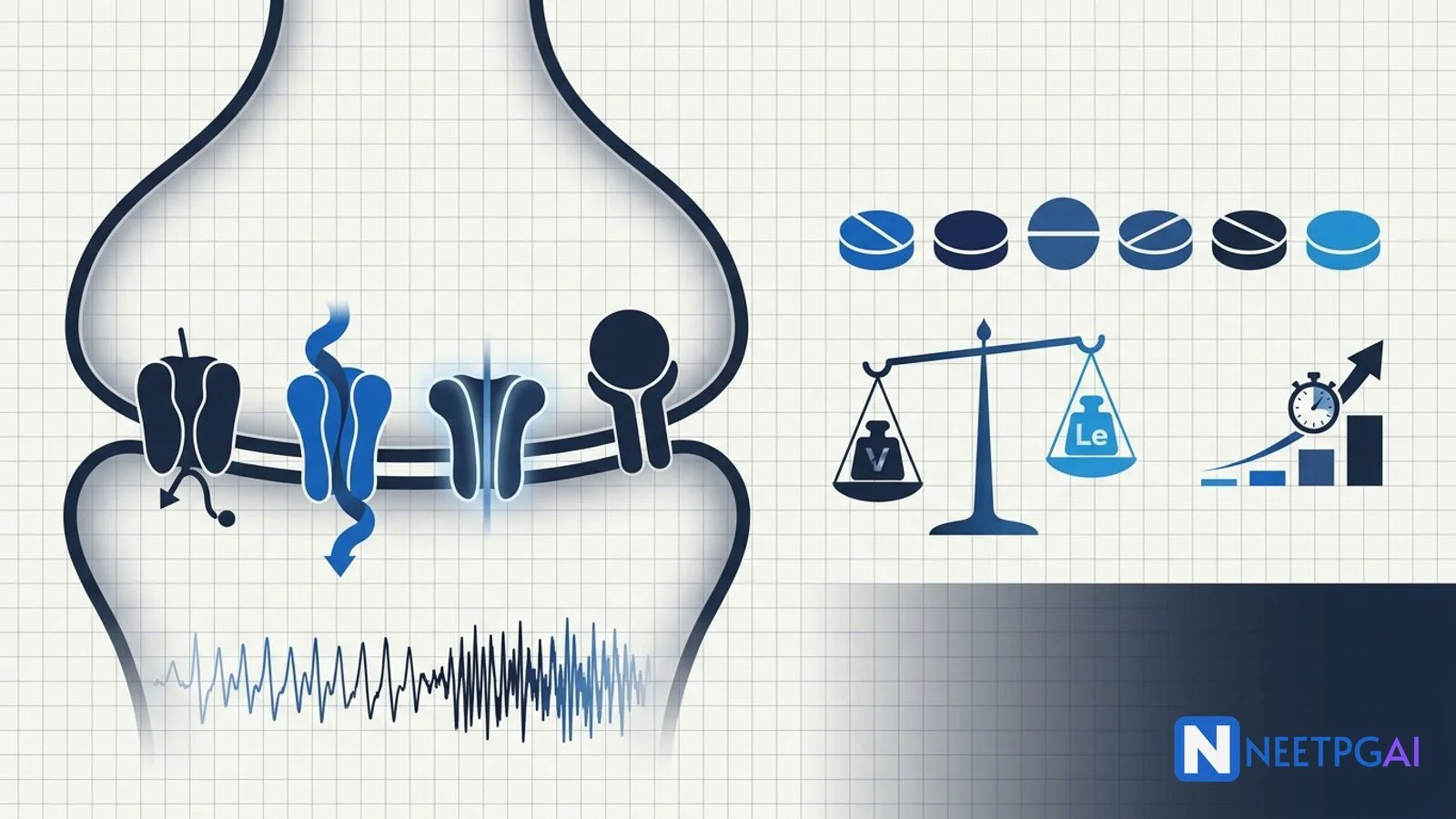
Antiepileptic Drugs for NEET PG 2027: Mechanisms, DOC, ADRs, Status Algorithm
Master antiepileptic drug pharmacology for NEET PG 2027 — mechanism by class, drug-of-choice by seizure type, key ADRs, pregnancy choices, and the status epilepticus algorithm.
Dr. NEETPGAI Editorial TeamPublished 10 Apr 2026Updated 29 Sept 202610 min read
Share this article
Ready to put this into practice?
Start practicing NEET PG MCQs with AI-powered explanations.
Antiepileptic drugs (AEDs) deliver 2 to 3 NEET PG questions per paper across Pharmacology, Neurology, and Pediatrics. The high-yield framework:
Mechanism by class — Na channel blockers (phenytoin, carbamazepine, lamotrigine), GABA enhancers (benzodiazepines, barbiturates, vigabatrin, tiagabine), Ca channel blockers (ethosuximide), glutamate inhibitors (perampanel), SV2A binders (levetiracetam).
DOC by seizure type — focal: levetiracetam or lamotrigine; GTCS: valproate (men) or lamotrigine/levetiracetam (women); absence: ethosuximide; myoclonic: valproate or levetiracetam.
Avoid — carbamazepine, phenytoin, gabapentin in absence and myoclonic seizures (paradoxical worsening).
Pregnancy — lamotrigine and levetiracetam are safest; valproate is teratogenic.
Status epilepticus — benzodiazepine first, then fosphenytoin/valproate/levetiracetam, then anaesthesia.
Antiepileptic drugs are a NEET PG goldmine because the topic combines pharmacology mechanism questions, paediatric neurology vignettes, obstetric drug-safety dilemmas, and emergency-medicine status-epilepticus algorithms in one tightly examinable cluster. The 2017 ILAE classification (focal-onset, generalised-onset, unknown-onset, with motor or non-motor sub-types) and the 2024 NICE epilepsy guideline simplified some drug-of-choice recommendations — examiners now actively ask the updated DOC.
This NEETPGAI deep dive walks through mechanisms by class, DOC by seizure type, the status-epilepticus algorithm, ADRs that recur in vignettes, and the high-yield pregnancy and paediatric considerations. Pair it with the Pharmacology subject hub and the common mistakes in pharmacology guide.
Mechanisms by drug class
Every AED works on one of four principal mechanisms — and many work on more than one. Understanding the mechanism predicts both efficacy and adverse effects.
Felbamate — NMDA antagonist; restricted use due to aplastic anaemia and hepatotoxicity.
Levetiracetam and brivaracetam — bind synaptic vesicle protein 2A (SV2A), modulating neurotransmitter release. Brivaracetam is more selective and 10 to 30 times more potent than levetiracetam.
Carbonic anhydrase inhibition
Topiramate, zonisamide, acetazolamide — multiple mechanisms including CA inhibition; cause metabolic acidosis, kidney stones, paraesthesia, weight loss.
Cannabidiol (newer)
Cannabidiol — approved for Dravet syndrome, Lennox-Gastaut syndrome, and tuberous sclerosis-associated seizures.
Drug of choice by seizure type
The 2024 NICE update made important changes — particularly for women of childbearing age — and these are exam-relevant.
Focal (focal-onset) seizures
First-line — lamotrigine or levetiracetam. Carbamazepine and oxcarbazepine remain widely used; in India, carbamazepine often persists as first-line due to cost.
First-line — vigabatrin (especially in tuberous sclerosis) or ACTH.
Second-line — high-dose oral steroids.
Dravet syndrome
Valproate plus clobazam first; stiripentol, fenfluramine, cannabidiol added. Avoid sodium channel blockers (carbamazepine, phenytoin, lamotrigine) — they worsen Dravet seizures.
Key adverse drug reactions
Cutaneous and hypersensitivity
Stevens-Johnson syndrome and toxic epidermal necrolysis — carbamazepine (HLA-B*1502 in Han Chinese, Thai, and South Indian populations), lamotrigine (especially with rapid titration or co-valproate), phenytoin, phenobarbitone.
Valproate — hepatotoxicity (highest risk in children under 2 years on polytherapy with mitochondrial disease — especially POLG mutation). Hyperammonaemia even with normal LFTs.
Status epilepticus is defined as continuous seizure activity above 5 minutes or recurrent seizures without recovery between episodes. Mortality rises with duration. The 2016 NCS and 2024 ILAE algorithms agree on a stepwise approach.
Stage 1 — Stabilisation phase (0 to 5 minutes)
ABCs, IV access, glucose check (give 25 g dextrose if hypoglycaemic plus thiamine 100 mg in malnourished), ECG, basic labs.
Stage 2 — Initial therapy (5 to 20 minutes)
First-line — benzodiazepine:
IV lorazepam 0.1 mg/kg (max 4 mg) — preferred IV agent.
IM midazolam 10 mg — preferred when IV access not yet available (RAMPART trial).
IV diazepam 0.15 to 0.2 mg/kg — alternative.
PR diazepam 0.2 to 0.5 mg/kg — used in paediatrics at home or in transit.
Stage 3 — Second-line therapy (20 to 40 minutes)
Established status epilepticus. Choose ONE:
Fosphenytoin 20 mg PE/kg IV at up to 150 mg PE/min.
Valproate 40 mg/kg IV (max 3 g) over 10 minutes.
Levetiracetam 60 mg/kg IV (max 4500 mg) over 15 minutes.
ESETT trial (2019) showed all three are equivalent for second-line therapy. Levetiracetam is increasingly preferred for safety.
Stage 4 — Third-line therapy (above 40 minutes)
Refractory status epilepticus — give continuous-infusion anaesthesia and intubate:
Propofol — bolus 1 to 2 mg/kg, then 2 to 10 mg/kg/hr.
Midazolam infusion — 0.05 to 0.4 mg/kg/hr.
Pentobarbital — last-line; deep coma with burst suppression on EEG.
Continuous EEG monitoring is mandatory once anaesthesia is started. Goal — burst suppression for 24 to 48 hours, then taper.
Stage 5 — Super-refractory status (above 24 hours despite anaesthesia)
Ketamine, isoflurane, hypothermia, ketogenic diet, immunotherapy if autoimmune cause suspected.
NEET PG MCQ traps
Absence seizure with carbamazepine — paradoxical worsening; switch to ethosuximide or valproate. Classic vignette stem.
Phenytoin zero-order kinetics — small dose increase from 300 to 400 mg can cause toxicity. Plot levels.
Purple-glove syndrome — IV phenytoin extravasation; use fosphenytoin instead.
Pseudoseizures (PNES) — bilateral asynchronous limb movements, pelvic thrusting, eyes forced closed, post-ictal lactate normal. EEG normal during episode.
Antiepileptic enzyme induction — phenytoin, carbamazepine, phenobarbitone reduce OCP efficacy and warfarin levels. Valproate is an inhibitor (raises lamotrigine levels — start low, go slow).
Lamotrigine plus valproate — valproate inhibits lamotrigine glucuronidation; halve the lamotrigine dose to avoid SJS.
HLA-B*1502 — Han Chinese, Thai, South Indian; test before starting carbamazepine.
Tiagabine and gabapentin — worsen absence and myoclonic seizures.
Valproate in pregnancy — avoid in women of childbearing age unless no alternative; risk-mitigation programs require dual contraception.
Recent updates and Indian context
2024 NICE epilepsy guideline — lamotrigine and levetiracetam are first-line in women of childbearing age for GTCS and focal seizures; valproate avoided.
ESETT trial (2019) — fosphenytoin, valproate, and levetiracetam are equivalent in established status epilepticus.
Cannabidiol — approved for Dravet, Lennox-Gastaut, and tuberous sclerosis-associated seizures.
HLA-B*1502 screening before carbamazepine is now formally recommended in South Asian populations — relevant FMGE and NEET PG vignette.
Indian context — phenytoin and carbamazepine remain widely prescribed due to cost; levetiracetam generics have increased access. Valproate is still over-prescribed in young women in district practice — this is the single most common drug-related teratogenicity question in NEET PG.
Frequently asked questions
What is the drug of choice for absence seizures?
Ethosuximide is first-line for typical childhood absence seizures (3 Hz spike-and-wave on EEG) when only absence seizures are present. Valproate is preferred when GTCS coexist. Lamotrigine is third-line. Carbamazepine, phenytoin, and gabapentin can paradoxically worsen absence seizures and are contraindicated.
Which AED is safest in pregnancy?
Lamotrigine and levetiracetam have the lowest teratogenicity and are preferred in pregnancy. Valproate has the highest risk (neural tube defects up to 10 percent, IQ reduction) and should be avoided in women of childbearing age unless no alternative exists. All women on AEDs need pre-conceptional folate 4 to 5 mg daily.
What is the status epilepticus management ladder?
First line is IV lorazepam 0.1 mg/kg (or IV diazepam, IM midazolam if no IV access) within 5 minutes. Second line at 20 to 40 minutes is IV fosphenytoin, valproate, or levetiracetam. Refractory status (above 40 minutes) needs anesthetic infusion — propofol, midazolam, or pentobarbital with continuous EEG.
Which AED causes Stevens-Johnson syndrome most commonly?
Carbamazepine has the strongest association, especially in patients with HLA-B1502 allele (common in Han Chinese, Thai, and South Indian populations). Lamotrigine causes SJS particularly with rapid titration or co-administration with valproate. Phenytoin and phenobarbitone are also implicated. HLA-B1502 testing is recommended before starting carbamazepine in at-risk populations.
What is the drug of choice for focal seizures?
First-line options are lamotrigine, levetiracetam, oxcarbazepine, and carbamazepine. Levetiracetam is increasingly preferred due to favourable pharmacokinetics, no significant drug interactions, and rapid titration. Carbamazepine remains widely used in India given cost. Phenytoin has fallen out of favour due to non-linear kinetics.
This content is for educational purposes for NEET PG exam preparation. It is not a substitute for professional medical advice, diagnosis, or treatment. Clinical information has been reviewed by qualified medical professionals.
Written by: NEETPGAI Editorial Team
Reviewed by: Pending SME Review
Last reviewed: May 2026