NEETPGAI
FeaturesBlogComparePricing
Log inStart Free
NEETPGAI

AI-powered NEET PG preparation platform. Master all 19 subjects with adaptive MCQs, AI tutoring, and spaced repetition.

Product

  • Features
  • Subjects
  • Previous Year Questions
  • Compare
  • Pricing
  • Blog

Features

  • Adaptive MCQ Practice
  • AI Tutor
  • Mock Tests
  • Spaced Repetition

Resources

  • Blog
  • Study Guides
  • NEET PG Updates
  • Contact & support

Legal

  • Privacy Policy
  • Terms of Service

Stay updated

© 2026 NEETPGAI. All rights reserved.
    Practice 1,453+ Pediatrics MCQs
    Free signup · Full bank · Detailed explanations
    Start Free
    SubjectsPediatrics
    Clinical
    AI-powered

    Pediatrics for NEET PG 2026

    Free practice + topic-wise study material with AI explanations.

    90 daysto NEET PG 2026
    Exam date: 30 Aug 2026
    Your prep stageRevision Phase
    Foundation
    180+ days
    Deep Study
    90-180 days
    Revision
    30-90 days
    Final Sprint
    <30 days

    Rapid revision of all subjects. 2 mock tests per week.

    1. 1Prioritise the 28 high-yield topics — they account for ~70% of Pediatrics questions every year.
    2. 2Practice 1,453+ topic-tagged MCQs with detailed AI explanations to build pattern recognition.
    3. 3Use SM-2 spaced repetition — wrong answers auto-schedule for review at expanding intervals.
    4. 4Revise PYQs from the last 5 years to spot recurring themes and adjust your priorities.
    5. 5Take subject-wise mock tests every 2 weeks to benchmark recall under exam conditions.
    Start Free PracticeGenerate AI Study Plan

    Pediatrics at a glance

    Live from MCQ bank
    1,453practice MCQs
    Updated daily as new questions are SME-approved.
    28
    HY
    high-yield topics
    ~70% of NEET PG Pediatrics marks come from these.
    43total topics
    Across 9 canonical systems.
    100% free — unlimited MCQs and real PYQs, no credit card.
    About Pediatrics in NEET PG

    What you need to know about Pediatrics

    Quick answer

    Pediatrics covers the growth, development, nutrition, immunisation, and disease management of children from birth through adolescence, and it carries approximately 12% weightage (range 10–15%) in NEET PG 2026 — making it one of the top 5 scoring subjects in the paper. NEET PG tests clinical reasoning here, not rote recall: expect scenario-based questions on a 32-week preterm in respiratory distress, a child with a murmur whose anatomy you must reconstruct, or a vaccine mismatch in the National Immunisation Schedule. Prioritise the neonatal block (APGAR, RDS, Neonatal Jaundice, Sepsis) and the preventive block (NIS, PEM, Vitamin Deficiencies) — together they account for roughly 7–8 of every 12 Pediatrics questions in recent papers. Developmental Milestones and Growth Charts are high-recall, high-reward topics you can master in under 10 hours of focused study. Spaced-repetition tools like NEETPGAI compress the revision cycle to 7–10 days across all 637 approved Pediatrics practice questions.

    Pediatrics in NEET PG 2026 tests your ability to apply clinical knowledge across 43 syllabus topics spread over 9 body systems — neonatal medicine, nutrition, immunisation, respiratory, cardiovascular, neurology, infectious diseases, genetics, and growth and development. The subject rewards aspirants who understand mechanisms: knowing why a preterm lung lacks surfactant (Type II pneumocyte immaturity before 34 weeks) is more useful than memorising a definition of RDS, because NEET PG questions will give you a clinical scenario and ask you to choose the next step or identify the exception.

    The subject sits at the intersection of Obstetrics (perinatal outcomes, TORCH infections, neonatal jaundice from ABO/Rh incompatibility), Pharmacology (KD Tripathi drug doses in children, aminoglycoside toxicity in neonatal sepsis), and Preventive and Social Medicine (Park's Textbook — National Immunisation Schedule, cold chain, ICMR/IAP vaccine updates). Questions on the National Immunisation Schedule frequently test the "EXCEPT" format, asking you to identify a mismatched vaccine-disease or vaccine-route pairing, exactly the kind of reasoning the NEETPGAI question bank is built around.

    The syllabus shape is front-loaded toward the neonatal period. Topics like APGAR Scoring, Neonatal Resuscitation, Meconium Aspiration Syndrome, and Neonatal Sepsis together form a dense cluster that appears in 3–4 questions per paper. Developmental Milestones (Nelson's Chapter on Development) is a standalone high-yield area where a single table — gross motor, fine motor, language, social — can yield 2 direct questions. Growth Charts and Anthropometry, including IAP growth charts and WHO Multicentre Growth Reference Study standards, are tested both as data-interpretation and as clinical-classification questions (SAM vs. MAM by MUAC and W/H Z-score).

    A common misconception is that Pediatrics is "just memorisation." In reality, the cardiovascular block (Tetralogy of Fallot, VSD, ASD, PDA) demands anatomical reasoning — you must know which of the four defects in ToF is absent in Pentalogy of Cantrell, or which shunt direction changes with Eisenmenger physiology. Similarly, Protein-Energy Malnutrition questions go beyond Kwashiorkor vs. Marasmus to ask about the Wellcome classification, RUTF composition, and F-75/F-100 therapeutic feeds per WHO/UNICEF protocols. Treat Pediatrics as a clinical subject from day one.

    Free PDF · NEET PG 2026

    Pediatrics High-Yield One-Liners

    200 textbook-style one-liners auto-extracted from approved Pediatrics MCQ explanations. Drop your email and we'll send the PDF — no spam, you can reply to unsubscribe.

    Highest-yield topics

    Pediatrics — focus areas that win the most marks

    These 12 topics historically carry a disproportionate share of Pediatrics questions on NEET PG. Tap any to start practising — the Pediatrics filter is pre-selected for you.

    Neonatology

    APGAR Scoring and Neonatal Resuscitation

    Start practising

    Neonatology

    Neonatal Jaundice

    Start practising

    Neonatology

    Respiratory Distress Syndrome

    Start practising

    Neonatology

    Meconium Aspiration Syndrome

    Start practising

    Neonatology

    Neonatal Sepsis

    Start practising

    Neonatology

    APGAR Scoring — Interpretation and Clinical Significance

    Start practising

    Growth and Development

    Developmental Milestones

    Start practising

    Growth and Development

    Growth Charts and Anthropometry

    Start practising

    Nutrition and Feeding

    Breastfeeding — Principles and Problems

    Start practising

    Nutrition and Feeding

    Protein-Energy Malnutrition — Clinical

    Start practising

    Nutrition and Feeding

    Vitamin Deficiencies in Children

    Start practising

    Immunisation

    National Immunisation Schedule

    Start practising

    Preparation strategy

    How to prepare Pediatrics — tactics that work

    Five repeatable tactics that NEET PG toppers consistently use for Pediatrics. Below: a deeper play-by-play.

    Build a strong foundation

    Read each high-yield topic from one standard textbook before opening any question bank.

    Practice in tight loops

    After every chapter, attempt 20–30 topic-tagged MCQs while the concepts are still fresh.

    Schedule spaced reviews

    Push wrong answers into SM-2 review queues — short, frequent, expanding intervals beat marathon revisions.

    Mine the last 5 years of PYQs

    Map every PYQ to its parent topic. Recurring themes are louder signal than weightage tables.

    Stress-test with mock tests

    A subject-wise mock every fortnight surfaces blind spots before the real exam does.

    Time budget

    • Allocate 10–12% of your total NEET PG 2026 preparation hours to Pediatrics — roughly 120–150 hours over a 6-month schedule.
    • Split as: Neonatal block 35%, Growth/Nutrition/Immunisation block 30%, Systemic diseases (CVS, Neuro, Respiratory, Infectious) 25%, Genetics and Miscellaneous 10%.

    Primary textbook

    • Nelson Textbook of Pediatrics (South Asia Edition, 21st ed.) is the gold standard. You do not need to read it cover to cover — use it as a reference for mechanisms and tables.
    • For exam-oriented reading, OP Ghai's Essential Pediatrics (9th Indian edition) is the single most tested source in NEET PG. Every table in Ghai — APGAR scoring criteria, Ballard score, Developmental Milestones by age, IAP immunisation schedule — is directly examinable.

    Supplementary sources

    • Park's Textbook of Preventive and Social Medicine (24th edition): Chapter on National Immunisation Schedule, cold chain, and UIP vaccines. Cross-reference with the latest IAP Advisory Committee on Vaccines (ACVIP) 2024 schedule for any additions (e.g., rotavirus, PCV, HPV rollout).
    • KD Tripathi's Essentials of Medical Pharmacology

    Put this into a 30-minute session today

    We'll pre-select Pediatrics and serve a mixed difficulty set.

    Try a 10-MCQ set
    Syllabus map
    Pediatrics — full topic list
    43 topics across 9 systems · 28 marked high-yield
    • APGAR Scoring and Neonatal Resuscitation
      High-yield
    • Neonatal Jaundice
      High-yield
    • Respiratory Distress Syndrome
      High-yield
    • Meconium Aspiration Syndrome
      High-yield
    • Neonatal Sepsis
      High-yield
    • Hypoxic Ischaemic Encephalopathy
      Moderate
    • Preterm and IUGR Baby Care
      Moderate
    • APGAR Scoring — Interpretation and Clinical Significance
      High-yield
    • Developmental Milestones
      High-yield
    • Growth Charts and Anthropometry
      High-yield
    • Failure to Thrive
      Moderate
    • Adolescent Growth — Tanner Staging
      Moderate
    • Breastfeeding — Principles and Problems
      High-yield
    • Complementary Feeding
      Moderate
    • Protein-Energy Malnutrition — Clinical
      High-yield
    • Vitamin Deficiencies in Children
      High-yield
    • National Immunisation Schedule
      High-yield
    • IAP Immunisation Recommendations
      High-yield
    • Vaccine Types and Cold Chain
      High-yield
    • Contraindications and AEFI
      Moderate
    • Measles — Clinical
      High-yield
    • Mumps and Rubella — Clinical
      Moderate
    • Pertussis and Diphtheria
      High-yield
    • Pediatric TB
      High-yield
    • Dengue in Children
      High-yield
    • Enteric Fever in Children
      Moderate
    • Diphtheria — Clinical Features, Complications and Management
      High-yield
    • Parvovirus B19 and Exanthematous Viral Infections
      Moderate
    • Congenital Heart Disease — Acyanotic
      High-yield
    • Congenital Heart Disease — Cyanotic
      High-yield
    • Rheumatic Heart Disease in Children
      Moderate
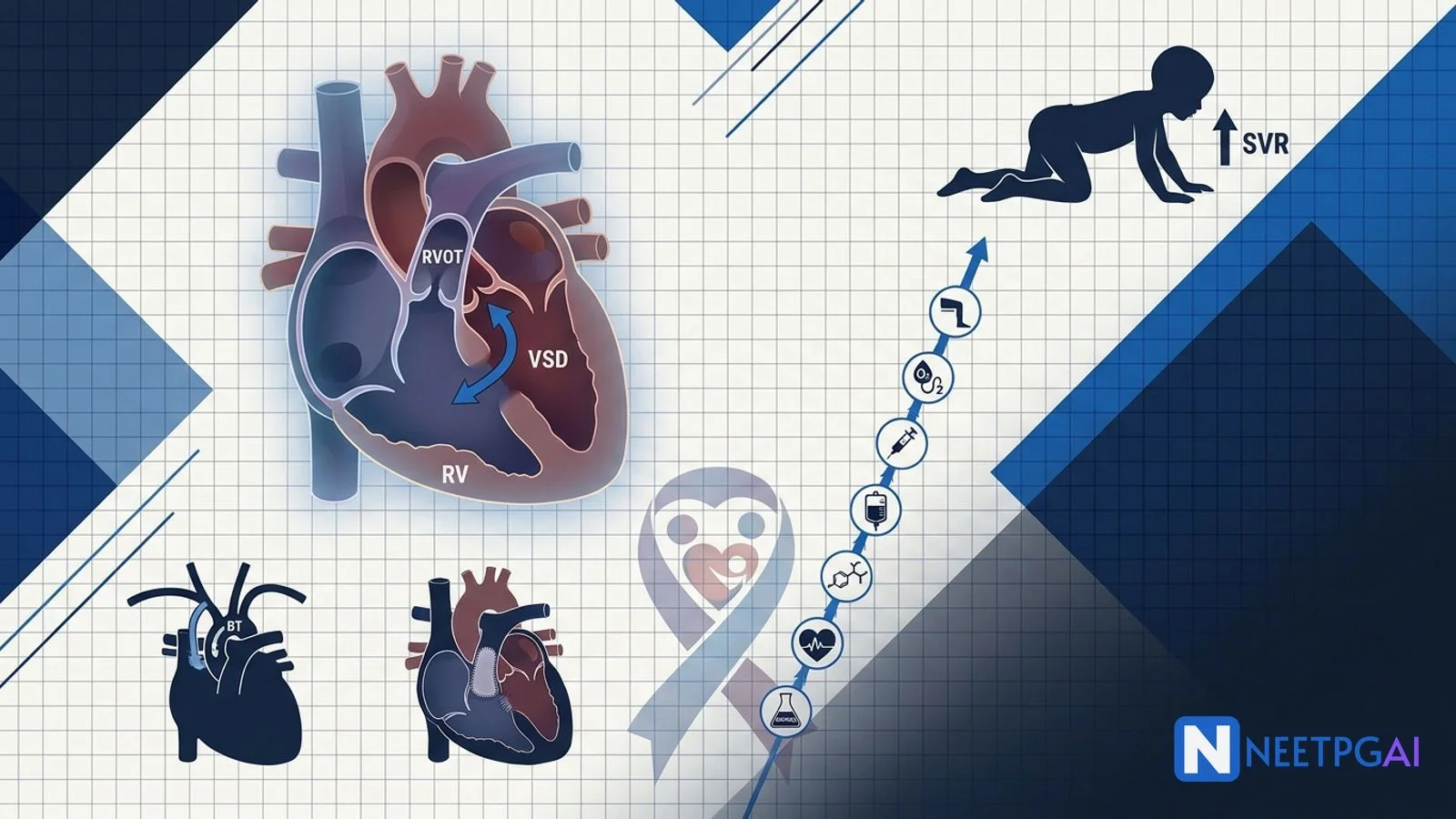
    • Congenital Heart Disease — Tetralogy of Fallot
      High-yield
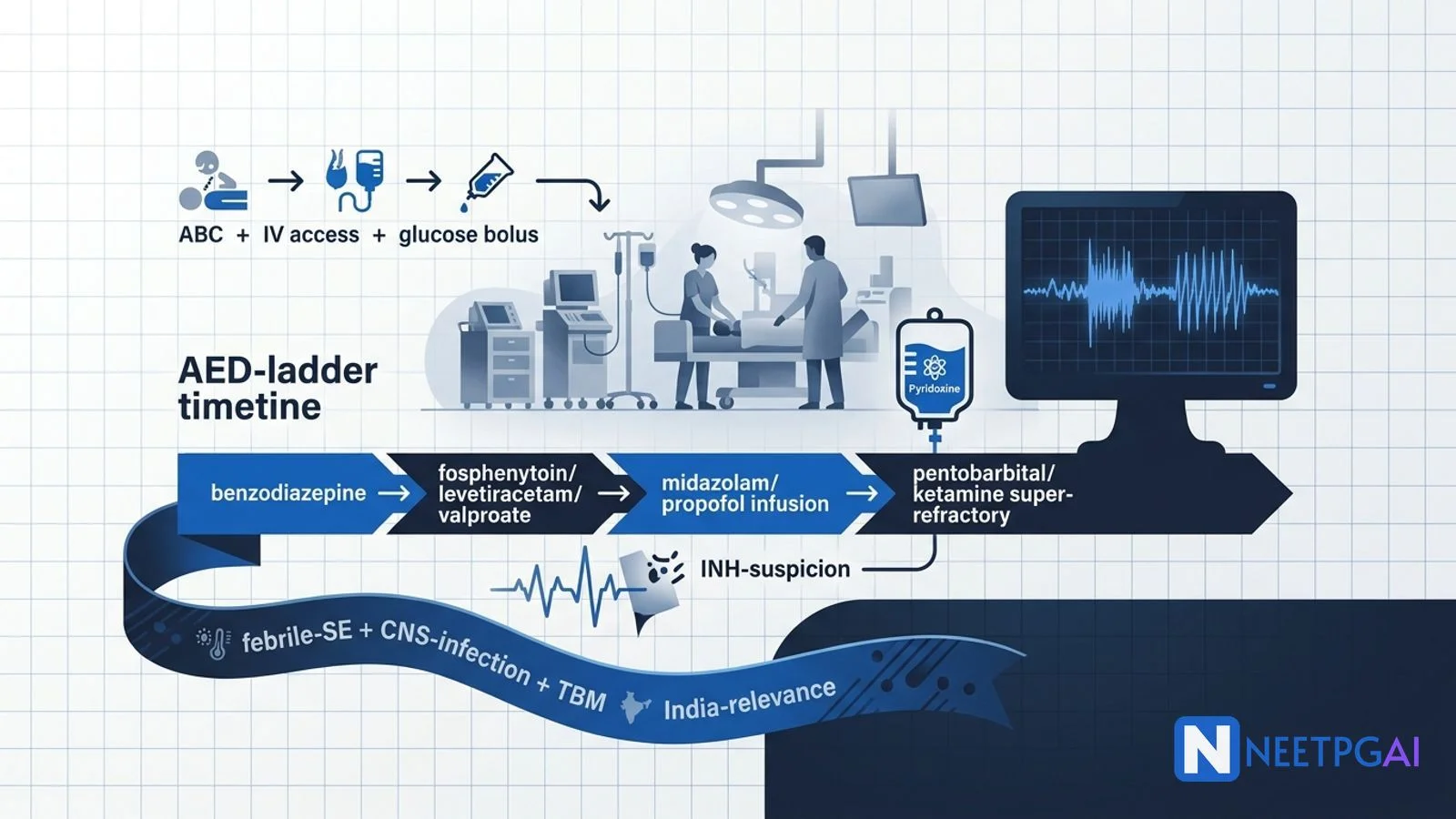
    • Status Epilepticus in Children
      High-yield
    • Pediatric Shock Management
      High-yield
    • Acute Diarrhea and Dehydration
      High-yield
    • Poisoning in Children
      Moderate
    • Down Syndrome and Aneuploidies
      High-yield
    • Common Single-Gene Disorders
      Moderate
    • Neonatal Screening — IEM
      Moderate
    • Neural Tube Defects
      Moderate
    • Childhood Leukemias
      High-yield
    • Wilms Tumor and Neuroblastoma
      High-yield
    • Hemolytic Anemias of Childhood
      Moderate
    Today's NEET PG Pediatrics MCQ

    Test yourself in 60 seconds

    New question every day
    Congenital Heart Disease — Tetralogy of Fallot
    easy

    Which of the following is NOT one of the four anatomical defects that constitute Tetralogy of Fallot?

    Tap an option to reveal the answer and AI explanation. New question rotates daily at midnight IST.

    Study guides

    Pediatrics study guides

    17 in-depth Pediatrics guides curated for NEET PG aspirants.
    1 / 6
    Wilms Tumor and Neuroblastoma Pediatric Oncology for NEET PG 2026
    29 May 2026
    Wilms tumor
    neuroblastoma

    Wilms Tumor and Neuroblastoma Pediatric Oncology for NEET PG 2026

    Master Wilms tumour vs neuroblastoma, WAGR/Denys-Drash/Beckwith-Wiedemann, NMYC amplification, NWTS/INRG staging and treatment for NEET PG 2026.

    Read more
    Image MCQ: Pediatric Imaging Findings for NEET PG (Intussusception, Pyloric Stenosis, Hirschsprung, VUR, DDH)
    27 May 2026
    image mcq
    pediatrics

    Image MCQ: Pediatric Imaging Findings for NEET PG (Intussusception, Pyloric Stenosis, Hirschsprung, VUR, DDH)

    5 pediatric imaging MCQs for NEET PG: intussusception target sign, hypertrophic pyloric stenosis string sign, Hirschsprung contrast enema, VUR grading on MCUG, DDH Graf alpha angle.

    Read more
    Clinical Case: 2-Year-Old Boy with White Pupillary Reflex on Flash Photographs — Leukocoria and Retinoblastoma Workup for NEET PG
    9 May 2026
    clinical case
    pediatrics

    Clinical Case: 2-Year-Old Boy with White Pupillary Reflex on Flash Photographs — Leukocoria and Retinoblastoma Workup for NEET PG

    NEET PG pediatric leukocoria case: 2-yo with white pupillary reflex, differential, MRI orbit (never CT), Reese-Ellsworth + IIRC staging, focal therapy, chemoreduction, enucleation, RB1 testing.

    Read more
    pediatrics
    Free AI tutor trial · No card required

    Stuck on a Pediatrics concept? Ask the AI tutor.

    Trained on standard textbooks (Harrison's, Robbins, KD Tripathi, BD Chaurasia, Bailey & Love). Drop your email — we'll send a one-tap link to start asking questions. 3 free messages per day, ongoing.

    • Cite-anchored answers (chapter + page when applicable)
    • Mermaid diagrams and clinical pearls inline
    • NEET PG-tuned, never generic ChatGPT

    Why aspirants choose NEETPGAI for Pediatrics

    AI-first preparation built specifically for the NEET PG question pattern.

    Textbook-quality AI explanations

    Every Pediatrics MCQ comes with a detailed Claude-authored explanation citing standard references (Harrison's, Bailey & Love, Robbins, Park's etc.) — never a one-line answer key.

    SM-2 spaced repetition

    Wrong answers auto-schedule for review at expanding intervals (1d → 3d → 7d → 21d). Most aspirants need only half the practice volume to retain the same recall.

    PYQ-aligned question patterns

    Every Pediatrics question is generated against the NMC syllabus and validated against the last 5 years of NEET PG / INI-CET previous year questions.

    24/7 AI Tutor for Pediatrics doubts

    Stuck on a tricky topic? Ask the AI Tutor anytime — it answers in seconds with diagrams, mnemonics, and clinical pearls tailored to NEET PG.

    Ready to test yourself?

    Test your Pediatrics knowledge with AI-powered MCQs and detailed explanations — no signup required to try.

    Practice Pediatrics MCQs

    Pediatrics preparation FAQs

    Common questions from NEET PG aspirants preparing Pediatrics.

    Sources & references
    1. NEETPGAI PYQ and Practice Question Database — Pediatrics module (N = 637 approved questions)
    2. NMC NEET PG Syllabus 2026 — Pediatrics (43 topics across 9 systems)
    3. OP Ghai's Essential Pediatrics, 9th Edition — Meharban Singh & Paul (CBS Publishers, New Delhi)
    4. Nelson Textbook of Pediatrics, 21st Edition (South Asia Edition) — Kliegman et al. (Elsevier)
    5. IAP Advisory Committee on Vaccines and Immunization Practices (ACVIP) — Recommended Immunization Schedule 2024, Indian Pediatrics Journal
    6. Park's Textbook of Preventive and Social Medicine, 24th Edition — K. Park (Banarsidas Bhanot Publishers, Jabalpur)

    Ready to master Pediatrics?

    Sign up free and practice all 1453+ MCQs with AI-powered explanations tailored to your performance.

    Create Free Account
    (9th edition): Drug doses in neonates and children, especially for neonatal sepsis (ampicillin + gentamicin first-line), seizure management (phenobarbitone 20 mg/kg loading dose in neonates), and vitamin supplementation doses.

    Daily and weekly rhythm

    • Daily (2 hours): Read one topic from Ghai + solve 15–20 NEETPGAI practice questions on that topic the same evening. Do not let reading and practice be separated by more than 24 hours.
    • Weekly (Sunday, 3 hours): Full-topic revision of the week's material using flashcards or a self-made one-page summary. Review all incorrectly answered questions from the week.
    • Monthly: One full-length Pediatrics subject test (60–70 questions) under timed conditions.

    High-yield topic tactics

    • Developmental Milestones: Make a 4-column table (Gross Motor / Fine Motor / Language / Social) with age in months. Pin it above your study desk. Test yourself daily — "At 9 months, what is the pincer grasp status?" (Inferior pincer at 9 months, mature pincer at 12 months.)
    • National Immunisation Schedule: Draw the schedule from memory once a week. Know the route, dose, site, and contraindications for each vaccine. BCG intradermal at birth, OPV 0 at birth, Hepatitis B at 0-6-10-14 weeks — these pairings are tested in the "EXCEPT" format.
    • Neonatal Resuscitation: Follow the NRP 2020 algorithm. Know the decision points: HR < 100 bpm → PPV; HR < 60 bpm after 30 seconds PPV → chest compressions at 3:1 ratio; HR still < 60 bpm → adrenaline 0.1–0.3 mL/kg of 1:10,000 IV.
    • RDS vs. MAS: Contrast the two on CXR findings, surfactant use (yes in RDS, controversial in MAS), and gestational age profile. NEET PG loves the "which is NOT a feature of" format here.

    Mistakes to avoid

    • Do not skip the cardiovascular block assuming it belongs to Medicine. ToF, VSD, TGA, and Eisenmenger syndrome are tested from a Pediatrics lens — age of presentation, cyanosis timing, and surgical correction age.
    • Do not rely on a single source for the immunisation schedule. IAP and NMC syllabus versions differ slightly; know both.
    • Do not memorise PEM classifications without understanding the clinical signs — pitting oedema in Kwashiorkor is a direct consequence of hypoalbuminaemia, and NEET PG will test the mechanism, not just the name.

    Revision rhythm in the final 6 weeks

    • Week 1–2: Neonatal block (APGAR, RDS, MAS, Jaundice, Sepsis) — 200 NEETPGAI questions.
    • Week 3: Growth, Nutrition, PEM, Vitamin Deficiencies — 150 questions.
    • Week 4: Immunisation + Developmental Milestones — 100 questions.
    • Week 5–6: Systemic diseases + full mock tests. Target 75%+ accuracy on Pediatrics before exam day.