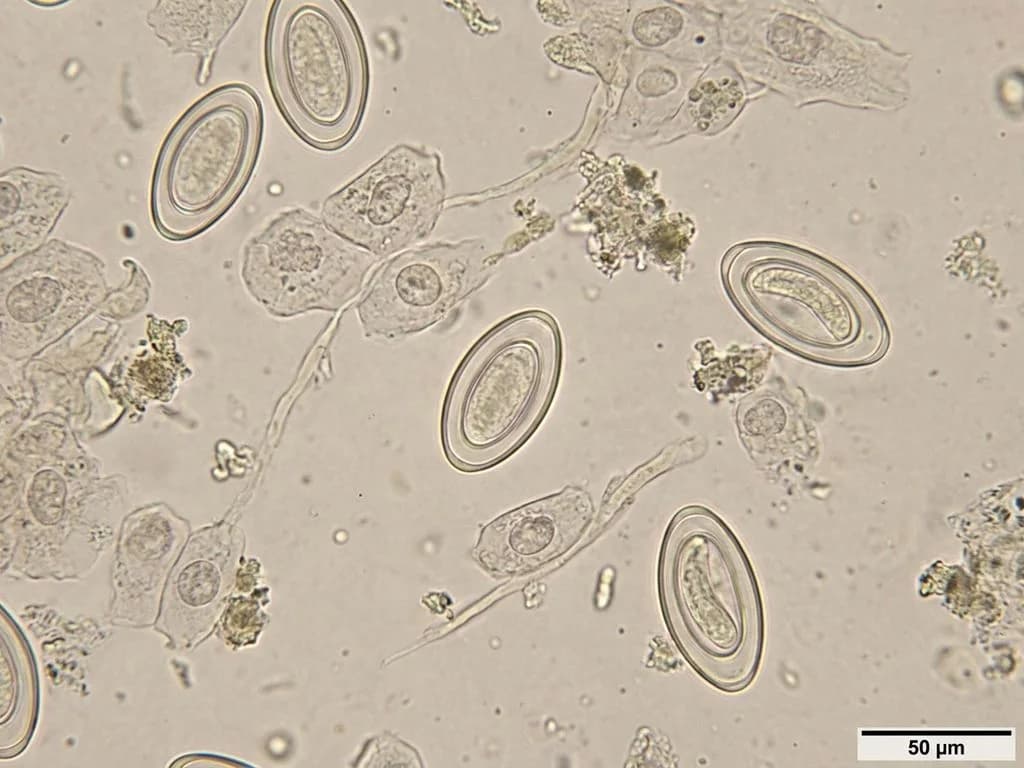
Correct Answer: B. Enterobius vermicularis
Enterobius vermicularis (pinworm) is the most common cause of perianal itching, especially in children and in Indian households with poor sanitation. The diagnosis is confirmed by the scotch tape test (cellophane tape swab of the perianal region in early morning), which reveals characteristic embryonated eggs — oval, flattened on one side, measuring 50–60 μm × 20–30 μm. The eggs are immediately infectious (embryonated within 4–6 hours) and cause intense itching due to female worms migrating to the perianal skin at night to deposit eggs. This nocturnal migration is pathognomonic and explains the classic presentation of perianal pruritus worse at night. The peripheral swab (scotch tape preparation) is the gold standard diagnostic method, showing these distinctive eggs. Treatment in India follows IAP guidelines: albendazole 400 mg single dose, repeated after 2 weeks, with simultaneous treatment of all household contacts to prevent reinfection.
Why the other options are wrong
A. H Nana — Hymenolepis nana (dwarf tapeworm) causes abdominal symptoms and diarrhea, not perianal itching. Diagnosis is by stool examination showing characteristic eggs with polar filaments, not perianal swab. H. nana is rare in India compared to E. vermicularis. The scotch tape test is specific for pinworm eggs and would not show tapeworm morphology. C. Ancylostoma — Ancylostoma duodenale causes hookworm disease with anemia, protein malnutrition, and ground itch (larval penetration), not perianal itching. Diagnosis requires stool examination showing hookworm eggs (60–80 μm, oval with thin shell), not perianal swab. Ancylostoma does not migrate to perianal skin and causes systemic symptoms, not localized pruritus. D. Necator Americanus — Necator americanus (American hookworm) is rare in India and causes similar hookworm disease with anemia and malabsorption, not perianal itching. Diagnosis is by stool examination for hookworm eggs, not perianal swab. The clinical presentation is systemic (iron deficiency anemia, protein loss) rather than localized nocturnal perianal pruritus characteristic of pinworm.
High-Yield Facts
- Scotch tape test is the gold standard diagnostic method for E. vermicularis — performed early morning before defecation or bathing.
- Embryonated eggs of E. vermicularis are 50–60 μm × 20–30 μm, oval, flattened on one side, immediately infectious within 4–6 hours.
- Nocturnal perianal migration of gravid females causes intense itching worse at night — pathognomonic for pinworm infection.
- Albendazole 400 mg single dose (repeated after 2 weeks) is the Indian DOC; simultaneous treatment of all household contacts is essential.
- Fecal-oral transmission via contaminated fomites and inhalation of eggs makes pinworm highly contagious in schools and households with poor hygiene.
Mnemonics
TAPE for Pinworm Diagnosis Tape swab (scotch tape test) → Anal itching (perianal pruritus) → Peripheral eggs (embryonated) → Enterobius vermicularis. Use this when you see 'perianal itching + swab' in a question. NIGHT Itch = Pinworm Nocturnal migration → Intense itching → Gravid females → Household transmission → Tape test confirms. Helps recall the classic nocturnal presentation.
NBE Trap
NBE pairs "perianal itching" with hookworm (Ancylostoma/Necator) to trap students who confuse ground itch (larval penetration) with pinworm-induced perianal pruritus. The key discriminator is the scotch tape swab showing embryonated eggs — hookworms are diagnosed by stool examination, not perianal swab.
Clinical Pearl
In Indian pediatric practice, pinworm is the most common helminthic infection in urban and rural children. A child presenting with nocturnal perianal itching and sleep disturbance should prompt immediate scotch tape testing — early diagnosis and family-wide treatment prevents recurrent infections and school transmission. Many Indian mothers report "worms in stool" after albendazole treatment, which is actually dead worms being expelled.
_Reference: Jawetz, Melnick & Adelberg's Medical Microbiology Ch. 46 (Helminths); Park's Textbook of Preventive and Social Medicine Ch. 7 (Parasitic Infections)_