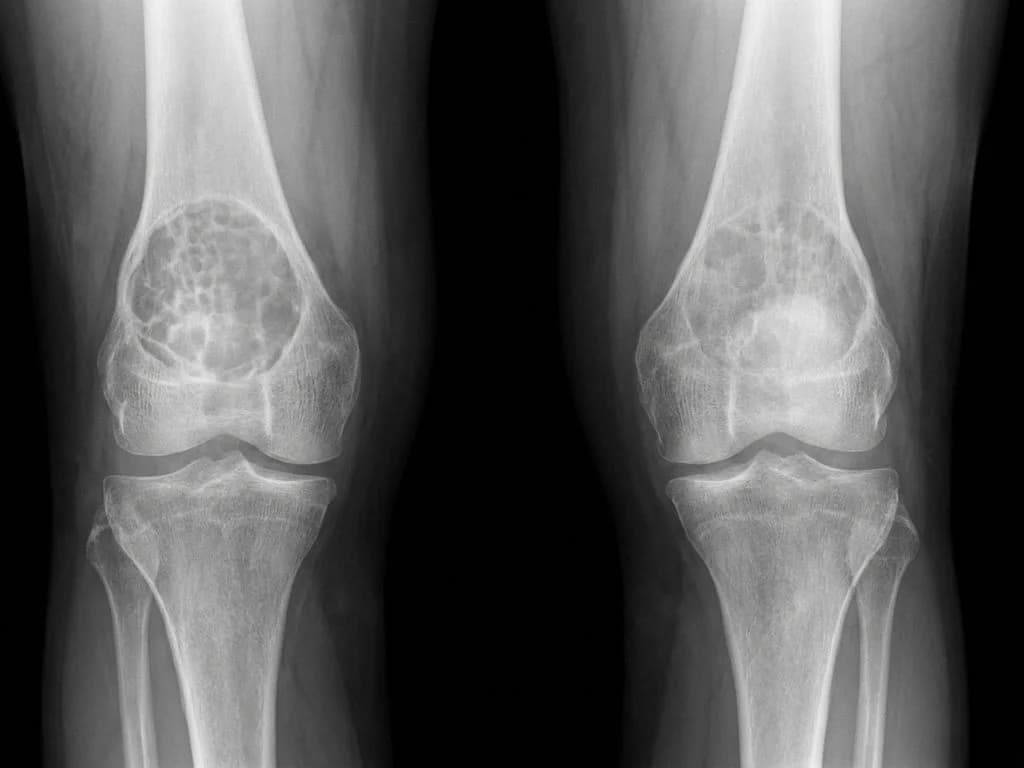
Correct Answer: B. Giant cell tumor
Giant cell tumor (GCT) of bone is the classic diagnosis in a skeletally mature patient (22-year-old female) presenting with an epiphyseal or epiphyseal-metaphyseal lytic lesion. The discriminating feature here is the epiphyseal location extending to the metaphysis in a young adult with closed physes—this is pathognomonic for GCT. GCT typically arises after skeletal maturity (peak 20–40 years) and characteristically involves the epiphysis, often extending into the metaphysis, distinguishing it from other benign bone tumors. Histologically, it comprises hemosiderin-laden macrophages, spindle cells, and multinucleated giant cells. On imaging, GCT appears as a well-demarcated, eccentric, lytic lesion with a thin sclerotic rim, often reaching the articular surface. The epiphyseal predilection in a skeletally mature patient is the key discriminator. Treatment in India follows standard protocols: curettage with or without adjuvants (phenol, liquid nitrogen, or cement) for grade I–II lesions; wide excision or amputation reserved for aggressive (grade III) or recurrent cases. The recurrence rate is 10–65% depending on grade and treatment method.
Why the other options are wrong
A. Chondroblastoma — Chondroblastoma is an epiphyseal lesion, but it occurs in skeletally immature patients (10–20 years) with open physes. The patient here is 22 years old with closed physes, making this diagnosis unlikely. Chondroblastoma also presents as a smaller, more centrally located epiphyseal lesion with a characteristic 'chicken-wire' calcification pattern, not seen in GCT. C. Osteochondroma — Osteochondroma is a metaphyseal lesion arising from the growth plate, typically in patients aged 10–20 years. It presents as an exostosis with a cartilage cap, not an epiphyseal lytic lesion. The lesion is usually eccentric and projects away from the joint. The age and radiographic appearance (epiphyseal lytic lesion) rule out osteochondroma. D. Aneurysmal bone cyst — Aneurysmal bone cyst (ABC) is a metaphyseal or diametaphyseal lesion that occurs in younger patients (5–20 years) and presents as an expansile, lytic lesion with fluid-fluid levels on MRI. Although it can be epiphyseal, it typically does not reach the articular surface and lacks the well-demarcated, sclerotic rim characteristic of GCT. The patient's age and epiphyseal location with metaphyseal extension favor GCT.
High-Yield Facts
- GCT epiphyseal location in skeletally mature patients (20–40 years) is pathognomonic; extends to metaphysis and often reaches articular surface.
- Histology of GCT: hemosiderin-laden macrophages, spindle cells, and multinucleated giant cells; NOT osteoclasts (common misconception).
- Recurrence rate varies 10–65% based on grade (I–III) and treatment; curettage + adjuvants (phenol, liquid nitrogen, cement) is standard for low-grade lesions in India.
- Chondroblastoma is epiphyseal but in immature skeletons (10–20 years); osteochondroma is metaphyseal; ABC is metaphyseal/diametaphyseal.
- Malignant transformation of GCT to sarcoma is rare (<5%) but reported; aggressive grade III lesions warrant wide excision.
Mnemonics
GCT vs Others: AGE & LOCATION Giant cell tumor = Grown-up (20–40 yrs) + Epiphysis. Chondroblastoma = Childhood (10–20 yrs) + epiphysis. Osteochondroma = Older child (10–20 yrs) + Metaphysis. ABC = Adolescent (5–20 yrs) + Metaphysis/diametaphysis. GCT Imaging Pearl: 'SCLEROTIC RIM' GCT = Skeletal maturity + Closed physes + Lytic + Epiphyseal + Rim (sclerotic). This 5-point checklist clinches the diagnosis on plain radiographs.
NBE Trap
NBE often pairs epiphyseal location with chondroblastoma (which is also epiphyseal) to trap students who forget that chondroblastoma occurs in immature skeletons with open physes, whereas GCT occurs after skeletal maturity. Age is the key discriminator.
Clinical Pearl
In Indian orthopedic practice, GCT of the distal femur and proximal tibia are the most common sites. Young women presenting with knee pain and swelling should raise suspicion for GCT; early diagnosis and curettage with adjuvants can preserve joint function and avoid amputation, which is critical in resource-limited settings where prosthetic rehabilitation is costly.
_Reference: Bailey & Love Ch. 40 (Bone Tumours); Robbins Ch. 26 (Musculoskeletal System)_