Correct Answer: D. Stapes
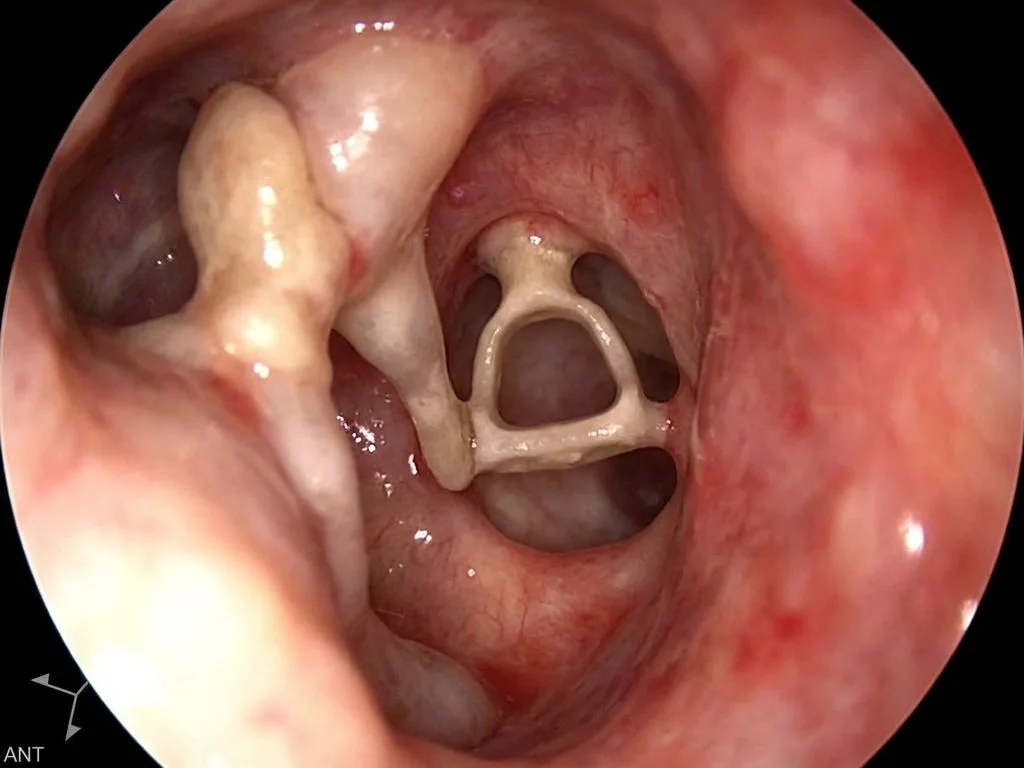
The stapes (stirrup) is the structure depicted in the image. It is the smallest and most medial ossicle of the three ossicles in the middle ear, and indeed the smallest bone in the entire human body. Its highly distinctive stirrup-like shape — comprising a head, neck, anterior crus, posterior crus, and a flat oval footplate — makes it immediately identifiable on anatomical specimens or imaging. The head of the stapes articulates with the lenticular process of the incus via the incudostapedial joint, while the footplate sits in the oval window, sealed by the annular ligament.
The stapes plays a critical role in the ossicular chain by transmitting vibrations received from the incus and converting them into fluid waves in the perilymph of the cochlea via footplate movement at the oval window. The two crura (anterior and posterior) arch from the neck down to the footplate, creating the characteristic open-frame stirrup appearance that distinguishes it from all other ossicles. In Indian ENT practice, stapes pathology — particularly otosclerosis, where the footplate becomes fixed due to abnormal bone remodelling — is a well-recognised cause of progressive conductive hearing loss, managed surgically by stapedectomy or stapedotomy.
Why other options are wrong
- A. Malleus — The malleus (hammer) is the most lateral ossicle, with a long manubrium (handle) embedded in the tympanic membrane and a rounded head articulating with the incus. Its elongated hammer-like morphology is entirely distinct from the stirrup shape of the stapes.
- B. Incus — The incus (anvil) is the middle ossicle with a body and two divergent processes (long and short). Its anvil-like shape with two prominent processes is clearly different from the delicate two-crura-and-footplate architecture of the stapes.
- C. Vomer — The vomer is a flat nasal bone forming the inferior part of the nasal septum. It is located in the nasal cavity, not the middle ear, and has absolutely no role in sound transmission. This is a classic NBE distractor pairing nasal anatomy with middle ear structures to test anatomical precision.