
NEETPGAI
FeaturesBlogComparePricing
Log inStart Free
NEETPGAI

AI-powered NEET PG preparation platform. Master all 19 subjects with adaptive MCQs, AI tutoring, and spaced repetition.

Product

  • Features
  • Subjects
  • Previous Year Questions
  • Compare
  • Pricing
  • Blog

Features

  • Adaptive MCQ Practice
  • AI Tutor
  • Mock Tests
  • Spaced Repetition

Resources

  • Blog
  • Study Guides
  • NEET PG Updates
  • Contact & support

Legal

  • Privacy Policy
  • Terms of Service

Stay updated

© 2026 NEETPGAI. All rights reserved.
    PYQs/2022/Q75
    Verified answer (AI cross-checked + SME reviewed)

    Q75 (2022, Cutaneous Infections) — Correct answer: D. Both bacteria and fungi can be causative.
    NEET PG 2022
    Q75
    hand Dermatology
    Cutaneous Infections
    tier-2 (3/3 verifier agreement)
    Clinical image for NEET PG 2022 Q75

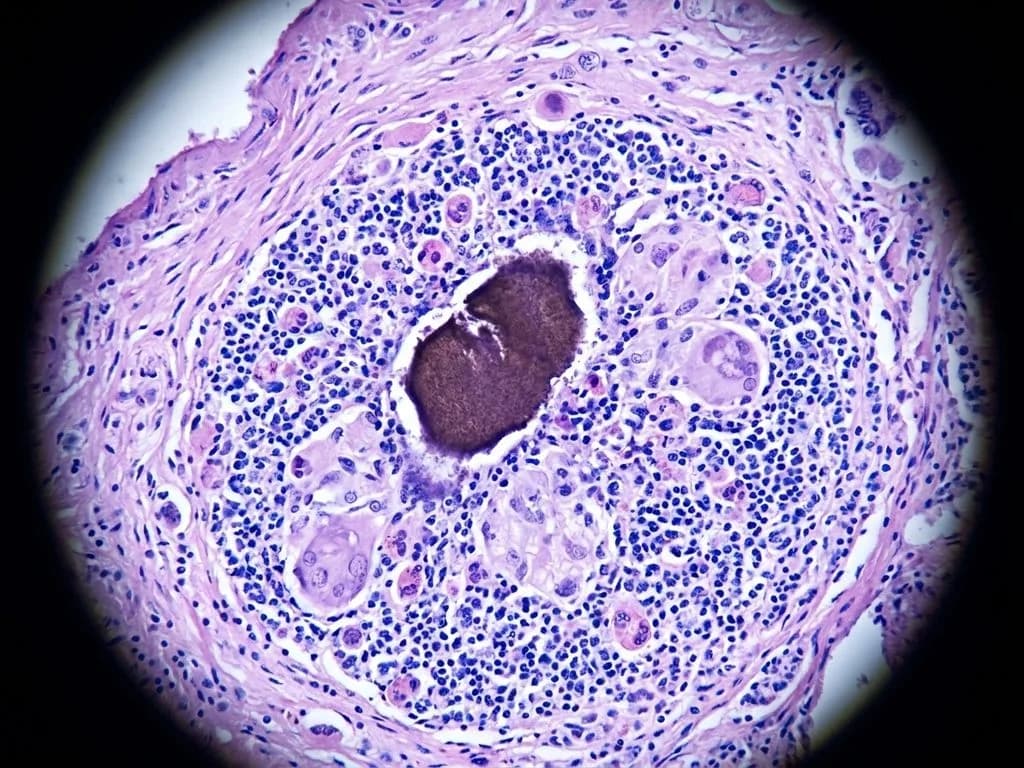
    A farmer presents to you with swelling on foot and multiple discharging sinuses in the lower limb. Granules from the discharge were examined under the microscope, shown below. [image] Which of the following is true regarding this condition? [image]

    A. There is lymphocyte accumulation
    B. Undergoes lymphatic spread
    C. Involves only superficial tissues
    D. Both bacteria and fungi can be causative

    Correct Answer: D. Both bacteria and fungi can be causative

    The clinical presentation of swelling with multiple discharging sinuses and granules in the discharge is pathognomonic for mycetoma (Madura foot). The granules shown microscopically represent the hallmark feature—aggregates of causative organisms embedded in a matrix. Mycetoma is a chronic suppurative infection that can be caused by both bacterial and fungal agents. Bacterial mycetoma (eumycetoma) is caused by Actinomycetes (Nocardia, Streptomyces, Actinomadura), while fungal mycetoma (eumycetoma) is caused by true fungi (Madurella, Aspergillus, Fusarium). In India, particularly in endemic regions (Rajasthan, Gujarat, Tamil Nadu), both forms are prevalent. The granules are the diagnostic hallmark—they are compact colonies of the causative organism surrounded by a host inflammatory response. The presence of granules in discharge is the key discriminating feature that confirms mycetoma and supports the answer that both bacterial and fungal agents can cause this condition. Treatment differs based on the causative agent: bacterial mycetoma responds to antibiotics (sulfonamides, aminoglycosides), while fungal mycetoma requires antifungals or surgical excision, making the distinction clinically important.

    Why the other options are wrong

    A. There is lymphocyte accumulation — While mycetoma does involve chronic inflammation, the hallmark histopathology is suppuration with granule formation, not lymphocyte accumulation. The granules are surrounded by neutrophilic abscesses and fibrosis, not granulomatous inflammation with epithelioid cells and lymphocytes. This is a trap for students confusing mycetoma with tuberculosis or sarcoidosis. B. Undergoes lymphatic spread — Mycetoma is a localized suppurative infection that spreads by direct extension and sinus tract formation, not via lymphatic channels. Lymphatic spread is characteristic of acute bacterial infections like cellulitis or lymphangitis, not the chronic, localized nature of mycetoma. Regional lymph nodes are typically not involved unless secondary bacterial infection occurs. C. Involves only superficial tissues — Mycetoma is a deep tissue infection that characteristically involves subcutaneous tissues, fascia, and can extend to bone (osteomyelitis). The multiple discharging sinuses indicate deep involvement with tract formation. Superficial involvement would suggest impetigo or other surface infections, not the chronic suppurative nature of mycetoma with granule formation.

    High-Yield Facts

    • Mycetoma granules are the diagnostic hallmark—compact colonies of causative organisms visible in discharge, distinguishing it from other chronic infections.
    • Bacterial mycetoma (eumycetoma) is caused by Actinomycetes (Nocardia, Actinomadura); fungal mycetoma is caused by true fungi (Madurella, Aspergillus)—treatment differs (antibiotics vs. antifungals/surgery).
    • Endemic in India: Rajasthan, Gujarat, Tamil Nadu, Madhya Pradesh; highest incidence in males aged 20–40 years working in agriculture.
    • Discharging sinuses with granules in discharge are pathognomonic; granules may be colored (black, yellow, red) depending on causative organism.
    • Deep tissue involvement with extension to bone is characteristic; superficial spread does not occur—direct extension and sinus tract formation are the pattern.

    Mnemonics

    MADURA FOOT = Mycetoma Multiple sinuses, Actinomycetes/fungi, Deep tissue, Underground spread (direct extension), Recurrent discharge, A = Actinomadura/Aspergillus. Use when you see discharging sinuses + granules. GRANULES = Mycetoma Diagnosis Granules in discharge, Recurrent sinuses, Actinomycetes or fungi, Not lymphatic spread, Underground (deep), Localized, Endemic (India), Suppurative. Memory hook for the key features.

    NBE Trap

    NBE pairs mycetoma with "lymphocyte accumulation" to lure students who confuse it with granulomatous diseases (TB, sarcoidosis). The correct pathology is suppurative with neutrophilic abscesses, not granulomatous inflammation. Additionally, "lymphatic spread" is a trap for students who conflate mycetoma with acute bacterial infections.

    Clinical Pearl

    In rural India, a farmer presenting with Madura foot and granules in discharge is a classic presentation. The color of granules (black in Madurella, yellow in Streptomyces) can guide initial therapy while culture results are pending. Early recognition and appropriate antimicrobial therapy (sulfonamides for bacterial, itraconazole for fungal) can prevent amputation, making the distinction between bacterial and fungal causes clinically critical.

    _Reference: Robbins Ch. 9 (Infectious Diseases); Harrison Ch. 211 (Fungal Infections); KD Tripathi Ch. 47 (Antimicrobial Agents)_

    Ask AI Tutor about this question

    Stuck on a distractor? Want a worked-through clinical scenario? The AI Tutor is a NEETPGAI Pro feature — sign up free to practice the full question bank, then unlock the AI Tutor when you're ready.

    Explain this concept in plain language
    Why is each wrong option wrong?
    Give me a clinical scenario where this is tested
    Sign up free Already have an account? Log in

    Free to start, no credit card required. The 3 prompts/day quota is shared with practice + tutor + deep-dive across NEETPGAI.

    Memory-based reconstruction

    NBE does not officially release NEET PG papers per the 2025 Supreme Court directive. This question was reconstructed from 1 community source: PrepLadder NEET PG 2022 Recall PDF. Cross-verified by Claude Haiku 4.5 + Gemini 2.5 Flash + community-aggregate vote, then reviewed by a practising medical SME.

    ← All NEET PG 2022 questionsPractice with AI Tutor →

    Join our NEET PG community

    Daily MCQs, study tips, and topper strategies on Telegram.

    Join on Telegram →