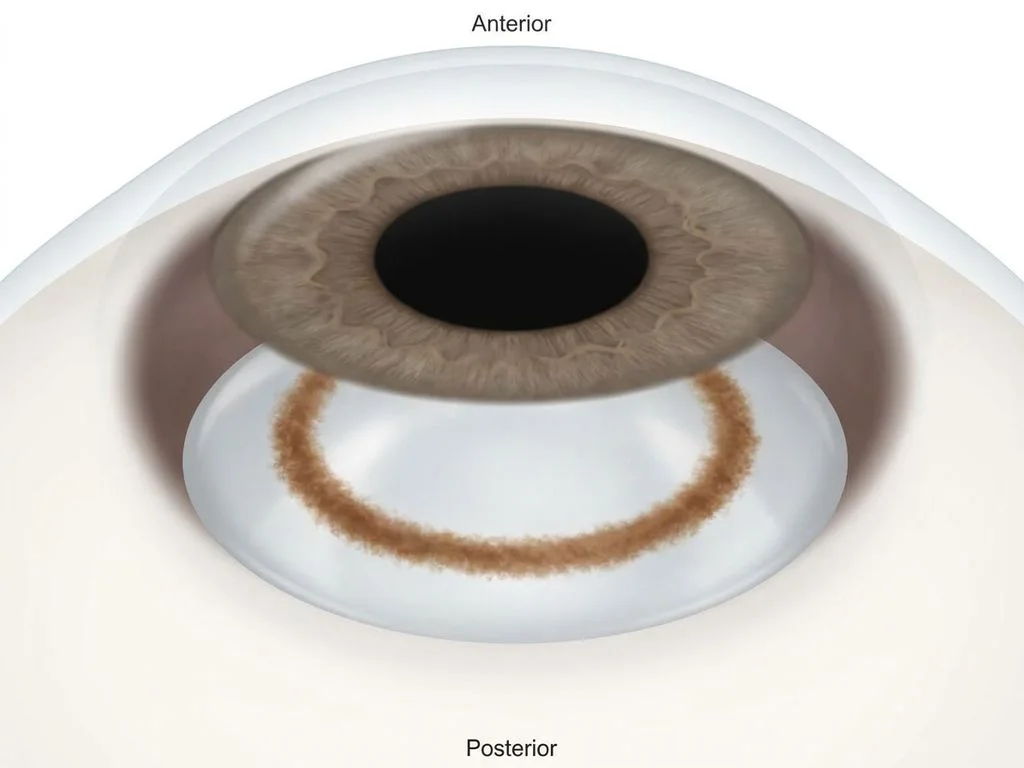
Correct Answer: D. Vossius Ring
A Vossius ring is a classic sign of blunt ocular trauma. When the eye sustains a concussive blow, the iris is forcefully pressed against the anterior lens capsule. The iris pigment epithelium leaves a circular, brownish-golden pigment imprint on the anterior lens surface — this is the Vossius ring. It corresponds in size and shape to the pupillary margin of the iris and is best visualised on slit-lamp examination. Its presence is pathognomonic of prior blunt trauma to the globe, even when the patient's history is unclear or incomplete.
Vossius ring is clinically important in the context of glaucoma because blunt trauma can simultaneously damage the trabecular meshwork (angle recession), leading to angle-recession glaucoma — a secondary open-angle glaucoma that may manifest years after the original injury. Identifying a Vossius ring on slit-lamp should therefore prompt gonioscopy to assess for angle recession and long-term IOP monitoring. The ring itself does not impair vision but serves as a permanent marker of the traumatic event.
Why Other Options Are Wrong
- A. Intraocular foreign body — Presents with a history of high-velocity projectile injury, corneal or scleral entry wound, and foreign material visible on imaging (X-ray, CT, or B-scan ultrasound). It does not produce a discrete pigmented ring on the anterior lens capsule.
- B. Pseudoexfoliation syndrome — Produces white, fluffy fibrillar material on the anterior lens capsule in a characteristic three-zone pattern (central disc → clear intermediate zone → peripheral granular zone). This is entirely different in colour, texture, and aetiology from the brown pigment ring of Vossius. PXF is a chronic systemic fibrillopathy, not a traumatic pigment imprint.
- C. Ocular trauma — While blunt trauma is indeed the cause of a Vossius ring, "ocular trauma" alone is too broad and non-specific to be the diagnosis. The question asks for the specific clinical finding/diagnosis visible in the image, which is the Vossius ring — the pathognomonic sign that identifies the nature and site of the traumatic impact.