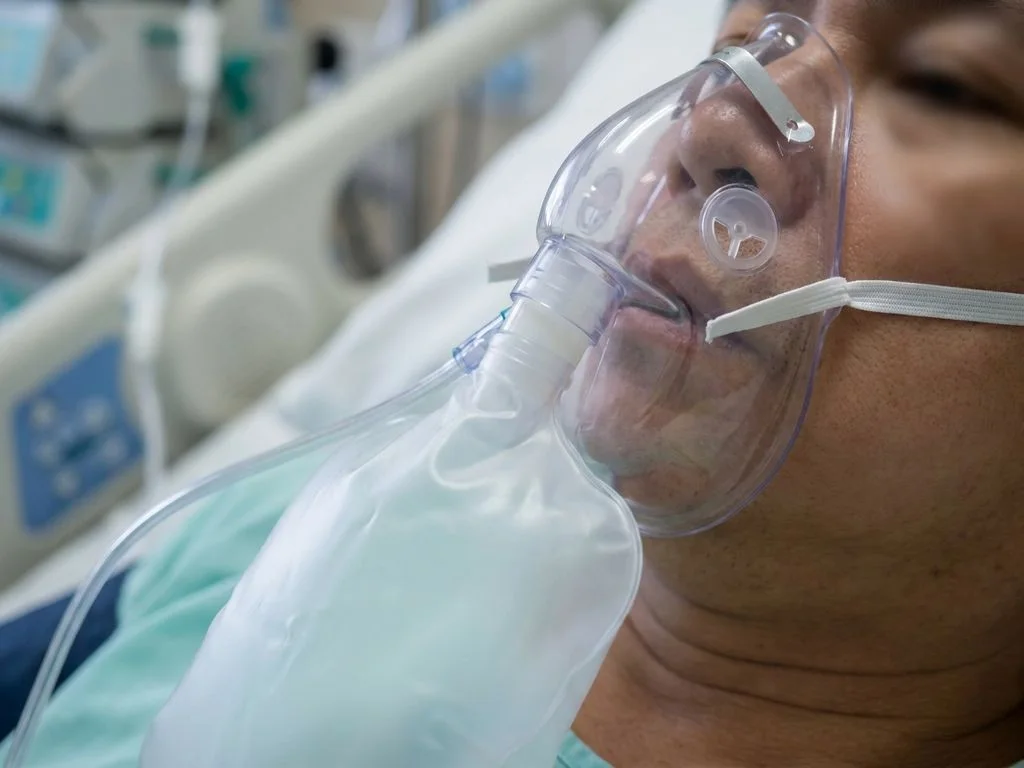
Correct Answer: D. Non-rebreathing mask
The non-rebreathing mask is the gold standard for delivering high-concentration oxygen (80–95% FiO₂) to patients with severe hypoxemia, including those with COVID-19 requiring urgent oxygenation. It consists of a face mask connected to a reservoir bag with one-way valves that prevent rebreathing of exhaled air—critical in pandemic settings where rapid oxygen delivery is essential before intubation. During the COVID-19 surge in Indian ICUs, the non-rebreathing mask became the bridge therapy between nasal cannula and mechanical ventilation, allowing FiO₂ delivery of 60–80% with proper seal and bag inflation. The mask's design ensures that the first third of exhalation fills the reservoir bag (which must remain at least one-third full), while the remaining exhaled air exits through exhalation ports, preventing CO₂ rebreathing. This is distinct from other high-flow devices and is preferred in acute hypoxemic respiratory failure when rapid oxygenation is needed without invasive airway management.
Why the other options are wrong
A. Hudson mask — The Hudson mask (simple face mask) delivers only 40–60% FiO₂ and lacks a reservoir bag or one-way valves. It cannot achieve the high oxygen concentrations required in severe COVID-19 hypoxemia. NBE may trap students who confuse 'mask' terminology; Hudson is suitable only for mild hypoxemia, not acute respiratory distress. B. Nebuliser — A nebuliser is an aerosol delivery device for medications (bronchodilators, steroids), not a primary oxygen delivery system. During COVID-19, nebulisers were actually restricted in many Indian hospitals due to aerosol generation risk. This is a category error—nebulisers supplement oxygen therapy but do not replace it as a standalone oxygenation mask. C. Venturi mask — The Venturi mask delivers precise, moderate FiO₂ (24–50%) via the Bernoulli principle and is used for controlled oxygen therapy in COPD or hypercapnic patients. It cannot deliver the high FiO₂ (80–95%) needed in acute COVID-19 hypoxemia. NBE may trap students who know Venturi is 'precise'—but precision is irrelevant when high-flow oxygen is urgently needed.
High-Yield Facts
- Non-rebreathing mask FiO₂: 60–95% (highest among non-invasive masks); requires 10–15 L/min flow rate.
- Reservoir bag must stay ≥1/3 full during inspiration; if it collapses completely, patient rebreathes CO₂ and mask becomes ineffective.
- One-way valves prevent backflow of exhaled air into the reservoir, distinguishing it from partial-rebreathing masks.
- COVID-19 context: Non-rebreathing was the preferred bridge therapy in Indian ICUs before high-flow nasal cannula (HFNC) or intubation.
- Contraindication: Avoid in patients requiring precise FiO₂ control (e.g., hypercapnic COPD) due to variable delivery.
Mnemonics
NRB = No Rebreathing (High Flow) Non-Rebreathing mask = No Rebreathing + Bag = highest FiO₂ (80–95%), used in acute hypoxemia. Remember: bag must stay inflated, or patient rebreathes. Oxygen Mask Hierarchy (FiO₂ Delivery) Hudson (40–60%) < Venturi (24–50%) < Partial-rebreathing (60–75%) < Non-rebreathing (80–95%). Use this ladder when choosing masks in acute settings.
NBE Trap
NBE may pair "COVID-19 injection" (likely a translation artifact for "COVID-19 infection") with Venturi mask, since Venturi is commonly taught as a "precise" mask. Students may incorrectly choose Venturi thinking precision matters in acute hypoxemia, when in fact high-flow delivery is the priority.
Clinical Pearl
During the 2020–2021 COVID-19 surge in Indian hospitals, non-rebreathing masks were the workhorse for triaging hypoxemic patients—allowing rapid oxygenation in the emergency department and ward before ICU admission. Proper bag inflation checks and flow rate adjustment (10–15 L/min) were critical nursing skills that prevented treatment failure.
_Reference: Harrison Ch. 295 (Respiratory Support); KD Tripathi Ch. 8 (Oxygen Therapy and Respiratory Support)_