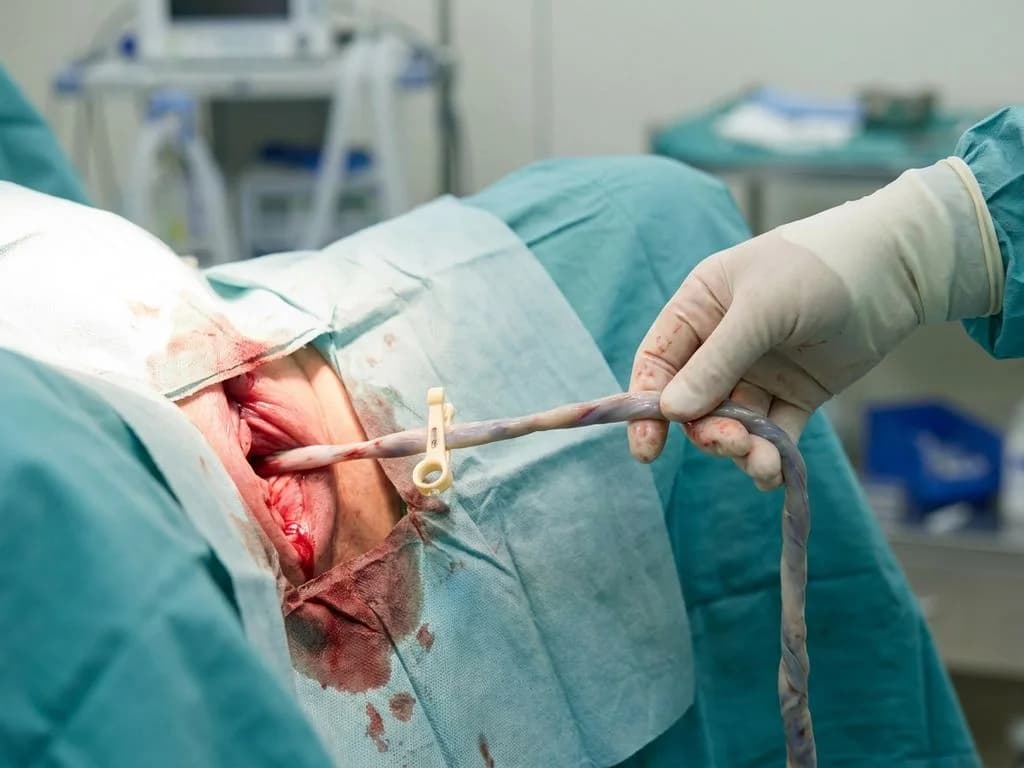
Correct Answer: B. Manual removal of placenta
The image depicts a maneuver (likely fundal pressure or Brandt-Andrews maneuver) performed during the third stage of labour. When incomplete placental separation occurs with massive hemorrhage, this represents a retained placenta with hemorrhage — a true obstetric emergency. Manual removal of placenta (MRPL) is the gold standard management in this scenario because: (1) it immediately controls hemorrhage by allowing direct uterine compression and identification of bleeding vessels, (2) it removes the source of continued bleeding from the placental bed, and (3) it prevents further maternal blood loss and shock. Per Indian guidelines (FOGSI, ICOG) and standard obstetric practice, when placental separation is incomplete and hemorrhage is ongoing, waiting for spontaneous delivery or using conservative methods risks maternal exsanguination. MRPL must be performed under anesthesia (spinal or general) with IV access, cross-matched blood available, and uterotonic support (oxytocin/ergot alkaloids post-removal). This is the standard of care in Indian tertiary centers and aligns with Harrison and Robbins principles of managing life-threatening hemorrhage in obstetrics.
Why the other options are wrong
A. Start oxytocin infusion and wait for spontaneous delivery of placenta — This is wrong because oxytocin alone cannot separate an already-retained placenta; it only aids separation when the placenta is partially separated. Waiting for spontaneous delivery in the setting of massive hemorrhage is dangerous and delays definitive management. This option represents a conservative approach suitable only for minor bleeding without separation failure — a critical NBE trap that confuses management of normal third stage with retained placenta with hemorrhage. C. Arrange for blood and use Crede's method for placental delivery — Crede's method (external fundal pressure) is contraindicated when the placenta is incompletely separated because it risks uterine rupture and placental fragmentation, leading to retained fragments and worsening hemorrhage. While arranging blood is correct, Crede's method is an outdated technique (pre-1980s) and is not recommended in modern Indian obstetric practice. This option tests whether students confuse historical methods with current evidence-based management. D. Uterine massage — Uterine massage is appropriate for atonic postpartum hemorrhage (soft, boggy uterus) but is ineffective and potentially harmful in retained placenta with incomplete separation. Massaging a uterus with an adherent placenta does not aid separation and delays definitive intervention. This option is a distractor that tests understanding of the specific pathophysiology — retained placenta requires mechanical removal, not massage.
High-Yield Facts
- Retained placenta with hemorrhage is an obstetric emergency requiring immediate manual removal under anesthesia, not conservative management.
- MRPL is contraindicated in placenta accreta/increta/percreta (risk of massive hemorrhage, hysterectomy may be needed) — diagnosis must be suspected preoperatively.
- Incomplete placental separation + massive hemorrhage = MRPL; incomplete separation + minor bleeding = wait 30 min with oxytocin, then reassess.
- Brandt-Andrews maneuver (controlled cord traction with fundal support) aids normal placental separation; failure of this maneuver signals retained placenta.
- MRPL technique: hand inserted into uterus, follow cord to placenta, separate by sweeping motion, remove placenta, then oxytocin/ergot to contract uterus and control bleeding.
Mnemonics
MRPL Indications (RHINO) Retained placenta >30 min, Hemorrhage (massive), Incomplete separation, Need for immediate delivery, Other failed conservative measures. Use this when deciding between watchful waiting and MRPL. Third Stage Hemorrhage Management (CRAM) Control (IV access, cross-match), Rub (uterine massage for atony), Agents (oxytocin/ergot), Manual removal (if retained placenta). Sequence guides decision-making.
NBE Trap
NBE pairs "oxytocin + wait" with retained placenta to trap students who conflate normal third-stage management with emergency retained placenta. The key discriminator is massive hemorrhage — this shifts the decision from conservative to surgical immediately.
Clinical Pearl
In Indian tertiary centers, retained placenta with hemorrhage is a leading cause of maternal mortality. Delays in MRPL due to attempting conservative measures (oxytocin, massage, Crede's) have resulted in preventable deaths. The rule: if placenta is not delivered within 30 minutes of cord clamping AND there is significant bleeding, proceed to MRPL immediately — do not wait.
_Reference: DC Dutta's Textbook of Obstetrics (3rd Stage of Labour, Retained Placenta); Harrison Ch. 6 (Obstetric Hemorrhage); FOGSI Guidelines on Management of Third Stage Labour_