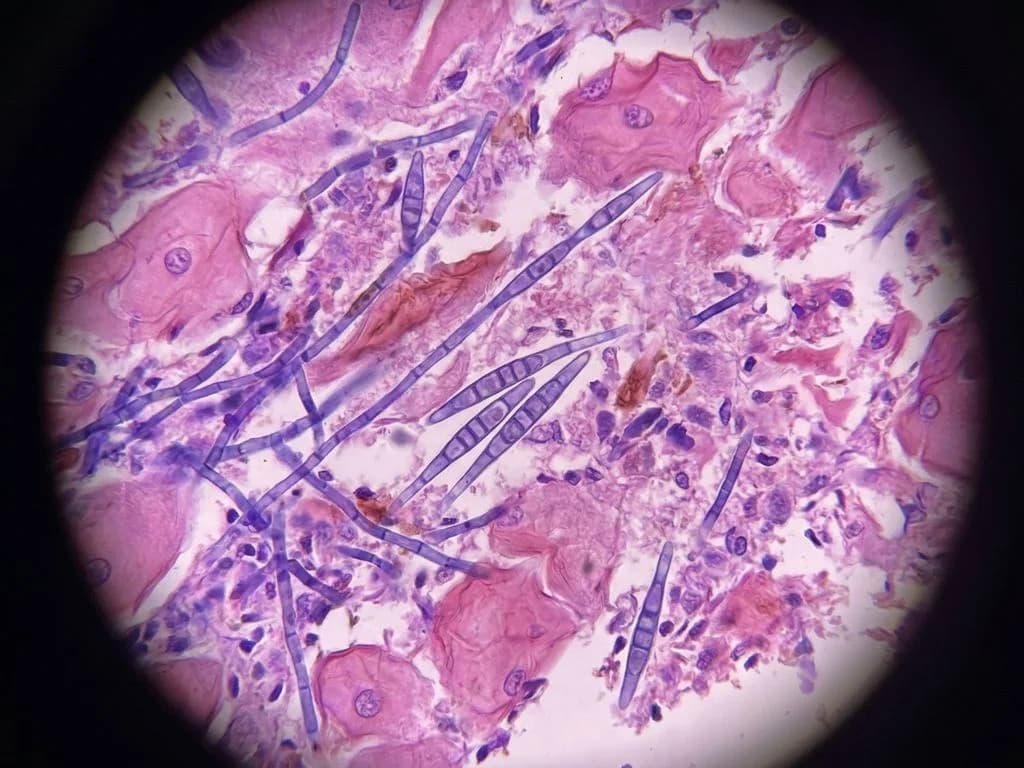
Correct Answer: D. Trichophyton rubrum
Trichophyton rubrum is the most common dermatophyte causing tinea axillaris (axillary ringworm) in India and globally. The key discriminating feature here is the red pigment-producing fungus with pencil-shaped macroconidia. T. rubrum produces a distinctive red/pink pigment on the reverse side of culture media (especially on Sabouraud dextrose agar), which is pathognomonic for this species. The pencil-shaped (or cigar-shaped) macroconidia are characteristic of T. rubrum and are 4–8 cells in length with a distinctive tapered appearance. Microscopically, these macroconidia are sparse and appear as thin, elongated structures. T. rubrum is anthropophilic, causes chronic infections, and is responsible for 70–80% of dermatophyte infections in India. Axillary involvement is common in warm, humid climates and presents as pruritic erythematous patches. The combination of red pigment production and pencil-shaped macroconidia is virtually diagnostic of T. rubrum, making it the gold standard answer for this clinical presentation.
Why the other options are wrong
A. Trichophyton violaceum — T. violaceum produces a violet/purple pigment on the reverse of culture media, not red. Although it is anthropophilic and causes tinea capitis in Indian children, it does not produce pencil-shaped macroconidia; instead, it is typically non-sporulating or produces very few spores. The pigment color is the key discriminator—violet, not red. B. Trichophyton schoenleinii — T. schoenleinii is a non-sporulating anthropophilic dermatophyte that causes favus (tinea favosa), a chronic scalp infection endemic in parts of India. It does not produce macroconidia and does not produce red pigment. It is characterized by scutula formation on the scalp, not axillary involvement with pigmented spores. C. Trichophyton tonsurans — T. tonsurans is a common cause of tinea capitis in North America but is rare in India. It produces buff-colored to tan pigment, not red, and its macroconidia are club-shaped or comma-shaped, not pencil-shaped. Although it can cause body ringworm, the pigment and spore morphology do not match the clinical description.
High-Yield Facts
- T. rubrum red pigment on reverse of Sabouraud dextrose agar is pathognomonic and appears within 2–4 weeks of culture.
- Pencil-shaped (cigar-shaped) macroconidia of T. rubrum are 4–8 cells, sparse, and tapered at both ends—diagnostic on microscopy.
- T. rubrum causes 70–80% of dermatophyte infections in India; anthropophilic, chronic, and affects skin, nails, and hair.
- Tinea axillaris presents as pruritic erythematous patches in inframammary and axillary folds; warm, humid climate is a risk factor.
- T. violaceum (violet pigment), T. schoenleinii (non-sporulating, favus), and T. tonsurans (buff pigment, comma-shaped spores) are key differentials.
Mnemonics
RED = RUBRUM Red pigment on reverse of culture = T. RUBrum. Violet = Violaceum; Buff/Tan = Tonsurans. Use this color-coding to rapidly identify dermatophytes on culture. PENCIL = RUBRUM Pencil-shaped macroconidia = T. Rubrum. Club-shaped = Tonsurans; Non-sporulating = Schoenleinii. Spore morphology is the fastest microscopic discriminator.
NBE Trap
NBE pairs "red pigment" with "anthropophilic dermatophyte" to lure students into choosing T. violaceum (which is also anthropophilic but produces violet, not red, pigment). The trap is conflating pigment color with epidemiology—students must recognize that red pigment + pencil-shaped spores = T. rubrum, not violet pigment.
Clinical Pearl
In Indian dermatology practice, T. rubrum is the "default" dermatophyte—if you see a pruritic axillary or intertriginous lesion with no other clues, T. rubrum is statistically the most likely culprit. The red pigment on culture is so characteristic that many labs use it as a rapid screening tool before sending samples for further identification.
_Reference: Jawetz Melnick & Adelberg's Medical Microbiology Ch. 44 (Dermatophytes); Robbins Pathologic Basis of Disease Ch. 25 (Fungal Infections)_