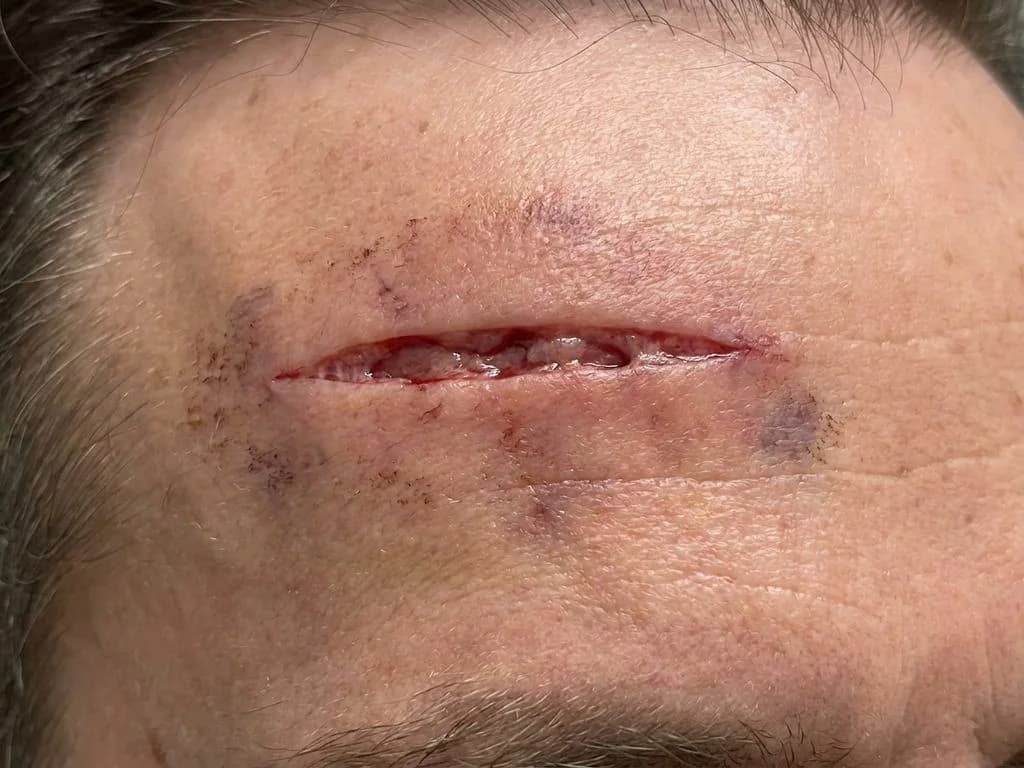
Correct Answer: B. Incised looking laceration
An incised-looking laceration is a laceration (tear) that mimics the appearance of an incised wound due to the direction and mechanism of the blunt force trauma. The key discriminator is the underlying mechanism: lacerations result from blunt force trauma that splits tissue along natural planes of cleavage, yet when the force is applied in a direction parallel to skin tension lines (Langer's lines), the resulting wound edges appear sharp and clean—resembling an incised wound. However, histologically and forensically, the presence of tissue bridging in the wound depths, bruising of wound margins, and irregular deeper layers confirm it is a laceration. This distinction is critical in Indian medico-legal practice: a laceration-looking incised wound suggests a sharp instrument applied with force, whereas an incised-looking laceration indicates blunt trauma applied along favorable anatomical planes. The wound in this image shows clean, sharp-appearing edges (mimicking an incised wound) but with the underlying tissue damage pattern characteristic of blunt force trauma—the hallmark of an incised-looking laceration. Recognition of this distinction is essential for accurate injury reconstruction and establishing the weapon/mechanism in criminal investigations.
Why the other options are wrong
A. Incise wound — An incised wound is produced by a sharp instrument (knife, blade, glass) with clean, regular edges and no tissue bridging in the depths. The image shows blunt force trauma characteristics—bruising, tissue irregularity at depth, and evidence of splitting along tissue planes—which are absent in true incised wounds. This is a pure sharp-instrument injury, not what the image demonstrates. C. Laceration-looking incised wound — This describes a sharp-instrument wound that appears irregular or ragged due to the angle of application or tissue resistance. However, the image shows a wound with sharp, clean edges—the opposite presentation. A laceration-looking incised wound would have irregular, jagged margins with tissue bridging, which contradicts the clean appearance seen here. D. Laceration — A pure laceration from blunt force typically shows irregular, jagged, bruised edges with obvious tissue bridging and crushing. The image displays clean, sharp-appearing edges that would not be characteristic of a typical laceration. The term 'incised-looking' is the critical qualifier that distinguishes this from a simple laceration.
High-Yield Facts
- Incised-looking laceration = blunt force trauma applied parallel to Langer's lines, producing sharp-edged appearance but with blunt-force tissue damage at depth.
- Tissue bridging in wound depths = hallmark of laceration (blunt trauma), absent in true incised wounds (sharp instrument).
- Langer's lines (skin tension lines) determine wound edge appearance: parallel application → clean edges; perpendicular application → irregular, jagged edges.
- Medico-legal distinction: incised-looking laceration suggests blunt object (hammer, fist, fall) applied favorably; laceration-looking incised wound suggests sharp instrument applied at unfavorable angle.
- Bruising of wound margins = present in lacerations and blunt trauma; absent in incised wounds from sharp instruments.
Mnemonics
SHARP vs BLUNT Edge Memory SHARP = Clean edges, no bridging, no bruising (incised wound). BLUNT = Bruised edges, tissue bridging, irregular depths (laceration). BLUNT-PARALLEL = Clean edges + bruised depths = incised-looking laceration. Langer's Line Rule Wound parallel to Langer's lines → sharp appearance (even if blunt force). Wound perpendicular to Langer's lines → jagged appearance (even if sharp instrument). Always check depth and margins together.
NBE Trap
NBE pairs sharp-appearing edges with "incised wound" to trap students who rely only on surface appearance. The trap is ignoring the underlying tissue damage pattern (bruising, tissue bridging) that reveals the true blunt-force mechanism. Students must examine wound depth and margins, not just the surface.
Clinical Pearl
In Indian medico-legal autopsies and injury assessments, distinguishing incised-looking lacerations from true incised wounds is critical for weapon identification and criminal reconstruction. A fall victim with a head wound showing clean edges but bruised depths suggests blunt trauma (fall), not assault with a sharp weapon—a distinction that can alter the entire legal narrative in courts.
_Reference: Robbins & Cotran Pathologic Basis of Disease (Forensic Pathology section); Reddy's Forensic Medicine & Toxicology Ch. 5 (Wounds & Injuries)_