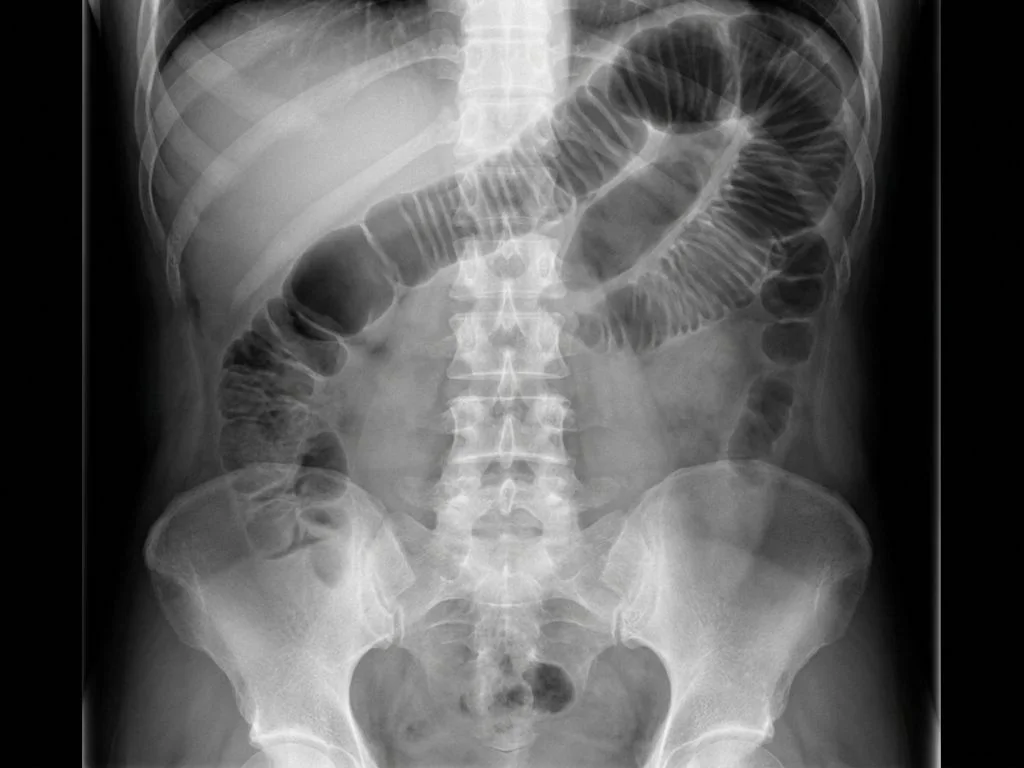
Correct Answer: C. Jejunum
The jejunum is identified on plain abdominal X-ray by the characteristic "valvulae conniventes" (plicae circulares) — complete, tall, closely-spaced mucosal folds that extend across the entire width of the bowel lumen. These are the hallmark radiological sign of jejunal loops. In contrast to the ileum, jejunal folds are taller, more numerous, and more regularly spaced, creating a "feathery" or "ladder-like" appearance on barium studies. The jejunum also has a larger caliber (typically 3–4 cm) compared to the ileum (2–3 cm). On plain films showing dilated small bowel, the presence of prominent, complete transverse striations spanning the full bowel width is pathognomonic for jejunum. This distinction is clinically important in India where small bowel obstruction (SBO) from adhesions, hernias, and volvulus are common presentations in emergency departments. The jejunum occupies the left upper abdomen and comprises approximately 40% of small bowel length, making it a frequent site of obstruction. Recognition of jejunal involvement helps localize the pathology and guides surgical planning in cases requiring intervention.
Why the other options are wrong
A. Transverse colon — The transverse colon is a large bowel structure with a haustra (sacculations) and taeniae coli visible on X-ray — not the fine, complete valvulae conniventes seen here. Colonic loops are wider (>5 cm) and lack the characteristic ladder-like striations of small bowel. The location and mucosal pattern are distinctly different from jejunum. B. Ileum — While the ileum is also small bowel, it has incomplete, shorter, and more widely-spaced plicae that do not span the entire bowel width — creating a 'sparse' appearance. Ileal loops are narrower (2–3 cm) and located in the right lower abdomen and pelvis. The dense, complete transverse folds visible here are characteristic of jejunum, not ileum. D. Duodenum — The duodenum is retroperitoneal and rarely dilates uniformly on plain films; it is typically seen as a small, fixed C-shaped loop in the right upper quadrant. Duodenal obstruction presents differently (proximal gastric dilation with minimal distal bowel gas). The extensive, regular valvulae conniventes pattern shown here is not characteristic of duodenal pathology.
High-Yield Facts
- Valvulae conniventes (plicae circulares) are complete, tall, closely-spaced mucosal folds that span the entire jejunal lumen width — the pathognomonic radiological sign of jejunum on plain X-ray.
- Jejunal caliber is typically 3–4 cm (larger than ileum 2–3 cm); jejunum occupies the left upper abdomen and comprises ~40% of small bowel length.
- Ileal plicae are incomplete, shorter, and widely-spaced, not crossing the full bowel width — creating a sparse 'string of pearls' appearance, distinguishing it from jejunum.
- Small bowel obstruction (SBO) is a common surgical emergency in India; adhesions, hernias, and volvulus are leading causes; jejunal involvement requires early surgical evaluation.
- Barium studies show jejunum with a 'feathery' or 'ladder-like' pattern due to prominent valvulae; ileum appears 'sparse' or 'string-like' — key differentiating radiological signs.
Mnemonics
JEJ = Jumbled, Entire, Joined (folds) Jumbled (dense folds), Entire width (complete plicae), Joined closely (tall, regular) — helps recall that jejunal folds are complete, tall, and closely-spaced across the entire bowel width, unlike ileal folds which are incomplete and sparse. JILEUM mnemonic Jejunum = Jammed (with folds), Ileum = Incomplete (folds). Quick recall: jejunal folds are packed and complete; ileal folds are incomplete and scattered.
NBE Trap
NBE may pair dilated small bowel loops with "ileum" because both are small bowel; however, the radiological hallmark of complete, tall valvulae conniventes spanning the entire lumen width is specific to jejunum, not ileum. Students who rely on location alone (ileum = right lower abdomen) rather than mucosal pattern may fall into this trap.
Clinical Pearl
In Indian emergency departments, a patient presenting with acute abdominal pain and distension with plain X-ray showing the characteristic "ladder-like" or "feathery" pattern of dilated jejunal loops suggests proximal small bowel obstruction — often from adhesions post-laparotomy or incarcerated hernia — requiring urgent surgical consultation and fluid resuscitation before definitive intervention.
_Reference: Robbins Ch. 17 (Small Intestine); Bailey & Love Ch. 68 (Small Intestine Obstruction); Harrison Ch. 287 (Gastrointestinal Imaging)_