
NEETPGAI
FeaturesBlogComparePricing
Log inStart Free
NEETPGAI

AI-powered NEET PG preparation platform. Master all 19 subjects with adaptive MCQs, AI tutoring, and spaced repetition.

Product

  • Features
  • Subjects
  • Previous Year Questions
  • Compare
  • Pricing
  • Blog

Features

  • Adaptive MCQ Practice
  • AI Tutor
  • Mock Tests
  • Spaced Repetition

Resources

  • Blog
  • Study Guides
  • NEET PG Updates
  • Contact & support

Legal

  • Privacy Policy
  • Terms of Service

Stay updated

© 2026 NEETPGAI. All rights reserved.
    PYQs/2021/Q182
    Verified answer (AI cross-checked + SME reviewed)

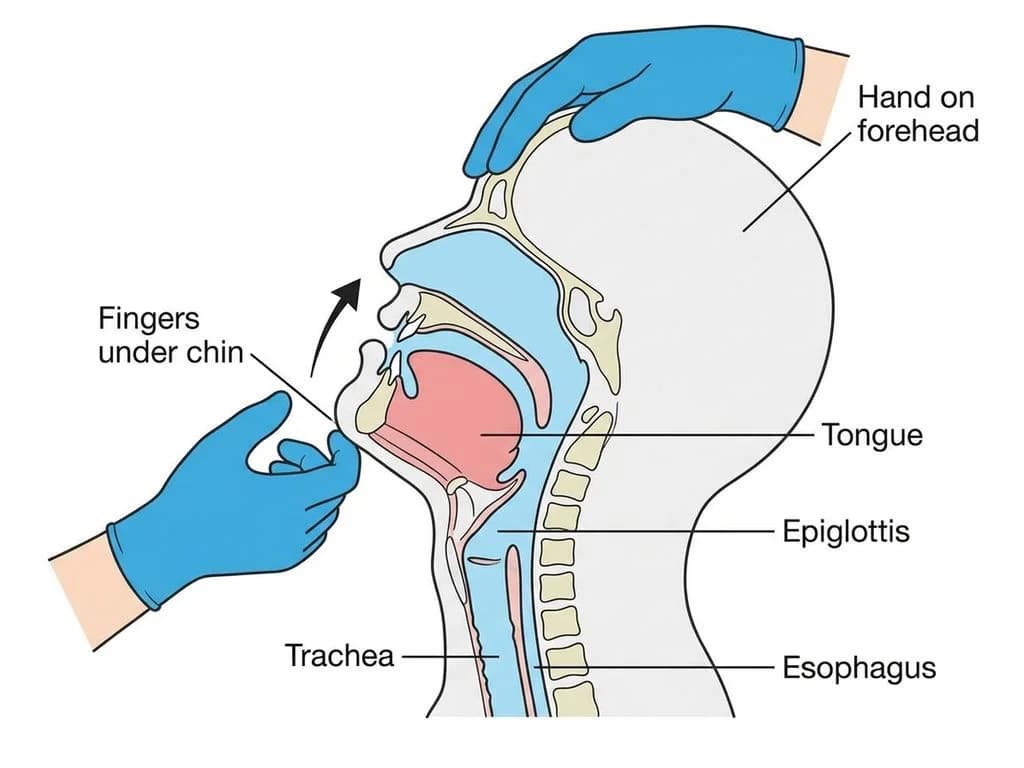
    Q182 (2021, Oxygen Therapy and Airway) — Correct answer: C. Head tilt, chin lift.
    NEET PG 2021
    Q182
    syringe Anesthesia
    Oxygen Therapy and Airway
    tier-3 (2/3 verifier agreement)
    Clinical image for NEET PG 2021 Q182

    What is the maneuver being performed in the given image? La d

    A. Jaw thrust
    B. In line manual stabilisation
    C. Head tilt, chin lift
    D. Head extension

    Correct Answer: C. Head tilt, chin lift

    The head tilt, chin lift maneuver is the primary technique for opening an obstructed airway in an unconscious patient without suspected cervical spine injury. The maneuver involves tilting the head backward (extension at the atlantoaxial joint) while simultaneously lifting the mandible upward via the chin, which displaces the tongue and soft palate anteriorly and away from the posterior pharyngeal wall. This relieves airway obstruction caused by posterior displacement of the tongue—the most common cause of airway obstruction in unconscious patients. The maneuver is simple, requires no equipment, and is the first-line technique taught in Basic Life Support (BLS) and Advanced Cardiac Life Support (ACLS) protocols in India. It is contraindicated only when cervical spine injury is suspected, in which case jaw thrust is preferred. The head tilt, chin lift is effective in approximately 80% of cases of tongue-related obstruction and is universally recommended by Indian guidelines (RNTCP, IAP) and international protocols (AHA, ILCOR) for initial airway management in the pre-hospital and emergency department setting.

    Why the other options are wrong

    A. Jaw thrust — Jaw thrust is the alternative maneuver for suspected cervical spine injury, not the primary technique for routine airway opening. While it also displaces the mandible forward to relieve tongue obstruction, it requires more skill, is more tiring to perform, and is reserved for trauma patients with potential C-spine injury. The image shows a non-trauma scenario with simple airway opening, making head tilt, chin lift the correct choice. B. In line manual stabilisation — In-line manual stabilization is a C-spine protection technique used during intubation in trauma patients, not an airway opening maneuver. It involves stabilizing the head and neck in neutral position to prevent further injury. This is a supplementary technique applied during intubation, not a primary method for opening an obstructed airway in a non-trauma patient. D. Head extension — Head extension alone, without chin lift, is incomplete and ineffective for airway opening. While head tilt involves extension at the atlantoaxial joint, the critical component is the simultaneous upward lift of the mandible (chin lift), which actively displaces the tongue. Extension alone does not reliably relieve tongue obstruction and is not recognized as a standalone airway maneuver in BLS/ACLS protocols.

    High-Yield Facts

    • Head tilt, chin lift is the first-line airway opening maneuver in unconscious non-trauma patients; effective in ~80% of tongue-related obstructions.
    • The maneuver works by anterior displacement of the tongue and soft palate away from the posterior pharyngeal wall via combined head extension and mandibular lift.
    • Contraindicated in suspected cervical spine injury; jaw thrust is the alternative in trauma patients.
    • No equipment required; taught in all BLS/ACLS courses in India and forms the foundation of emergency airway management.
    • Posterior tongue displacement is the most common cause of airway obstruction in unconscious patients; head tilt, chin lift directly addresses this.

    Mnemonics

    HCL = Head tilt, Chin Lift Head tilt (backward extension) + Chin Lift (upward mandibular displacement) = Opens airway. Use in non-trauma; switch to Jaw Thrust if C-spine injury suspected. TILT-LIFT Rule TILT the head back, LIFT the chin up → Tongue moves forward → Airway opens. Two-step action = two-part name.

    NBE Trap

    NBE may pair "head extension" as a distractor to test whether students understand that extension alone is insufficient—the chin lift component is equally critical. Students who focus only on the head movement (extension) rather than the combined maneuver may incorrectly choose option D.

    Clinical Pearl

    In Indian emergency departments and pre-hospital settings, head tilt, chin lift is the go-to first maneuver for any unconscious patient without trauma history—it requires no equipment, takes 2 seconds, and often resolves snoring/gurgling airway obstruction immediately. Failure to open the airway with this maneuver should prompt consideration of foreign body, aspiration, or need for jaw thrust (if C-spine injury suspected).

    _Reference: Guyton & Hall Textbook of Medical Physiology (Respiratory Physiology chapter); Harrison's Principles of Internal Medicine Ch. 295 (Cardiopulmonary Resuscitation); Indian BLS/ACLS Guidelines (Indian Red Cross Society)_

    Ask AI Tutor about this question

    Stuck on a distractor? Want a worked-through clinical scenario? The AI Tutor is a NEETPGAI Pro feature — sign up free to practice the full question bank, then unlock the AI Tutor when you're ready.

    Explain this concept in plain language
    Why is each wrong option wrong?
    Give me a clinical scenario where this is tested
    Sign up free
    Memory-based reconstruction

    NBE does not officially release NEET PG papers per the 2025 Supreme Court directive. This question was reconstructed from 1 community source: PrepLadder NEET PG 2021 Recall PDF. Cross-verified by Claude Haiku 4.5 + Gemini 2.5 Flash + community-aggregate vote, then reviewed by a practising medical SME.

    ← All NEET PG 2021 questionsPractice with AI Tutor →
    Already have an account? Log in

    Free to start, no credit card required. The 3 prompts/day quota is shared with practice + tutor + deep-dive across NEETPGAI.