
NEETPGAI
FeaturesBlogComparePricing
Log inStart Free
NEETPGAI

AI-powered NEET PG preparation platform. Master all 19 subjects with adaptive MCQs, AI tutoring, and spaced repetition.

Product

  • Features
  • Subjects
  • Previous Year Questions
  • Compare
  • Pricing
  • Blog

Features

  • Adaptive MCQ Practice
  • AI Tutor
  • Mock Tests
  • Spaced Repetition

Resources

  • Blog
  • Study Guides
  • NEET PG Updates
  • Contact & support

Legal

  • Privacy Policy
  • Terms of Service

Stay updated

© 2026 NEETPGAI. All rights reserved.
    PYQs/2021/Q168
    Verified answer (AI cross-checked + SME reviewed)

    Q168 (2021, Parasitology) — Correct answer: D. Strongylodies stercoralis.
    NEET PG 2021
    Q168
    bug Microbiology
    Parasitology
    tier-2 (3/3 verifier agreement)
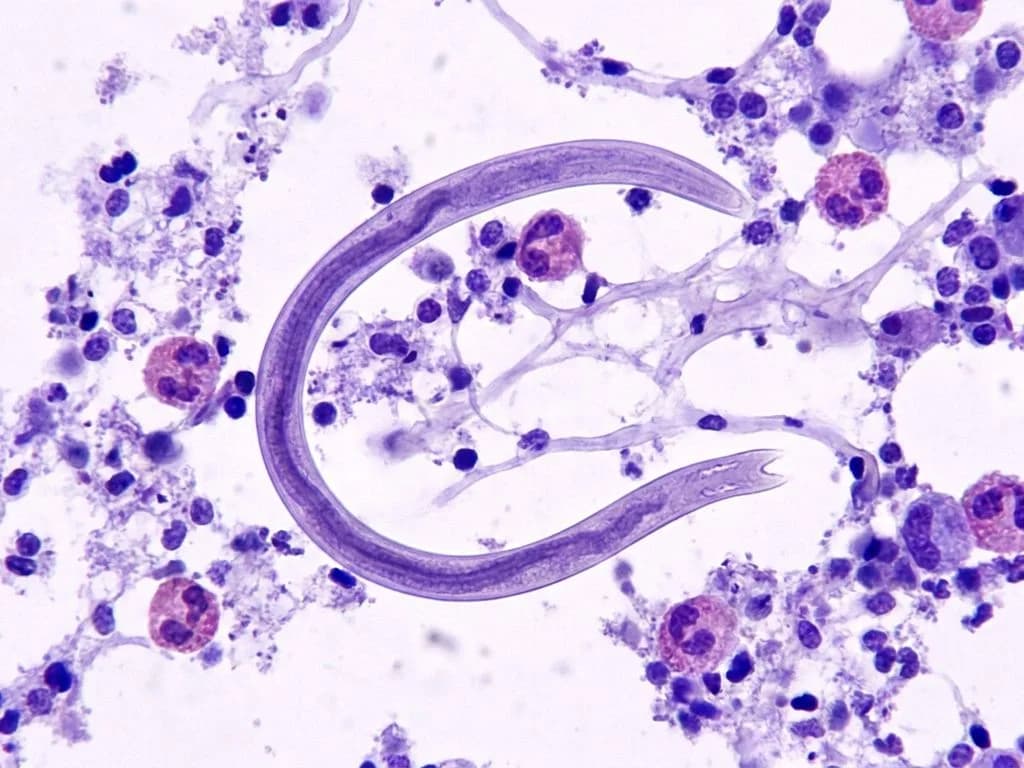
    Clinical image for NEET PG 2021 Q168

    A patient who was on steroids for the treatment of chronic urticaria presents to the emergency department with acute worsening of respiratory symptoms. He says that he has been having a nocturnal cough for the last several weeks. A hemogram revealed elevated eosinophils. Bronchoalveolar lavage (BAL) specimen following bronchoscopy showed the presence of certain larvae as shown in the image below. Identify the causative organism.

    A. Enterobius vermicularis
    B. Capillaria philippinensis
    C. Ancylostoma caninum
    D. Strongylodies stercoralis

    Correct Answer: D. Strongylodies stercoralis

    Strongyloides stercoralis is the only nematode capable of autoinfection and hyperinfection, making it uniquely dangerous in immunocompromised hosts (including chronic steroid users). The clinical presentation—nocturnal cough, elevated eosinophils, and larvae in BAL—is pathognomonic for pulmonary strongyloidiasis during hyperinfection syndrome. In steroid-treated patients, the parasite's ability to complete its entire life cycle within the host (internal autoinfection) leads to exponential larval multiplication, overwhelming the lungs and other organs. The filariform larvae (shown in BAL) are the infective stage that penetrate the respiratory epithelium. Strongyloides is endemic in tropical regions including India (particularly southern states), and chronic steroid use is a well-recognized trigger for hyperinfection. The combination of steroid-induced immunosuppression + nocturnal cough + eosinophilia + larvae in BAL is diagnostic. Unlike other helminths, Strongyloides can persist for decades in the host and reactivate explosively when immunity wanes—a critical distinction that makes this the only organism fitting the acute worsening pattern in a steroid-dependent patient.

    Why the other options are wrong

    A. Enterobius vermicularis — Enterobius (pinworm) causes perianal itching and is transmitted via fecal-oral route; it does NOT cause pulmonary disease, eosinophilia, or appear in BAL. It is non-invasive and remains in the colon. NBE trap: students may confuse any helminth with respiratory symptoms, but Enterobius is strictly intestinal. B. Capillaria philippinensis — Capillaria causes intestinal capillariasis (endemic in Southeast Asia, rare in India) with severe diarrhea and malabsorption, NOT pulmonary disease. It does not undergo autoinfection or hyperinfection in immunocompromised hosts. Larvae would not be found in BAL; diagnosis is by stool examination. C. Ancylostoma caninum — Ancylostoma (hookworm) causes cutaneous larva migrans and intestinal disease with anemia and protein loss, NOT acute pulmonary hyperinfection. While it can cause eosinophilia, it does NOT undergo autoinfection or reactivate explosively in steroid-treated patients. Larvae in BAL would be extremely rare and atypical.

    High-Yield Facts

    • Autoinfection and hyperinfection are unique to Strongyloides stercoralis—filariform larvae penetrate intestinal mucosa and can re-infect the host internally, leading to exponential multiplication in immunosuppressed states.
    • Steroid-induced hyperinfection syndrome in Strongyloides presents with acute respiratory symptoms, eosinophilia, and larvae in BAL; mortality can exceed 50% if untreated.
    • Nocturnal cough with eosinophilia and larvae in respiratory secretions is classic for pulmonary strongyloidiasis during hyperinfection.
    • Strongyloides is endemic in India (southern states, tropical regions) and should be screened for before starting long-term steroids in at-risk populations.
    • Ivermectin is the DOC for Strongyloides hyperinfection (200 µg/kg daily for 1–2 weeks); albendazole is alternative but less effective in hyperinfection.
    • Eosinophilia + larvae in BAL in a steroid-treated patient is pathognomonic for Strongyloides until proven otherwise—other helminths do not cause this combination.

    Mnemonics

    STRONG = Steroid-triggered hyperinfection Steroid use → Triggers hyperinfection → Respiratory symptoms (nocturnal cough) → Overwhelmingly high eosinophils → Nematode in BAL → Giant larval burden. Use when you see steroids + acute respiratory worsening + eosinophilia. AUTO-HYPER rule AUTOinfection + HYPERinfection = only Strongyloides. No other helminth reactivates explosively in immunosuppressed hosts. When you see 'steroid patient + acute worsening,' think Strongyloides first.

    NBE Trap

    NBE pairs "chronic steroid use" with "eosinophilia" to lure students toward common helminths (hookworm, Ascaris) that cause eosinophilia but NOT hyperinfection or pulmonary disease. The key discriminator is the acute worsening in a steroid-treated patient—only Strongyloides reactivates explosively under immunosuppression.

    Clinical Pearl

    In Indian clinical practice, Strongyloides screening (serology or stool examination) is now recommended before initiating long-term steroids in patients from endemic areas (southern India, tribal regions). A single case of missed Strongyloides hyperinfection in a steroid-dependent patient can be fatal—making pre-steroid screening a life-saving intervention in endemic populations.

    _Reference: Jawetz, Melnick & Adelberg's Medical Microbiology (Ch. Nematodes); Robbins & Cotran Pathologic Basis of Disease (Ch. Infectious Diseases); Harrison's Principles of Internal Medicine (Ch. 219: Helminthic Infections)_

    Ask AI Tutor about this question

    Stuck on a distractor? Want a worked-through clinical scenario? The AI Tutor is a NEETPGAI Pro feature — sign up free to practice the full question bank, then unlock the AI Tutor when you're ready.

    Explain this concept in plain language
    Why is each wrong option wrong?
    Give me a clinical scenario where this is tested
    Sign up free Already have an account? Log in

    Free to start, no credit card required. The 3 prompts/day quota is shared with practice + tutor + deep-dive across NEETPGAI.

    Memory-based reconstruction

    NBE does not officially release NEET PG papers per the 2025 Supreme Court directive. This question was reconstructed from 1 community source: PrepLadder NEET PG 2021 Recall PDF. Cross-verified by Claude Haiku 4.5 + Gemini 2.5 Flash + community-aggregate vote, then reviewed by a practising medical SME.

    ← All NEET PG 2021 questionsPractice with AI Tutor →

    Join our NEET PG community

    Daily MCQs, study tips, and topper strategies on Telegram.

    Join on Telegram →