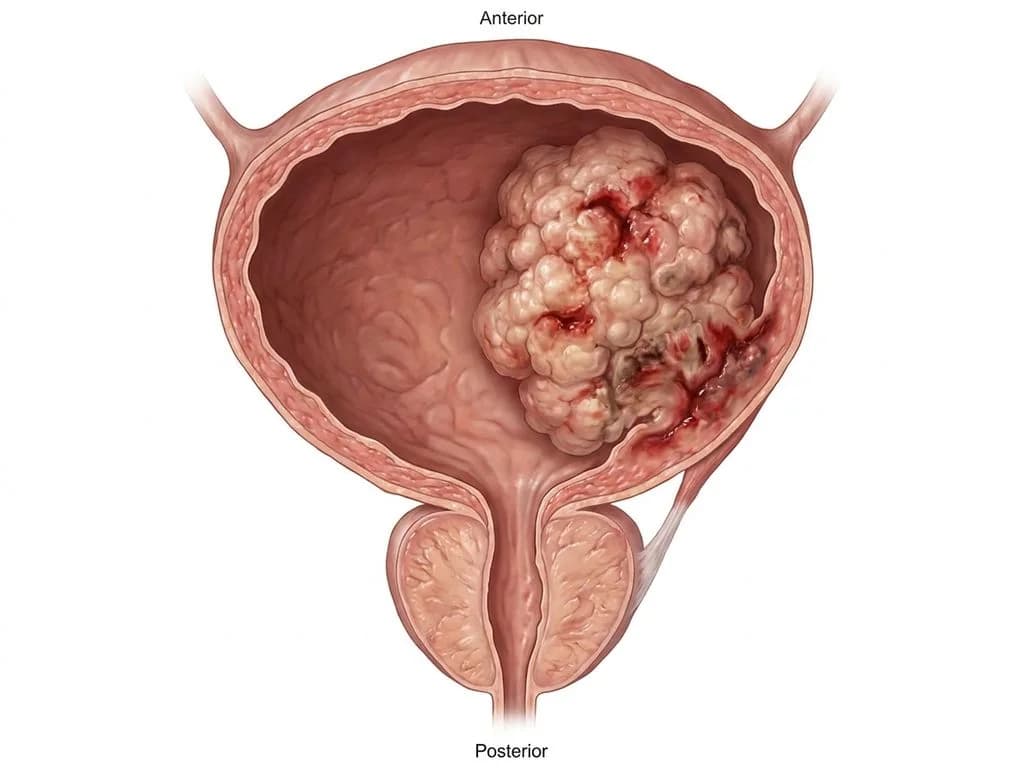
Correct Answer: C. Bladder carcinoma
Cystoprostatectomy is the en bloc surgical removal of the bladder, prostate, and seminal vesicles—a procedure performed exclusively for invasive bladder carcinoma that has breached the muscularis propria (≥T2 stage). The gross specimen in this case would show a firm, infiltrative mass within the bladder wall with possible areas of necrosis, ulceration, or hemorrhage characteristic of urothelial carcinoma. The procedure is the gold standard for muscle-invasive bladder cancer in India and globally, as it provides complete oncologic resection with adequate margins. The specimen would demonstrate transmural invasion, distinguishing it from superficial lesions (Ta, T1) that are managed endoscopically. Histologically, urothelial carcinoma (transitional cell carcinoma) is the most common type (>90% of cases in India), though squamous cell and adenocarcinoma variants occur. The presence of a specimen large enough to warrant en bloc resection of adjacent organs indicates advanced local disease—the defining indication for this radical procedure. No other condition listed would necessitate cystoprostatectomy as a standard surgical approach.
Why the other options are wrong
A. Malakoplakia — Malakoplakia is a benign chronic inflammatory condition of the bladder caused by defective macrophage function, typically presenting with nodular mucosal lesions and Michaelis-Gutmann bodies on histology. It is managed conservatively with antibiotics and bladder instillations, never requiring cystoprostatectomy. This is a trap for students confusing inflammatory bladder conditions with malignancy. B. Schistosomiasis — Schistosomiasis haematobium causes chronic irritation leading to squamous metaplasia and increased risk of squamous cell carcinoma of the bladder, but the condition itself is not an indication for cystoprostatectomy. Management involves anthelmintic therapy and surveillance. The specimen would show parasitic eggs and chronic inflammation, not the invasive malignant mass requiring radical surgery. D. Prostate carcinoma — While prostate carcinoma may coexist with bladder cancer, isolated prostate cancer is managed by radical prostatectomy alone (with or without pelvic lymph node dissection), not cystoprostatectomy. Cystoprostatectomy is performed when the primary pathology is invasive bladder cancer requiring en bloc resection of adjacent organs. The specimen would be predominantly bladder-centered, not prostate-centered.
High-Yield Facts
- Cystoprostatectomy is indicated for muscle-invasive bladder cancer (≥T2 stage) with curative intent in fit patients.
- Urothelial carcinoma (transitional cell carcinoma) accounts for >90% of bladder cancers in India; squamous cell and adenocarcinoma are less common.
- Gross specimen shows firm, infiltrative mass with transmural invasion, often with areas of necrosis, ulceration, or hemorrhage.
- Schistosomiasis haematobium increases risk of squamous cell carcinoma but does not itself require cystoprostatectomy; managed with anthelmintics.
- Malakoplakia is a benign inflammatory condition managed medically; never requires cystoprostatectomy despite bladder involvement.
Mnemonics
CYSTO-PRO indications Cancer (invasive bladder) – Yes for radical resection; Squamous/Schistosomiasis – No (anthelmintics); Transitional cell – Yes if muscle-invasive; Other benign (malakoplakia) – No (medical management); Prostate alone – No (separate prostatectomy); Radical resection – Only for T2+ bladder cancer; Oncologic margins – Essential. Bladder Cancer Staging Trigger Ta/T1 (non-muscle-invasive) → TURBT + BCG; T2+ (muscle-invasive) → Cystoprostatectomy. Remember: Muscle invasion = Radical surgery.
NBE Trap
NBE pairs schistosomiasis with bladder pathology to lure students into confusing a risk factor for cancer with the actual malignancy requiring radical surgery. Similarly, malakoplakia is presented as a bladder specimen to trap those unfamiliar with its benign inflammatory nature.
Clinical Pearl
In Indian urology practice, cystoprostatectomy remains the gold standard for fit patients with muscle-invasive bladder cancer, offering the best oncologic outcomes. However, neoadjuvant chemotherapy (cisplatin-based) followed by radical cystoprostatectomy is increasingly adopted in tertiary centers to improve overall survival—a paradigm shift reflected in recent NCCN and Indian urologic society guidelines.
_Reference: Bailey & Love's Short Practice of Surgery (Ch. Urology); Robbins Pathology (Ch. Urinary System)_