NEETPGAI
FeaturesBlogComparePricing
Log inStart Free
NEETPGAI

AI-powered NEET PG preparation platform. Master all 19 subjects with adaptive MCQs, AI tutoring, and spaced repetition.

Product

  • Features
  • Subjects
  • Previous Year Questions
  • Compare
  • Pricing
  • Blog

Features

  • Adaptive MCQ Practice
  • AI Tutor
  • Mock Tests
  • Spaced Repetition

Resources

  • Blog
  • Study Guides
  • NEET PG Updates
  • Contact & support

Legal

  • Privacy Policy
  • Terms of Service

Stay updated

© 2026 NEETPGAI. All rights reserved.
    PYQs/2020/Q69
    Verified answer (AI cross-checked + SME reviewed)

    Q69 (2020, Renal System) — Correct answer: B. Urine immunoelectrophoresis.

    NEET PG 2020
    Q69
    microscope Pathology
    Renal System
    tier-3 (2/3 verifier agreement)
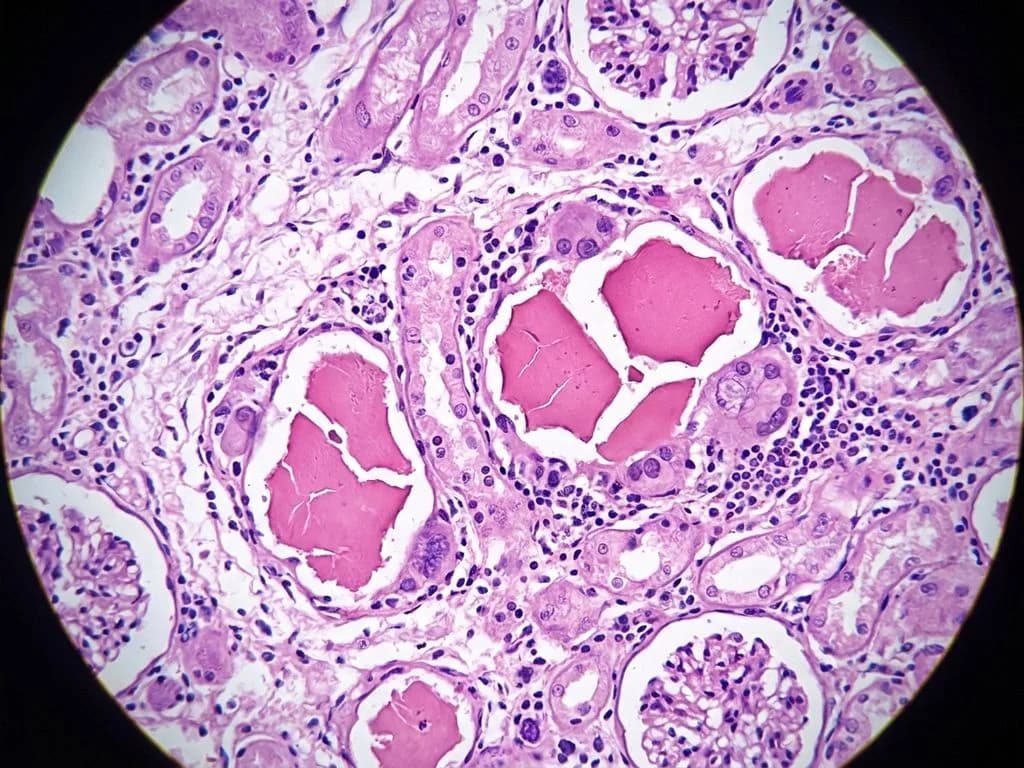
    Clinical image for NEET PG 2020 Q69

    A 51-year-old male patient came with complaints of hematuria to the clinic. On examination, he was normotensive and had pedal edema. Investigations revealed the patient had no glycosuria and had a creatinine of 9. His renal biopsy is shown below. Which of the following investigation should be done to identify the disease? La d

    A. Anti GBM antibodies
    B. Urine immunoelectrophoresis
    C. HIV RNA
    D. ANA

    Correct Answer: A. Anti GBM antibodies

    The clinical presentation of hematuria, pedal edema, normotension, elevated creatinine (9 mg/dL), and absence of glycosuria in a 51-year-old male points to a primary glomerulonephritis. The renal biopsy showing linear IgG deposition along the glomerular basement membrane (GBM) on immunofluorescence is pathognomonic for anti-GBM disease (Goodpasture syndrome). This is a type II hypersensitivity reaction where IgG antibodies target the NC1 domain of type IV collagen in the GBM, causing rapidly progressive glomerulonephritis (RPGN). The linear pattern of immunofluorescence is the gold standard diagnostic finding and distinguishes anti-GBM disease from other causes of RPGN (ANCA-associated vasculitis shows granular pattern, immune complex disease shows granular pattern). Serum anti-GBM antibodies are detected in >90% of patients with pulmonary-renal syndrome and ~80% with isolated glomerulonephritis. The absence of systemic features (normotensive, no respiratory symptoms) suggests isolated renal disease rather than pulmonary involvement. Testing for anti-GBM antibodies confirms the diagnosis and guides immunosuppressive therapy (corticosteroids + cyclophosphamide), which is critical to prevent progression to end-stage renal disease in Indian patients with limited dialysis access.

    Why the other options are wrong

    B. Urine immunoelectrophoresis — This test identifies monoclonal light chains (Bence Jones proteins) in urine and is used to diagnose light chain disease or multiple myeloma, not anti-GBM disease. While hematuria may occur in light chain disease, the linear IgG deposition on immunofluorescence and elevated creatinine without glycosuria or proteinuria pattern typical of myeloma make this incorrect. NBE may trap students who see 'elevated creatinine' and think of myeloma kidney. C. HIV RNA — HIV testing is indicated in patients with collapsing glomerulopathy or HIV-associated nephropathy (HIVAN), which presents with nephrotic syndrome and rapid renal decline in HIV+ patients. However, the linear IgG pattern on immunofluorescence is diagnostic of anti-GBM disease, not HIVAN (which shows collapsing lesions on light microscopy). The question provides no risk factors or clinical context suggesting HIV infection. D. ANA — ANA is used to diagnose systemic lupus erythematosus (SLE) and other autoimmune diseases presenting with glomerulonephritis. While SLE can cause hematuria and renal dysfunction, the linear IgG deposition pattern on immunofluorescence is specific for anti-GBM disease, not SLE (which shows granular IgG + IgA + IgM + C3 deposition). ANA would be negative in anti-GBM disease, making this a classic NBE distractor.

    High-Yield Facts

    • Linear IgG deposition on immunofluorescence is pathognomonic for anti-GBM disease and distinguishes it from ANCA-associated vasculitis (granular pattern) and immune complex disease.
    • Anti-GBM antibodies are positive in >90% of pulmonary-renal syndrome and ~80% of isolated glomerulonephritis cases; serology confirms diagnosis when biopsy shows linear pattern.
    • RPGN with creatinine >6 mg/dL at presentation indicates advanced renal disease; immediate immunosuppression (methylprednisolone + cyclophosphamide) is critical to prevent ESRD in Indian patients.
    • Absence of glycosuria rules out diabetic nephropathy; absence of systemic features (normotension, no rash/arthritis) rules out SLE and vasculitis.
    • Pulmonary involvement occurs in ~50% of anti-GBM disease (hemoptysis, pulmonary infiltrates); isolated renal disease (as in this case) has better prognosis with treatment.

    Mnemonics

    LINEAR = Anti-GBM Linear IgG deposition = Anti-GBM disease. Granular = Immune complex (SLE, IgAN). Negative = ANCA-RPGN (pauci-immune). Use when interpreting immunofluorescence patterns on renal biopsy. RPGN Triad for Anti-GBM Rapidly progressive GN + Pulmonary hemorrhage (optional) + GBM antibodies = Goodpasture. Remember: linear pattern on IF is the diagnostic key, serology confirms.

    NBE Trap

    NBE pairs elevated creatinine with urine immunoelectrophoresis to lure students into thinking of myeloma kidney, and pairs hematuria with ANA to suggest SLE—both are wrong because the linear IgG pattern on biopsy is diagnostic of anti-GBM disease, not these conditions.

    Clinical Pearl

    In Indian practice, anti-GBM disease is often diagnosed late because RPGN is frequently attributed to post-infectious GN or IgAN. Early recognition via linear IgG pattern on biopsy and serology allows timely plasmapheresis + immunosuppression, which can salvage renal function even at creatinine >6 mg/dL—critical in settings with limited dialysis access.

    _Reference: Robbins Ch. 20 (Kidney); Harrison Ch. 279 (Glomerulonephritis)_

    Ask AI Tutor about this question

    Stuck on a distractor? Want a worked-through clinical scenario? The AI Tutor is a NEETPGAI Pro feature — sign up free to practice the full question bank, then unlock the AI Tutor when you're ready.

    Explain this concept in plain language
    Why is each wrong option wrong?
    Give me a clinical scenario where this is tested
    Sign up free Already have an account? Log in

    Free to start, no credit card required. The 3 prompts/day quota is shared with practice + tutor + deep-dive across NEETPGAI.

    Memory-based reconstruction

    NBE does not officially release NEET PG papers per the 2025 Supreme Court directive. This question was reconstructed from 1 community source: PrepLadder NEET PG 2020 Recall PDF. Cross-verified by Claude Haiku 4.5 + Gemini 2.5 Flash + community-aggregate vote, then reviewed by a practising medical SME.

    ← All NEET PG 2020 questionsPractice with AI Tutor →