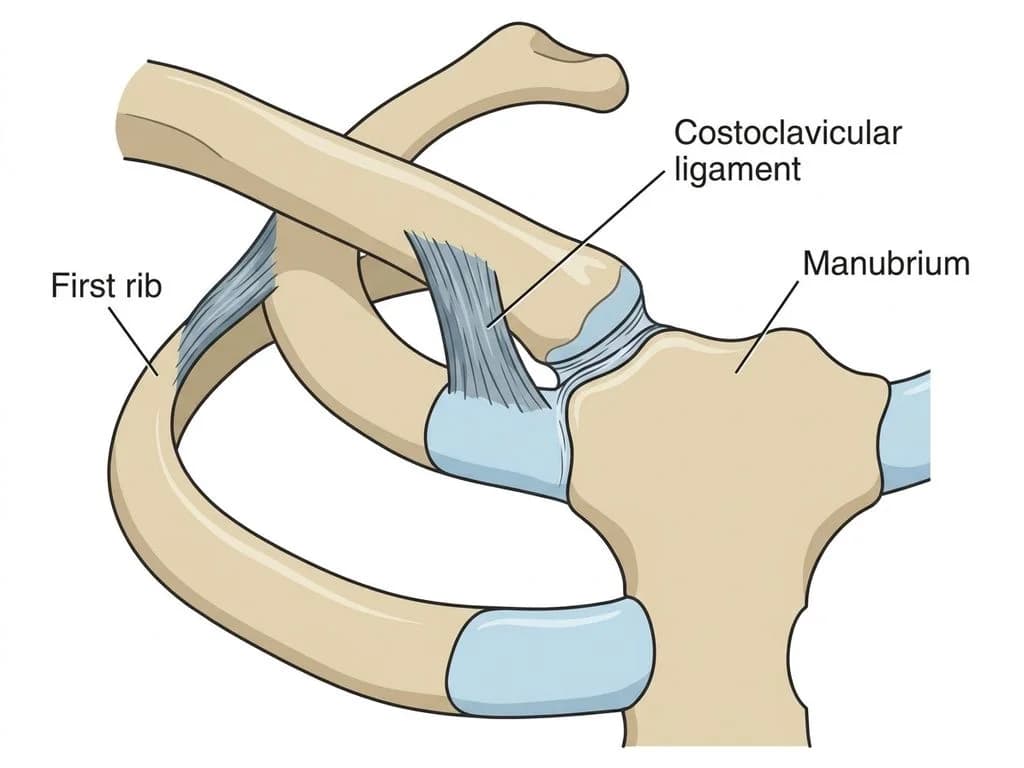
Correct Answer: D. Syndesmosis
A syndesmosis is a type of fibrous joint in which two bones are connected exclusively by dense fibrous connective tissue — either a ligament or an interosseous membrane — with no joint cavity and no cartilage interposed between the bony surfaces. In the thorax, the classic example of a syndesmosis is the interosseous ligament or fibrous membrane connecting adjacent structures such as the articulation between the fibrous bands uniting the ribs or the ligamentous connections at certain costal articulations. The defining feature is the fibrous tissue bridge between bones, which permits very limited movement (amphiarthrosis) but lacks the synovial lining or cartilaginous plate seen in other joint types.
The image in this question highlights a joint united by fibrous connective tissue (ligament/membrane) without a synovial cavity or hyaline cartilage plate — the hallmark of a syndesmosis. In thoracic anatomy, syndesmotic joints are important because they provide stability to the rib cage while still allowing the slight give needed for respiratory excursion. The amount of movement in a syndesmosis depends on the length of the connecting fibrous tissue: longer fibers permit more movement than shorter ones.
Why other options are wrong
- A. Synovial — Synovial joints possess a joint cavity lined by synovial membrane, articular cartilage, and a fibrous capsule (e.g., costovertebral joints). The joint shown lacks a synovial cavity and synovial fluid, ruling this out.
- B. Synarthrosis — Synarthrosis is a completely immobile fibrous joint (e.g., skull sutures) where bones are united by very short fibrous tissue with essentially no movement. While syndesmosis is sometimes classified under the broader fibrous joint category, synarthrosis specifically implies zero mobility and very short fibrous tissue — not the ligamentous/membranous bridge seen here.
- C. Synchondrosis — Synchondrosis is a cartilaginous joint united by hyaline cartilage (e.g., costochondral junctions in children, epiphyseal plates). The joint shown is united by fibrous tissue, not cartilage, making synchondrosis incorrect.
Mnemonic
"Syndesmosis = String of fibrous tissue" — think of the interosseous membrane between tibia and fibula as the prototype; the thoracic equivalent follows the same principle of a fibrous ligamentous bridge.