
NEETPGAI
FeaturesBlogComparePricing
Log inStart Free
NEETPGAI

AI-powered NEET PG preparation platform. Master all 19 subjects with adaptive MCQs, AI tutoring, and spaced repetition.

Product

  • Features
  • Subjects
  • Previous Year Questions
  • Compare
  • Pricing
  • Blog

Features

  • Adaptive MCQ Practice
  • AI Tutor
  • Mock Tests
  • Spaced Repetition

Resources

  • Blog
  • Study Guides
  • NEET PG Updates
  • Contact & support

Legal

  • Privacy Policy
  • Terms of Service

Stay updated

© 2026 NEETPGAI. All rights reserved.
    PYQs/2020/Q220
    Verified answer (AI cross-checked + SME reviewed)

    Q220 (2020, Orthopedics Oncology) — Correct answer: D. Giant cell tumour.
    NEET PG 2020
    Q220
    bone Orthopedics
    Orthopedics Oncology
    tier-2 (3/3 verifier agreement)
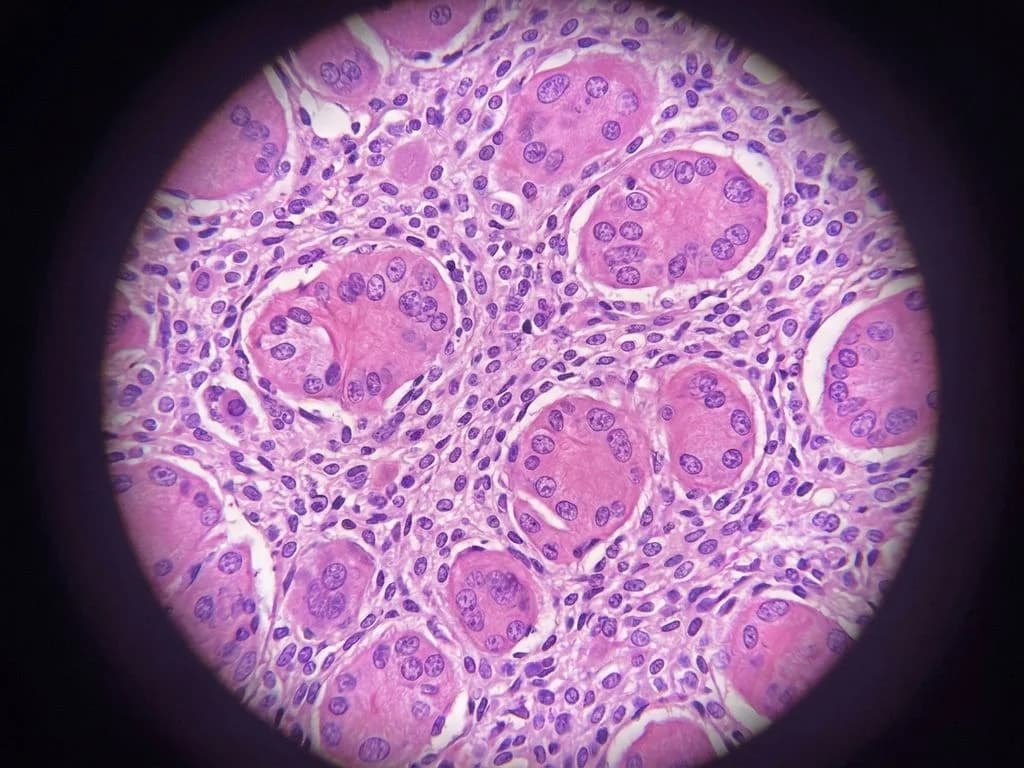
    Clinical image for NEET PG 2020 Q220

    A 30-year-old woman developed a tumor at the knee joint. Biopsy-image is given below. What is the most likely condition?

    A. Osteosarcoma
    B. Osteoblastoma
    C. Ewing’s Sarcoma
    D. Giant cell tumour

    Correct Answer: D. Giant cell tumour

    Giant cell tumour (GCT) is the most common diagnosis in a 30-year-old woman with a knee joint tumor, particularly when the lesion is epiphyseal or epiphyseal-metaphyseal in location. The discriminating feature is the age of presentation: GCT typically affects patients aged 20–40 years, with peak incidence in the third decade—exactly matching this patient's demographics. GCT arises in the epiphysis and extends to the metaphysis, characteristically occurring around the knee joint (distal femur and proximal tibia account for ~65% of cases). Histologically, GCT is defined by the presence of numerous multinucleated giant cells (osteoclast-like) interspersed among mononuclear stromal cells, which is the pathognomonic finding on biopsy. The tumor is locally aggressive but non-metastasizing, though recurrence is common (up to 50% after curettage alone). In Indian orthopedic practice, GCT is managed by intralesional curettage with adjuvants (phenol, liquid nitrogen, or cement) or wide excision depending on location and size. The epiphyseal location in a skeletally mature patient with this age group and histology makes GCT the definitive answer.

    Why the other options are wrong

    A. Osteosarcoma — Osteosarcoma typically presents in adolescents and young adults (10–25 years), with a second peak in elderly patients with Paget's disease. A 30-year-old woman is outside the primary age range. Osteosarcoma is metaphyseal (around the knee, but in the metaphysis, not epiphysis) and shows aggressive periosteal reaction ('sunburst' pattern) on imaging. Histologically, it contains malignant osteoid production, not giant cells. The epiphyseal location and giant cell histology rule this out. B. Osteoblastoma — Osteoblastoma is a benign osteoid-producing tumor that occurs in younger patients (10–30 years, but typically <20 years). It is usually small (<2 cm), located in the diaphysis or diaphyseal-metaphyseal region of long bones, and presents with pain relieved by NSAIDs (aspirin sensitivity is classic). Histologically, it shows abundant osteoid and osteoblasts, not multinucleated giant cells. The epiphyseal location and giant cell findings exclude osteoblastoma. C. Ewing's Sarcoma — Ewing's sarcoma is a malignant round-cell tumor of bone occurring in children and adolescents (5–25 years), with peak incidence in the second decade. A 30-year-old woman is beyond the typical age range. Ewing's sarcoma arises in the diaphysis or diaphyseal-metaphyseal region, not the epiphysis. Histologically, it shows small, uniform round cells with clear cytoplasm ('onion-skin' periosteal reaction on X-ray), not multinucleated giant cells. The age and histology make Ewing's sarcoma unlikely.

    High-Yield Facts

    • GCT age of presentation: 20–40 years, peak in third decade; rare before age 20 or after age 50.
    • Epiphyseal location: GCT characteristically arises in the epiphysis and extends into the metaphysis; ~65% occur around the knee (distal femur, proximal tibia).
    • Pathognomonic histology: Multinucleated giant cells (osteoclast-like) mixed with mononuclear stromal cells; no malignant osteoid or round-cell morphology.
    • Locally aggressive, non-metastasizing: GCT does not metastasize but has high recurrence rate (~50%) after simple curettage; wide excision or adjuvant therapy (phenol, liquid nitrogen, cement) reduces recurrence.
    • Indian DOC management: Intralesional curettage with adjuvants or wide excision depending on location, size, and recurrence risk; denosumab (RANKL inhibitor) is emerging option for unresectable or recurrent cases.

    Mnemonics

    GCT vs Others – AGE & LOCATION Giant cell tumor = Girls/young adults (20–40 yr), Epiphyseal. Osteosarcoma = Older teens (10–25 yr), metaphyseal. Ewing's = Early teens (5–25 yr), diaphyseal. GIANT CELL TUMOR – 'KNEE EPIPHYSIS' Knee (65% of GCT), Non-metastasizing, Epiphyseal origin, Epiphyseal-metaphyseal extension. Remember: GCT loves the knee epiphysis in young adults.

    NBE Trap

    NBE pairs "knee tumor" with "osteosarcoma" to trap students who recall the classic "metaphyseal lesion around the knee" teaching without checking the patient's age (30 years is too old for osteosarcoma) and the epiphyseal location (osteosarcoma is metaphyseal, not epiphyseal). The giant cell histology is the discriminator.

    Clinical Pearl

    In Indian orthopedic practice, a 30-year-old woman presenting with a knee swelling and epiphyseal biopsy showing multinucleated giant cells is GCT until proven otherwise. Early recognition is critical because simple curettage alone has high recurrence; adjuvant therapy (phenol or cement) or wide excision is often needed to reduce morbidity and preserve function in this age group.

    _Reference: Bailey & Love's Short Practice of Surgery (Orthopedics section on bone tumors); Robbins Pathology Ch. 26 (Bone and Soft Tissue Tumors)_

    Ask AI Tutor about this question

    Stuck on a distractor? Want a worked-through clinical scenario? The AI Tutor is a NEETPGAI Pro feature — sign up free to practice the full question bank, then unlock the AI Tutor when you're ready.

    Explain this concept in plain language
    Why is each wrong option wrong?
    Give me a clinical scenario where this is tested
    Sign up free Already have an account? Log in

    Free to start, no credit card required. The 3 prompts/day quota is shared with practice + tutor + deep-dive across NEETPGAI.

    Memory-based reconstruction

    NBE does not officially release NEET PG papers per the 2025 Supreme Court directive. This question was reconstructed from 1 community source: PrepLadder NEET PG 2020 Recall PDF. Cross-verified by Claude Haiku 4.5 + Gemini 2.5 Flash + community-aggregate vote, then reviewed by a practising medical SME.

    ← All NEET PG 2020 questionsPractice with AI Tutor →