
NEETPGAI
FeaturesBlogComparePricing
Log inStart Free
NEETPGAI

AI-powered NEET PG preparation platform. Master all 19 subjects with adaptive MCQs, AI tutoring, and spaced repetition.

Product

  • Features
  • Subjects
  • Previous Year Questions
  • Compare
  • Pricing
  • Blog

Features

  • Adaptive MCQ Practice
  • AI Tutor
  • Mock Tests
  • Spaced Repetition

Resources

  • Blog
  • Study Guides
  • NEET PG Updates
  • Contact & support

Legal

  • Privacy Policy
  • Terms of Service

Stay updated

© 2026 NEETPGAI. All rights reserved.
    PYQs/2020/Q182
    Verified answer (AI cross-checked + SME reviewed)

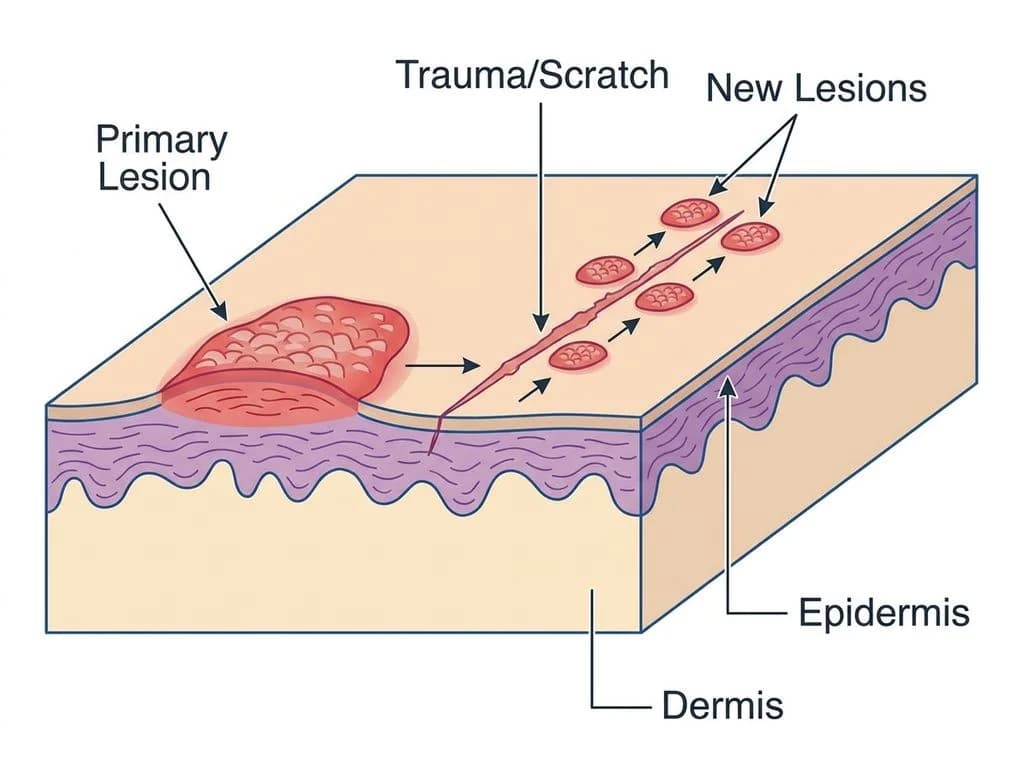
    Q182 (2020, Papulosquamous Disorders) — Correct answer: A. Isomorphic phenomenon.
    NEET PG 2020
    Q182
    hand Dermatology
    Papulosquamous Disorders
    tier-3 (2/3 verifier agreement)
    Clinical image for NEET PG 2020 Q182

    Identify the finding associated with the condition shown in the image below: La d

    A. Isomorphic phenomenon
    B. Nikolsky’s sign
    C. Meyerson phenomenon
    D. Gottron’s papule

    Correct Answer: A. Isomorphic phenomenon

    The isomorphic phenomenon (also called Koebner phenomenon) is the hallmark finding in psoriasis, where new lesions develop at sites of trauma, scratching, or injury to previously unaffected skin. The image shows "La d" (likely referring to a clinical presentation of psoriasis with characteristic lesions), and this phenomenon is pathognomonic for psoriasis in Indian dermatology practice. The mechanism involves activation of T cells and release of inflammatory cytokines (TNF-α, IL-17) at sites of skin injury, leading to keratinocyte proliferation and the characteristic erythematous, scaly plaques. This occurs in approximately 25–30% of psoriasis patients clinically, though histologically it may be present in up to 75% of cases. The isomorphic response typically appears 7–14 days after trauma and is a key diagnostic criterion used in Indian clinical settings to differentiate psoriasis from other papulosquamous disorders like lichen planus or pityriasis rosea. Recognition of this phenomenon is critical for patient counseling regarding trauma avoidance and for understanding disease pathogenesis.

    Why the other options are wrong

    B. Nikolsky's sign — Nikolsky's sign (intraepidermal acantholysis causing easy separation of epidermis from dermis) is characteristic of pemphigus vulgaris and toxic epidermal necrolysis, not psoriasis. While both are blistering/erosive conditions, psoriasis presents with intact papules and plaques with silvery scale, not flaccid blisters or mucosal involvement typical of pemphigus. This is a common NBE trap pairing dermatological signs with wrong conditions. C. Meyerson phenomenon — Meyerson phenomenon refers to a halo of eczema or inflammation around a pre-existing nevus or other skin lesion, seen in conditions like atopic dermatitis or contact dermatitis around nevi. It is not associated with psoriasis and represents a different pathophysiological mechanism (allergic/irritant inflammation rather than T-cell mediated psoriasiform response). This option tests whether students confuse named dermatological phenomena. D. Gottron's papule — Gottron's papules are characteristic of dermatomyositis, presenting as violaceous papules over the dorsal interphalangeal and metacarpophalangeal joints, often with heliotrope rash and muscle weakness. They are associated with autoimmune myositis, not psoriasis. This is a classic NBE trap: both are papular eruptions, but Gottron's papules have entirely different clinical context (myositis, systemic disease) and distribution.

    High-Yield Facts

    • Isomorphic phenomenon occurs in ~25–30% of psoriasis patients clinically; trauma triggers new lesions in 7–14 days.
    • Auspitz sign (pinpoint bleeding after scale removal) is another key finding in psoriasis, distinct from isomorphic phenomenon.
    • Psoriasis pathogenesis involves Th1/Th17 cells, TNF-α, and IL-17; TNF inhibitors are now standard therapy in India.
    • Koebner-positive conditions include psoriasis, lichen planus, and vitiligo; Koebner-negative include pityriasis rosea and secondary syphilis.
    • Indian prevalence of psoriasis is 0.44–2.8% with higher rates in North India; trauma avoidance is key counseling point.

    Mnemonics

    KOEBNER conditions (Trauma-triggered lesions) Kebner (psoriasis), Other: lichen planus, Erythema multiforme, Behavior: vitiligo, Necrobiosis lipoidica, Eruptive xanthomas, R: Rubella (congenital). Psoriasis is the classic example; always ask about trauma history. Psoriasis vs Lichen Planus (both Koebner-positive) Psoriasis: silvery scale, auspitz sign (pinpoint bleeding), isomorphic response. Lichen Planus: purple, polygonal, planar papules, Wickham's striae, oral involvement. Isomorphic phenomenon is more reliable in psoriasis; lichen planus shows true Koebner but with different morphology.

    NBE Trap

    NBE pairs multiple named dermatological phenomena (Nikolsky, Meyerson, Gottron) to test whether students confuse eponymous signs across different conditions. The trap is that all are real phenomena but only isomorphic phenomenon is specific to psoriasis; students who memorize signs without linking them to pathophysiology will guess incorrectly.

    Clinical Pearl

    In Indian outpatient practice, asking "Do your lesions appear after scratching or injury?" is a rapid bedside test for psoriasis. Patients often report lesions appearing on scars, tattoos, or areas of repeated trauma—this isomorphic response is so characteristic that its absence should prompt reconsideration of the diagnosis. Counseling patients to avoid trauma and maintain skin hygiene is a cornerstone of psoriasis management in resource-limited Indian settings.

    _Reference: Robbins Ch. 25 (Skin); Harrison Ch. 375 (Psoriasis); Ghai Essentials of Pediatric Nursing (psoriasis in Indian children)_

    Ask AI Tutor about this question

    Stuck on a distractor? Want a worked-through clinical scenario? The AI Tutor is a NEETPGAI Pro feature — sign up free to practice the full question bank, then unlock the AI Tutor when you're ready.

    Explain this concept in plain language
    Why is each wrong option wrong?
    Give me a clinical scenario where this is tested
    Sign up free Already have an account? Log in

    Free to start, no credit card required. The 3 prompts/day quota is shared with practice + tutor + deep-dive across NEETPGAI.

    Memory-based reconstruction

    NBE does not officially release NEET PG papers per the 2025 Supreme Court directive. This question was reconstructed from 1 community source: PrepLadder NEET PG 2020 Recall PDF. Cross-verified by Claude Haiku 4.5 + Gemini 2.5 Flash + community-aggregate vote, then reviewed by a practising medical SME.

    ← All NEET PG 2020 questionsPractice with AI Tutor →