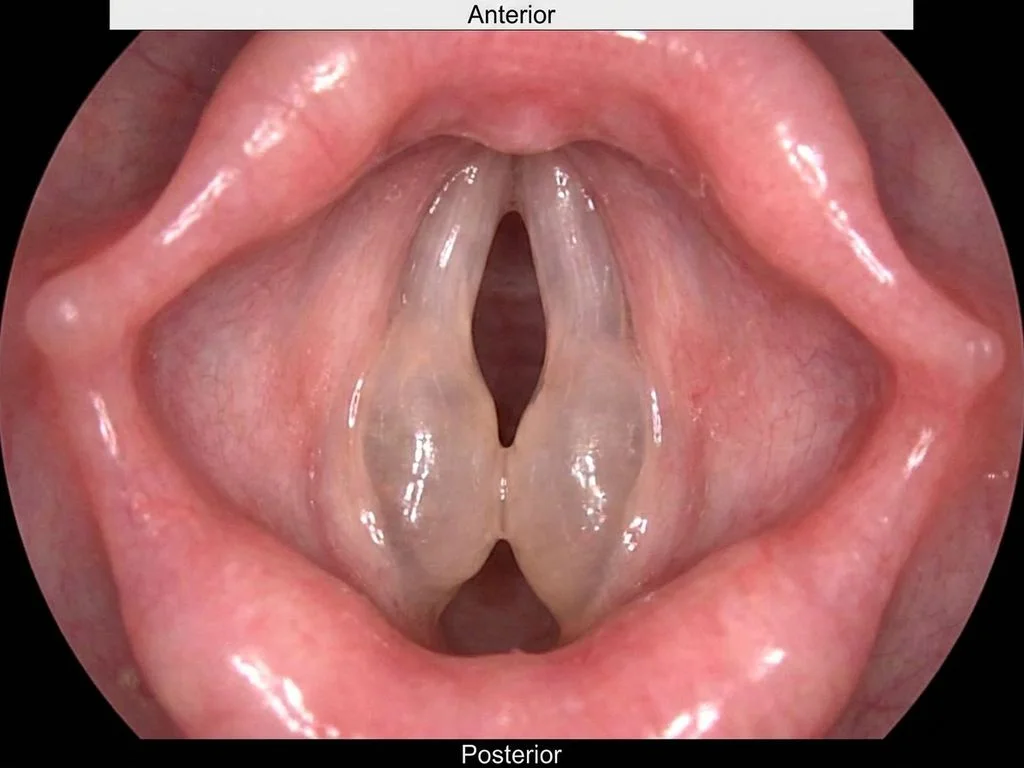
Correct Answer: C. Reinke's Edema
Reinke's edema is a benign condition characterised by bilateral, diffuse, smooth, gelatinous swelling of the vocal cords due to accumulation of oedematous fluid within Reinke's space — the superficial lamina propria of the true vocal cords. On laryngoscopy, the cords appear as pale, translucent, "sausage-like" or "polypoid" bilateral swellings that move freely with respiration. This is precisely the appearance depicted in the image, making Reinke's edema the correct diagnosis.
The condition is strongly associated with chronic cigarette smoking (the single most important risk factor), voice abuse, hypothyroidism, and gastro-oesophageal reflux disease (GERD). Smoking causes increased vascular permeability and disruption of the basement membrane, leading to fluid accumulation in Reinke's space. Patients typically present with progressive, low-pitched hoarseness ("masculine voice" in females) and a characteristic deep, rough voice quality. It is more common in middle-aged female smokers. Management involves smoking cessation (mandatory), voice therapy, and surgical microlaryngoscopic decortication (stripping of the oedematous mucosa) in refractory cases.
A useful mnemonic: WARTY vs WATERY — Reinke's edema is WATERY (smooth, watery, gelatinous, bilateral swelling), while laryngeal papilloma is WARTY (warty, pedunculated, nodular lesions).
Why Other Options Are Wrong
- A. Malignancy — Laryngeal squamous cell carcinoma presents as a solitary, ulcerated, irregular, infiltrative lesion with fixity of the cord, cervical lymphadenopathy, and constitutional symptoms. The image shows smooth bilateral swelling without ulceration or deep invasion, inconsistent with malignancy.
- B. Laryngeal papilloma — Recurrent respiratory papillomatosis (RRP) caused by HPV types 6 and 11 presents as multiple, warty, cauliflower-like, pedunculated nodules on the vocal cords. The image shows smooth, diffuse, bilateral gelatinous swelling — not discrete warty nodules — ruling out papilloma.
- D. Tracheomalacia — This is a structural/functional abnormality of the trachea (loss of cartilaginous support causing dynamic airway collapse during expiration), not a mucosal vocal cord lesion. It presents with expiratory stridor and barking cough and would not produce any visible cord swelling on laryngoscopy.