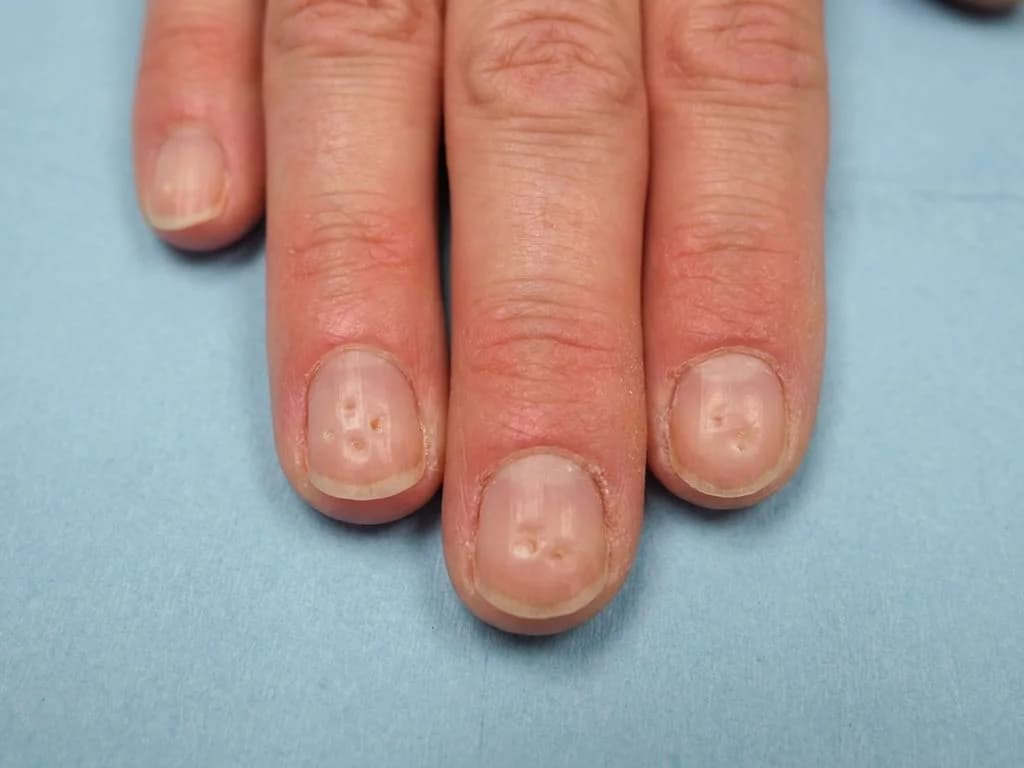
Correct Answer: C. Pitting of nails
Pitting of nails is the classic and most common nail finding in psoriasis, a chronic inflammatory dermatological condition prevalent across Indian populations. The pitting appears as small, punctate depressions on the nail surface, typically affecting the dorsal plate. Histopathologically, these pits result from focal areas of parakeratosis and loss of the normal nail plate architecture in the nail matrix, leading to defective keratinization. Psoriasis affects nails in approximately 10–55% of patients with cutaneous disease, and nail involvement can be the sole presenting feature in up to 5% of cases. The pits are usually multiple, randomly distributed, and may vary in depth and size. This finding is highly specific for psoriasis when present, though not pathognomonic (can occur in alopecia areata, lichen planus, and trauma). In the Indian context, psoriasis commonly presents with nail involvement in patients with plaque-type disease, and recognition of nail pitting is crucial for early diagnosis and initiation of topical or systemic therapy per Indian dermatological guidelines. The presence of nail pitting often correlates with more severe or long-standing cutaneous disease.
Why the other options are wrong
A. Oil drop sign — Oil drop sign (onycholysis with a yellowish-brown discoloration) is characteristic of fungal nail infections (onychomycosis), not psoriasis. While psoriasis can cause onycholysis, the oil drop appearance is pathognomonic for dermatophyte or candida infection. This is an NBE trap pairing nail changes with the wrong condition. B. Leukonychia striata — Leukonychia striata (horizontal white lines across the nail) is associated with hypoalbuminemia, liver disease, and chronic kidney disease (seen in nephrotic syndrome). It is not a feature of psoriasis. This option tests whether students confuse various nail pathologies; it is a common distractor in Indian medical exams. D. Pterygium of nails — Pterygium unguis (fusion of nail folds with loss of the nail plate) is a late sequela of lichen planus and Stevens-Johnson syndrome, not psoriasis. Although both psoriasis and lichen planus affect nails, pterygium formation is specific to lichen planus. This trap tests knowledge of nail pathology differentiation.
High-Yield Facts
- Nail pitting is present in 10–55% of psoriasis patients and is highly specific for the condition.
- Pits in psoriasis are caused by focal parakeratosis in the nail matrix leading to defective keratinization.
- Oil drop sign (onycholysis with brown discoloration) is pathognomonic for fungal nail infection, not psoriasis.
- Pterygium unguis (nail fold fusion) is a late sequela of lichen planus, not psoriasis.
- Nail involvement in psoriasis can be the sole presenting feature in up to 5% of cases, making it diagnostically important.
Mnemonics
NAIL PSORIASIS Pitting, Onycholysis, Infection (secondary), Leukonychia (rare) — but PITTING is the hallmark. Nail Signs by Disease Psoriasis = Pitting | Fungal = Oil drop | Lichen planus = Pterygium | Kidney disease = Leukonychia striata
NBE Trap
NBE pairs multiple nail pathologies (oil drop, leukonychia, pterygium) with psoriasis to test whether students can differentiate between nail signs and their associated systemic or dermatological conditions. The trap exploits the fact that psoriasis does affect nails, but students must recognize that pitting is the most common and characteristic finding.
Clinical Pearl
In Indian clinical practice, nail pitting in a patient with plaque psoriasis on the extensor surfaces (elbows, knees) is a red flag for systemic involvement and may warrant screening for psoriatic arthritis, which affects 5–30% of Indian psoriasis patients. Early recognition allows timely referral to rheumatology and initiation of DMARDs if needed.
_Reference: Robbins & Cotran Pathologic Basis of Disease, Ch. 25 (Skin); Rook's Textbook of Dermatology, Ch. on Psoriasis; KD Tripathi Essentials of Medical Pharmacology (for systemic therapy context)_