
NEETPGAI
FeaturesBlogComparePricing
Log inStart Free
NEETPGAI

AI-powered NEET PG preparation platform. Master all 19 subjects with adaptive MCQs, AI tutoring, and spaced repetition.

Product

  • Features
  • Subjects
  • Previous Year Questions
  • Compare
  • Pricing
  • Blog

Features

  • Adaptive MCQ Practice
  • AI Tutor
  • Mock Tests
  • Spaced Repetition

Resources

  • Blog
  • Study Guides
  • NEET PG Updates
  • Contact & support

Legal

  • Privacy Policy
  • Terms of Service

Stay updated

© 2026 NEETPGAI. All rights reserved.
    PYQs/2019/Q57
    Verified answer (AI cross-checked + SME reviewed)

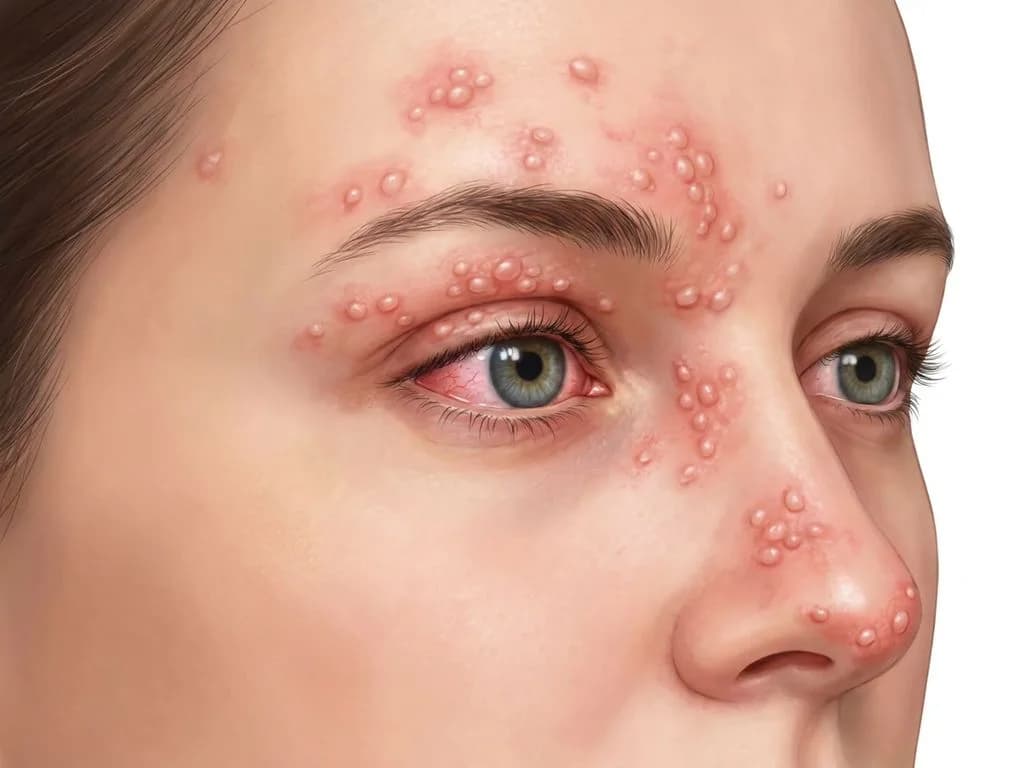
    Q57 (2019, Cutaneous Infections) — Correct answer: B. Mucous membranes within the affected dermatomes are involved.
    NEET PG 2019
    Q57
    hand Dermatology
    Cutaneous Infections
    tier-2 (3/3 verifier agreement)
    Clinical image for NEET PG 2019 Q57

    What is correct regarding the diagnosis based on the given image? La d

    A. Trigeminal dermatome is most commonly affected
    B. Mucous membranes within the affected dermatomes are involved
    C. Anterior nerve roots are more commonly involved
    D. The lesions are not infectious

    Correct Answer: B. Mucous membranes within the affected dermatomes are involved

    Herpes zoster (shingles) is a reactivation of latent varicella-zoster virus (VZV) from dorsal root ganglia, presenting with dermatomal vesicular eruptions. The critical distinguishing feature of zoster is that it does not respect anatomical boundaries — while the primary rash follows a dermatome, mucous membranes within that same dermatome are frequently involved. This is a hallmark finding that differentiates zoster from other dermatomal conditions. Involvement of oral mucosa (if trigeminal dermatome affected), genital mucosa (if sacral dermatome affected), or conjunctiva/cornea (if ophthalmic division involved) occurs in a significant proportion of cases. This mucosal involvement is clinically important because: (1) it increases infectivity risk, (2) it may cause severe pain and functional impairment, and (3) it requires specific management (e.g., ophthalmologic evaluation in ophthalmic zoster to prevent keratitis). The presence of vesicles on mucous membranes within the affected dermatome is therefore a diagnostic hallmark of herpes zoster and helps confirm the diagnosis clinically. Robbins Ch. 8; Harrison Ch. 187

    Why the other options are wrong

    A. Trigeminal dermatome is most commonly affected — While trigeminal (V1, V2, V3) zoster is common and clinically significant, it is not the most commonly affected dermatome. Thoracic dermatomes (T5–T10) account for approximately 50% of all zoster cases in India. The trigeminal distribution accounts for only 10–15% of cases. This is a frequency trap—NBE tests whether students confuse 'clinically important' with 'most common.' Ophthalmic zoster (V1) is particularly memorable due to serious complications, leading to overestimation of its frequency. C. Anterior nerve roots are more commonly involved — Herpes zoster arises from dorsal root ganglia reactivation, not anterior (ventral) roots. The virus reactivates in sensory ganglia and travels along sensory (dorsal) nerve fibers to produce the dermatomal rash. Anterior roots carry motor fibers; motor involvement in zoster is rare and occurs only when inflammation extends to anterior horns (post-herpetic motor paresis). This is a neuroanatomical trap—students may confuse the pathway of viral reactivation with nerve root classification. D. The lesions are not infectious — Herpes zoster lesions are highly infectious and transmit VZV to non-immune individuals, causing varicella (chickenpox), not zoster. Infectivity persists until all vesicles crust over (typically 7–10 days). This is a critical clinical safety trap—patients must be isolated from susceptible contacts, especially pregnant women and immunocompromised individuals. Stating lesions are 'not infectious' is dangerously incorrect and contradicts standard infection control practice in Indian hospitals.

    High-Yield Facts

    • Thoracic dermatomes (T5–T10) are affected in ~50% of zoster cases in India; trigeminal involvement occurs in only 10–15%.
    • Mucosal involvement within the affected dermatome is a diagnostic hallmark of zoster and occurs in a significant proportion of cases.
    • Zoster reactivates from dorsal root ganglia, not anterior roots; motor involvement is rare and indicates severe inflammation.
    • Post-herpetic neuralgia (PHN) is the most common complication in elderly patients (>60 years); incidence increases with age.
    • Varicella-zoster virus (VZV) in zoster lesions is transmissible to non-immune contacts as varicella; isolation is mandatory until crusting.

    Mnemonics

    ZOSTER Complications (Indian context) Zoster with Ophthalmic involvement → keratitis risk Secondary bacterial infection (common in tropical India) Trigeminal neuralgia-like pain (post-herpetic) Elder patients → PHN risk Ramsey Hunt (facial nerve zoster) → facial paralysis Mucosal Involvement Memory Hook "Zoster doesn't stop at skin—it crosses into mucosa." Think: Dermatomal = skin + mucosa in same territory. If trigeminal zoster → check mouth, eye, ear. If sacral zoster → check genitals.

    NBE Trap

    NBE pairs "trigeminal dermatome" with "most commonly affected" to exploit the clinical salience of ophthalmic zoster complications (keratitis, vision loss). Students remember V1 zoster as dramatic and assume it's frequent, when thoracic zoster is actually 3–5× more common. The correct answer tests knowledge of mucosal involvement as a diagnostic feature, not frequency.

    Clinical Pearl

    In Indian outpatient practice, a patient presenting with unilateral dermatomal vesicles + oral ulcers or conjunctivitis in the same distribution is zoster until proven otherwise. Mucosal involvement is your clinical red flag to initiate antiviral therapy immediately (acyclovir 800 mg 5× daily or valacyclovir) and refer for ophthalmology if V1 is involved—delaying treatment increases PHN risk and complications in our aging population.

    _Reference: Robbins Ch. 8 (Infectious Diseases); Harrison Ch. 187 (Varicella-Zoster Virus Infections)_

    Ask AI Tutor about this question

    Stuck on a distractor? Want a worked-through clinical scenario? The AI Tutor is a NEETPGAI Pro feature — sign up free to practice the full question bank, then unlock the AI Tutor when you're ready.

    Explain this concept in plain language
    Why is each wrong option wrong?
    Give me a clinical scenario where this is tested
    Sign up free Already have an account? Log in

    Free to start, no credit card required. The 3 prompts/day quota is shared with practice + tutor + deep-dive across NEETPGAI.

    Memory-based reconstruction

    NBE does not officially release NEET PG papers per the 2025 Supreme Court directive. This question was reconstructed from 1 community source: PrepLadder NEET PG 2019 Recall PDF. Cross-verified by Claude Haiku 4.5 + Gemini 2.5 Flash + community-aggregate vote, then reviewed by a practising medical SME.

    ← All NEET PG 2019 questionsPractice with AI Tutor →