Correct Answer: B. Inferior alveolar nerve
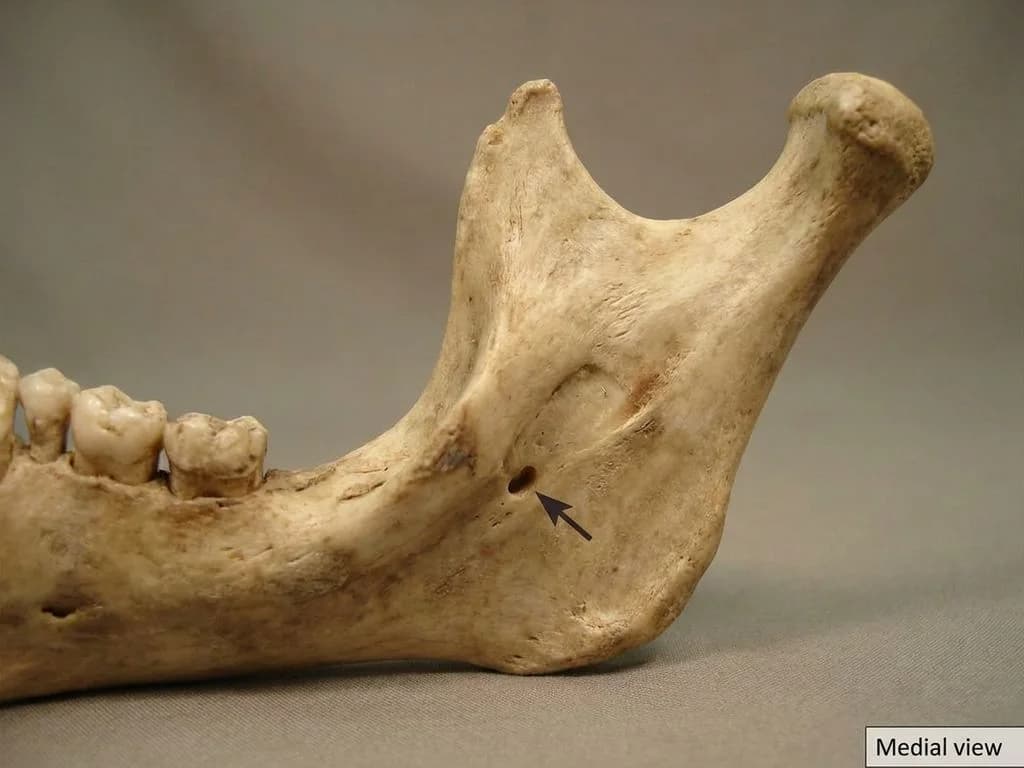
The inferior alveolar nerve (IAN) is a terminal branch of the mandibular division of the trigeminal nerve (CN V3). It enters the mandible through the mandibular foramen (also called the inferior alveolar foramen), located on the medial surface of the ramus of the mandible. This foramen is the key anatomical landmark for identifying the nerve's entry point. The IAN then travels through the mandibular canal, supplying sensory innervation to the lower teeth, gingiva, and anterior two-thirds of the tongue (via the lingual nerve after exiting as the mental nerve). In clinical practice, blockade of the IAN at the mandibular foramen is the most common regional anesthetic technique in Indian dental and oral surgical practice—the inferior alveolar nerve block (IANB) is routinely used for lower tooth extraction and oral procedures. The foramen's location (medial ramus, approximately at the junction of the anterior and middle thirds) is a critical landmark for safe surgical approaches to the mandible and for avoiding neurovascular injury during orthognathic surgery or mandibular fracture repair.
Why the other options are wrong
A. Lingual nerve — The lingual nerve is a sensory branch of CN V3 that does NOT pass through the mandibular foramen. It runs medial to the IAN and enters the oral cavity separately, supplying the anterior two-thirds of the tongue and floor of mouth. It may be encountered during oral surgical procedures but does not have a dedicated foramen at the mandibular ramus. This is a common trap because students confuse the lingual nerve's relationship with the IAN—they travel together briefly but have different entry routes. C. Chorda tympani nerve — The chorda tympani is a branch of CN VII (facial nerve) that passes through the middle ear and exits via the petrotympanic fissure—it does NOT pass through the mandibular foramen. Although it eventually joins the lingual nerve to supply taste to the anterior two-thirds of the tongue, its course is entirely different and located in the temporal bone region, not the mandibular ramus. NBE may include this to test knowledge of CN VII versus CN V3 branches. D. Mandibular nerve — The mandibular nerve (CN V3) is the parent trunk that divides into multiple branches (including the IAN, lingual, and buccal nerves) before reaching the mandibular foramen. The main trunk does NOT pass through the mandibular foramen itself; only its terminal branch (IAN) does. This is a deliberate trap—the foramen is named after the mandible, not the mandibular nerve, leading students to incorrectly select the larger nerve rather than the specific branch.
High-Yield Facts
- Mandibular foramen is located on the medial surface of the mandibular ramus, approximately at the junction of anterior and middle thirds—key landmark for IANB in Indian dental practice.
- Inferior alveolar nerve is the terminal sensory branch of CN V3 that enters the mandible via the mandibular foramen and travels in the mandibular canal.
- IANB (inferior alveolar nerve block) is the most commonly used regional anesthetic technique in Indian oral and maxillofacial surgery for lower tooth extraction and procedures.
- The lingula is a bony projection that partially covers the mandibular foramen medially—important landmark during surgical exposure of the mandible.
- Mental foramen is where the IAN exits as the mental nerve on the buccal surface of the mandible, typically below the premolar teeth—site of mental nerve blocks in Indian dental practice.
Mnemonics
IAN's Journey: MFC Mandibular foramen → Foramen in mandibular canal → Comes out as mental nerve. Helps recall that IAN enters at the mandibular foramen and exits at the mental foramen. CN V3 Branches at Mandible IAN (enters foramen), Lingual (medial, separate entry), Buccal (lateral, no foramen). Only IAN uses the mandibular foramen.
NBE Trap
NBE pairs "mandibular nerve" with "mandibular foramen" to trap students who assume the parent trunk passes through the foramen, when in fact only its terminal branch (IAN) does. The naming similarity is deliberate misdirection.
Clinical Pearl
During lower tooth extraction in Indian dental clinics, the IANB is administered by directing the needle toward the mandibular foramen on the medial ramus—failure to achieve proper block results in inadequate anesthesia of lower molars and premolars. Awareness of the foramen's exact location prevents needle misdirection and vascular puncture of the inferior alveolar artery.
_Reference: Robbins & Cotran Pathologic Basis of Disease (Head & Neck Anatomy section); Gray's Anatomy (Mandible and CN V3 branches); Clinically Oriented Anatomy by Moore (Mandibular nerve and foramen)_