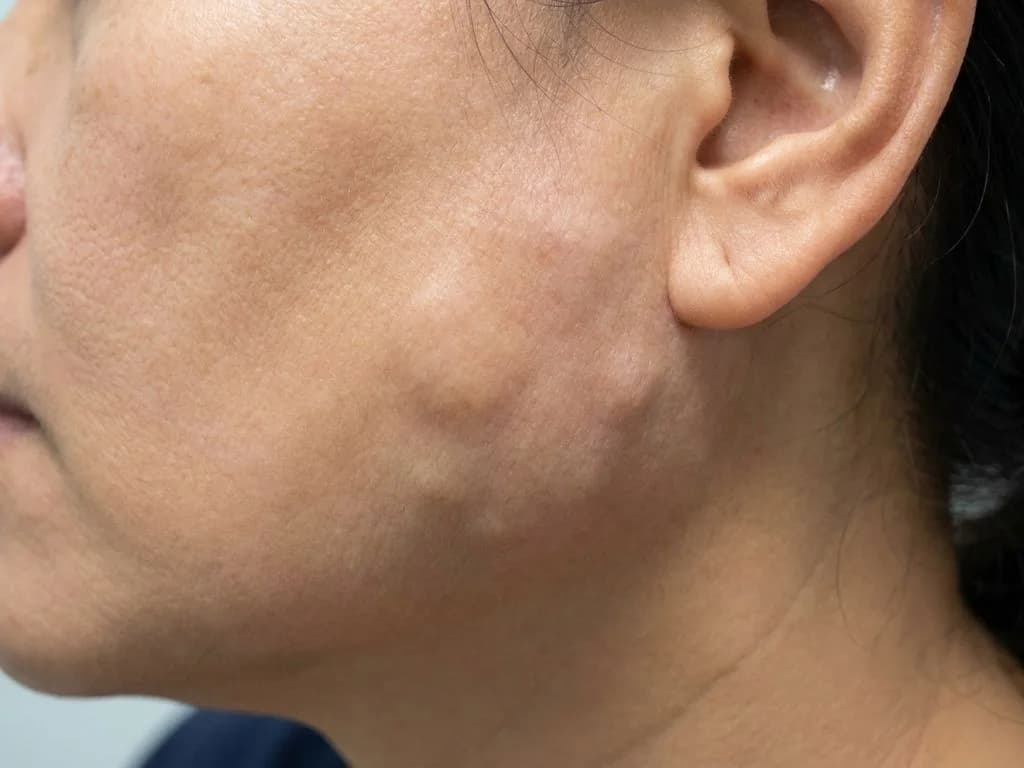
Correct Answer: B. Pleomorphic adenoma
Pleomorphic adenoma is the most common benign salivary gland tumour in India, accounting for 60–70% of parotid tumours. The clinical presentation—slow, progressive swelling over 1.5 years with variable consistency—is pathognomonic. The variable consistency reflects the tumour's mixed histology: epithelial and mesenchymal components (hence "pleomorphic"), creating areas of firmness, fluctuance, and sometimes cystic change. The parotid region (most common site, ~80% of cases) presents as a painless, mobile swelling anterior to the ear, often with facial nerve involvement if large. The slow growth over months to years is classic; rapid growth suggests malignancy (carcinoma ex pleomorphic adenoma). On palpation, the tumour feels firm yet heterogeneous due to its mixed stromal and glandular architecture. Imaging (ultrasound, MRI) shows a well-defined, lobulated mass with mixed echogenicity. Treatment is superficial or total parotidectomy with facial nerve preservation, as incomplete excision risks recurrence (5–10% even after complete excision). The variable consistency on examination—neither purely cystic nor uniformly hard—is the discriminating clinical sign that separates it from sebaceous cysts (uniform, fluctuant) and dermoid cysts (soft, compressible).
Why the other options are wrong
A. Sebaceous cyst — Sebaceous cysts present as uniformly soft, fluctuant, compressible swellings with a central punctum. They lack the variable consistency and firm, lobulated character of pleomorphic adenoma. Sebaceous cysts are epidermal inclusion cysts, not salivary gland tumours, and do not arise in the parotid region. The clinical examination findings—variable consistency with areas of firmness—rule out the uniform softness of a sebaceous cyst. C. Jaw Tumour — Jaw tumours (ameloblastoma, odontogenic keratocyst, dentigerous cyst) arise from mandibular or maxillary bone and present with bony swelling, dental displacement, or malocclusion. They are intraosseous or alveolar lesions, not soft tissue swellings of the parotid region. The slow, painless soft tissue swelling described is inconsistent with osseous pathology. Jaw tumours would show bony expansion on imaging, not the mixed soft tissue density of a salivary gland tumour. D. Dermoid cyst — Dermoid cysts are developmental lesions containing hair, sebaceous material, and sweat glands. They present as soft, compressible, painless swellings, typically in the midline (floor of mouth, neck) or lateral neck. They lack the firm, variable consistency and lobulated character of pleomorphic adenoma. Dermoid cysts are uniformly soft and mobile, not heterogeneous. They do not arise in the parotid gland and are not true neoplasms.
High-Yield Facts
- Pleomorphic adenoma is the most common benign salivary gland tumour (60–70% of parotid tumours) and accounts for ~80% of all parotid neoplasms in India.
- Variable consistency (firm, lobulated, heterogeneous on palpation) is the hallmark clinical sign due to mixed epithelial and mesenchymal histology.
- Slow growth over months to years is typical; rapid growth or facial nerve palsy suggests malignant transformation (carcinoma ex pleomorphic adenoma).
- Superficial parotidectomy with facial nerve preservation is the standard treatment; incomplete excision risks recurrence (5–10%).
- Recurrence risk increases with enucleation or incomplete excision; capsular rupture during surgery increases recurrence from 2% to 45%.
- MRI is the imaging modality of choice for preoperative assessment and facial nerve mapping before surgery.
Mnemonics
PLEOMORPHIC = Mixed Bag Parotid (80% of cases) | Lobulated, firm | Epithelial + mesenchymal | Old age (40–60 yrs) | Mobile, painless | Over months–years (slow) | Recurrence if incomplete | Preservation of facial nerve | Heterogeneous consistency | Imaging: MRI best | Complete parotidectomy. Use when you see 'slow parotid swelling with variable consistency.' SLOW GROWTH = Benign Slow (months–years) → benign | Lobulated, mobile → benign | Over 1–2 years → pleomorphic adenoma | Well-defined → benign. Rapid growth or facial nerve involvement → malignancy. Use to rule out malignant parotid tumours.
NBE Trap
NBE pairs "variable consistency" with multiple benign lesions (sebaceous cyst, dermoid cyst) to lure students into choosing a generic benign diagnosis. The trap is forgetting that variable consistency + slow growth + parotid region = pleomorphic adenoma specifically, not just any benign swelling. Students may also confuse dermoid cyst (soft, compressible) with pleomorphic adenoma (firm, heterogeneous).
Clinical Pearl
In Indian clinical practice, pleomorphic adenoma is the most common parotid tumour encountered in outpatient clinics. The key bedside finding—a firm yet heterogeneous swelling that has grown slowly over years—should immediately trigger the diagnosis. Always assess facial nerve function preoperatively; any palsy suggests malignant transformation and warrants aggressive surgery. Incomplete excision is the enemy: even small residual tumour cells lead to recurrence, sometimes with malignant transformation, making complete parotidectomy the gold standard in Indian surgical practice.
_Reference: Bailey & Love Ch. 32 (Salivary Gland Tumours); Robbins Ch. 16 (Head and Neck Pathology)_