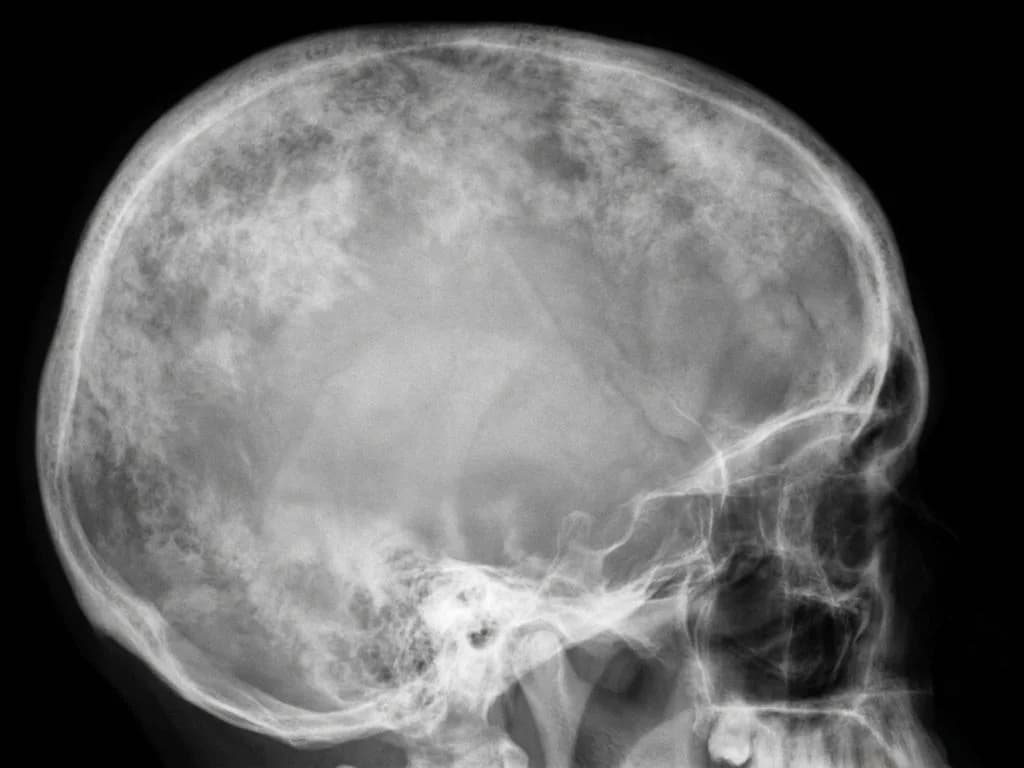
Correct Answer: B. Paget's disease
The skull X-ray shown demonstrates the classic "cotton-wool" appearance — coarse, patchy areas of sclerosis interspersed with lucencies, giving the calvarium a fluffy, disorganized look. This is the hallmark radiographic finding of Paget's disease of bone (osteitis deformans) involving the skull. In the sclerotic (late) phase, disordered bone remodeling by overactive osteoclasts followed by chaotic osteoblastic repair produces thickened, disorganized trabeculae that create this characteristic dense, woolly pattern on X-ray.
Paget's disease of the skull also classically shows enlargement of the calvarium (hat size increase), thickening of the diploë, and obliteration of the inner and outer tables. In the early (lytic) phase, a well-defined area of osteolysis called osteoporosis circumscripta may be seen, typically starting at the frontal or occipital bone and advancing. As the disease progresses into the mixed and sclerotic phases, the cotton-wool pattern predominates. Elevated serum alkaline phosphatase (with normal calcium and phosphate) is the biochemical hallmark, reflecting intense osteoblastic activity.
Why other options are wrong
- A. Hyperparathyroidism — Produces a "salt-and-pepper" (granular osteopenia) pattern of the skull due to diffuse, fine osteoclastic resorption driven by elevated PTH. This appears as a fine mottled granularity of the calvarium — distinctly different from the coarse, fluffy cotton-wool densities of Paget's. Loss of lamina dura and subperiosteal resorption of the middle phalanges are additional clues to hyperparathyroidism.
- C. Hyperthyroidism — Causes generalized, homogeneous osteoporosis due to accelerated bone turnover. The skull may show diffuse thinning but lacks the focal, coarse sclerotic patches characteristic of Paget's disease. There is no specific named skull pattern for hyperthyroidism.
- D. Multiple myeloma — Produces "punched-out" lytic lesions — discrete, round, well-defined areas of bone destruction without surrounding sclerosis, resembling holes punched in paper. This is entirely different from the mixed lytic-sclerotic cotton-wool pattern of Paget's disease.