Temperature regulation is a NEET PG staple that links physiology to critical-care medicine.
Normal core temperature — 36.5 to 37.5 °C oral; diurnal variation lowest around 6 a.m., peak around 6 p.m.; luteal-phase women run 0.3 to 0.5 °C higher.
Temperature regulation sits at the intersection of physiology and critical care — a single vignette can ask about the preoptic set-point, brown adipose tissue in neonates, an obstetric fever workup and the dantrolene protocol for malignant hyperthermia. NEET PG examiners exploit this cross-system reach.
This NEETPGAI deep dive covers normal thermoregulation, the pyrogen cascade, the clinical distinction between fever and hyperthermia, the emergency phenotypes and India-specific heat-stroke public-health context. Pair it with the exercise physiology guide for the exertional heat story.
Normal body temperature
Core body temperature is defended around 37 °C with a normal range of 36.5 to 37.5 °C when measured orally. Rectal readings run 0.3 to 0.6 °C higher than oral; axillary about 0.3 °C lower; tympanic membrane readings approximate core.
Physiological variations:
Diurnal rhythm — lowest around 6 a.m., peaks around 6 p.m. by 0.5 to 1.0 °C.
Menstrual cycle — post-ovulation luteal phase runs 0.3 to 0.5 °C higher (progesterone effect on hypothalamic set-point).
Age — neonates have unstable thermoregulation; elderly often run cooler baselines and mount smaller febrile responses.
Exercise — core temperature rises 1 to 2 °C in moderate work.
Core-shell distinction — the "core" of vital organs plus deep muscle is defended tightly; the shell (skin, subcutaneous fat, limbs) tolerates wider swings and buffers heat exchange with the environment.
Hypothalamic set-point
Two hypothalamic zones share the work:
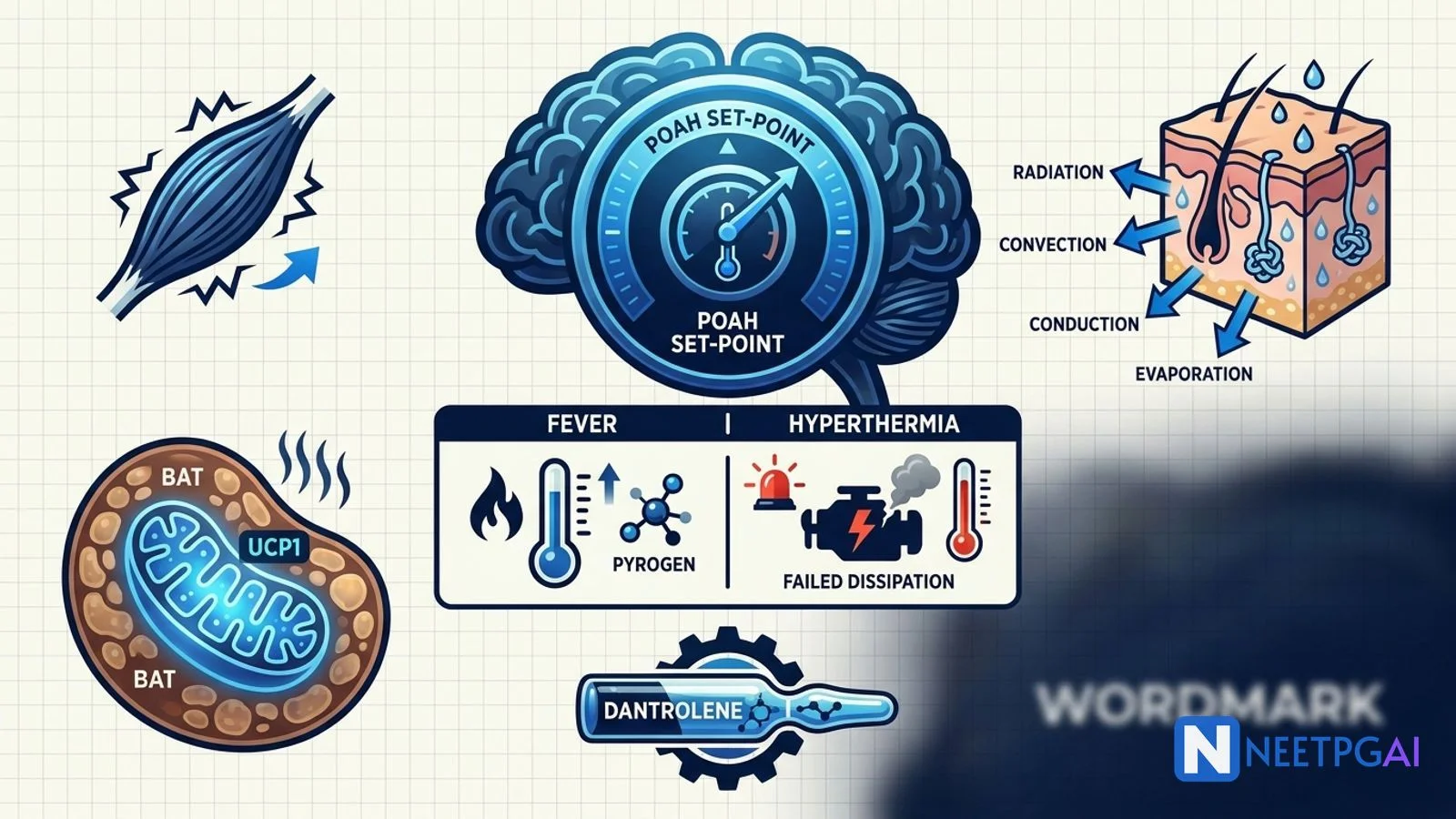
Anterior hypothalamus (preoptic area, POAH) — heat dissipation. Temperature-sensitive neurons rise their firing rate when warm; they drive sweating, cutaneous vasodilation and inhibition of shivering. POAH is where the reference set-point lives.
Posterior hypothalamus — heat conservation and generation. Drives cutaneous vasoconstriction, piloerection, shivering, catecholamine release and behavioural warming.
Peripheral thermoreceptors (skin) and central thermoreceptors (POAH and deep viscera) feed into this comparator. Cold receptors (A-delta and C fibres) outnumber warm receptors approximately 10:1 in the skin.
Heat loss mechanisms
Route
Contribution at rest, comfortable ambient
Notes
Radiation
About 60 percent
Depends on skin-environment gradient; net loss to cooler surroundings
Convection
About 15 percent
Rises with wind and swimming
Conduction
About 3 percent
Small unless in contact with cold surfaces (cold water)
Evaporation
About 22 percent
Rises to dominant mechanism in exercise and heat
Evaporation removes about 0.58 kcal per gram of sweat evaporated (latent heat of vaporisation). It becomes the only route when ambient temperature exceeds skin temperature (roughly above 35 °C) — hence the danger of high humidity, which abolishes the evaporative gradient.
Heat gain and thermogenesis
Basal metabolism provides constant thermogenesis. Voluntary muscle activity and shivering can raise heat production 4 to 5-fold acutely.
Shivering thermogenesis — involuntary rhythmic skeletal-muscle contraction driven by the posterior hypothalamus. All the ATP hydrolysis appears as heat because no external work is performed. Effective in adults; ineffective in neonates (immature muscle mass).
Non-shivering thermogenesis — brown adipose tissue (BAT) contains uncoupling protein 1 (UCP1, thermogenin). UCP1 in the inner mitochondrial membrane dissipates the proton gradient as heat rather than driving ATP synthase. BAT is abundant in neonates (interscapular, perirenal, axillary) and in hibernating mammals; small deposits persist in adults (supraclavicular, paraspinal) but contribute little to routine adult thermogenesis. Thyroid hormone and cold-induced sympathetic beta-3 adrenergic activation upregulate UCP1.
Diet-induced thermogenesis — postprandial rise of about 10 percent of ingested energy, protein highest, fat lowest.
The pyrogen cascade and fever mechanism
Fever begins with exogenous pyrogens — most classically Gram-negative lipopolysaccharide (LPS, endotoxin), but also Gram-positive teichoic acid, viral products, fungal products and immune complexes.
These stimulate monocytes, macrophages and endothelial cells to release endogenous pyrogens — IL-1 (alpha and beta), IL-6, TNF-alpha and interferons. These cytokines act on the organum vasculosum of the lamina terminalis (OVLT) — a circumventricular organ with no blood-brain barrier — inducing cyclooxygenase-2 (COX-2) and driving prostaglandin E2 (PGE2) production in the POAH.
PGE2 binds EP3 receptors on preoptic neurons, resetting the thermoregulatory set-point upwards. The body then responds as if cold — vasoconstriction, shivering, chills, behavioural warmth-seeking — until the new set-point is reached.
Antipyretics — NSAIDs (aspirin, ibuprofen) and paracetamol block COX and reduce PGE2 in the hypothalamus. Glucocorticoids block phospholipase A2 upstream and also suppress cytokine transcription. Antipyretics work in fever (set-point elevated) but do NOT lower temperature in hyperthermia (set-point normal).
Heat stroke — classic (non-exertional, elderly during heat wave) and exertional (young athletes, military, labourers). Core temperature over 40 °C plus CNS dysfunction. Cooling is priority; aim for core below 39 °C within 30 to 60 minutes.
Malignant hyperthermia (MH) — autosomal dominant RYR1 or CACNA1S mutation. Trigger: volatile anaesthetics (halothane, sevoflurane, isoflurane) or succinylcholine. Presents with sustained muscle rigidity, masseter spasm, rising end-tidal CO2, tachycardia, mixed acidosis, hyperkalaemia and rhabdomyolysis. Treat: stop trigger, hyperventilate with 100 percent oxygen, dantrolene 2.5 mg/kg IV bolus (repeat up to 10 mg/kg), active cooling, treat hyperkalaemia and DIC.
Neuroleptic malignant syndrome (NMS) — dopamine-receptor antagonists (typical antipsychotics; also metoclopramide, promethazine, or abrupt withdrawal of Parkinson dopaminergics). Days-to-weeks onset. Lead-pipe rigidity, hyperthermia, autonomic instability, altered mental status, raised CK. Treat: stop trigger, supportive care, cooling, benzodiazepines, dantrolene, bromocriptine or amantadine.
Serotonin syndrome — SSRIs, MAOIs, tramadol, linezolid combinations. Hours onset. Triad of altered mental status, autonomic hyperactivity and neuromuscular abnormalities (clonus, hyperreflexia, tremor, especially lower limbs). Treat: stop trigger, benzodiazepines, cyproheptadine (5-HT2A antagonist), active cooling.
Thyroid storm — decompensated hyperthyroidism, often precipitated by infection, surgery or radioiodine. Fever, tachyarrhythmia, agitation, GI symptoms. Treat: propylthiouracil (blocks synthesis and peripheral T4-to-T3 conversion), beta-blocker (propranolol also blocks conversion), iodine (given 1 hour after PTU to block release, Wolff-Chaikoff), hydrocortisone.
Anticholinergic toxidrome — "hot as a hare, dry as a bone, red as a beet, mad as a hatter, blind as a bat". Treat supportively; physostigmine in select cases.
Management principles
Fever — treat the underlying cause. Antipyretics (paracetamol first-line in children, ibuprofen alternative; avoid aspirin under 16 because of Reye syndrome risk) for comfort, not for the number on the thermometer. Sponging with tepid water is adjunctive but should not induce shivering (which raises heat production).
Hyperthermia — cooling is the definitive treatment.
External cooling — ice-water immersion (fastest, gold standard in exertional heat stroke), evaporative cooling (spray plus fan; better tolerated in elderly classic heat stroke), ice packs to axillae/groin/neck.
Internal cooling — cold IV fluids, cold gastric or bladder lavage, intravascular cooling catheters in select ICU settings.
Factitious fever — normal pulse-temperature dissociation; check simultaneous urine and blood.
Neonate thermoregulation — BAT-dependent; large surface-area-to-mass ratio; cold stress is dangerous.
Postoperative fever — 5 Ws (wind, water, walking, wound, wonder drugs) days 1 to 5 onwards.
India-specific context
Heat action plans — Ahmedabad's 2013 heat action plan (post-2010 heat wave) became the WHO template; now adopted across Odisha, Andhra Pradesh, Telangana and Delhi.
Occupational heat stress — outdoor workers, construction sites, brick kilns; National Programme on Climate Change and Human Health (NPCCHH) mandates local heat surveillance.
Neonatal hypothermia — leading contributor to neonatal mortality in home deliveries; kangaroo mother care and warm chain protocols central to national newborn care guidelines.
Malignant hyperthermia — under-recognised in India; dantrolene availability at district hospitals is patchy — a real exam-worthy safety issue for candidates joining anaesthesia postings.
Enteric fever season — pre-monsoon and monsoon peaks in typhoid across South Asia; classic step-ladder fever and relative bradycardia (Faget sign).
Frequently asked questions
What is the difference between fever and hyperthermia?
Fever is a regulated rise in body temperature caused by cytokine-driven upward resetting of the hypothalamic set-point via PGE2 in the preoptic area — the body 'wants' to be hotter and defends the new set-point. Hyperthermia is an uncontrolled rise despite an unchanged set-point — the body cannot dissipate heat fast enough. Antipyretics work in fever but not hyperthermia; hyperthermia demands active cooling.
Which brain region houses the thermoregulatory set-point?
The preoptic area of the anterior hypothalamus houses temperature-sensitive neurons that set the reference core temperature. Lesions to this area (from stroke, surgery or trauma) can abolish fever and impair heat dissipation. The posterior hypothalamus coordinates heat conservation and generation responses. Pyrogenic cytokines act through PGE2 on these preoptic neurons to shift the set-point upwards.
What produces non-shivering thermogenesis and in whom is it important?
Non-shivering thermogenesis is driven mainly by brown adipose tissue (BAT), which contains uncoupling protein 1 (UCP1) — this dissipates the mitochondrial proton gradient as heat rather than trapping it as ATP. Neonates depend heavily on BAT (present in interscapular, perirenal and axillary sites) because they cannot shiver effectively. Small amounts of BAT persist in adults but its contribution to human adult thermogenesis is limited.
What is malignant hyperthermia and how is it treated?
Malignant hyperthermia is a pharmacogenetic disorder — autosomal dominant mutations in the ryanodine receptor (RYR1) or CACNA1S — triggered by volatile anaesthetics (halothane, sevoflurane, isoflurane) or depolarising muscle relaxants (succinylcholine). Uncontrolled calcium release from the sarcoplasmic reticulum drives sustained muscle contraction, heat and rhabdomyolysis. Treatment is immediate dantrolene (2.5 mg/kg IV bolus, repeat up to 10 mg/kg), stopping the trigger, active cooling and supportive care for hyperkalaemia and DIC.
Why is heat stroke a major public-health concern in India?
India has recorded thousands of heat-stroke deaths in single summers, disproportionately affecting outdoor workers, elderly, homeless and slum populations. Rising ambient temperatures with climate change, urban heat islands, humidity that limits evaporative cooling and limited access to shade, hydration and cooling shelters combine dangerously. Delhi, Ahmedabad and Odisha have led on heat-action plans; NEETPGAI increasingly tests candidates on classic (non-exertional) vs exertional heat stroke recognition and management.
This content is for educational purposes for NEET PG exam preparation. It is not a substitute for professional medical advice, diagnosis, or treatment. Clinical information has been reviewed by qualified medical professionals.
Written by: NEETPGAI Editorial Team
Reviewed by: Pending SME Review
Last reviewed: September 2026