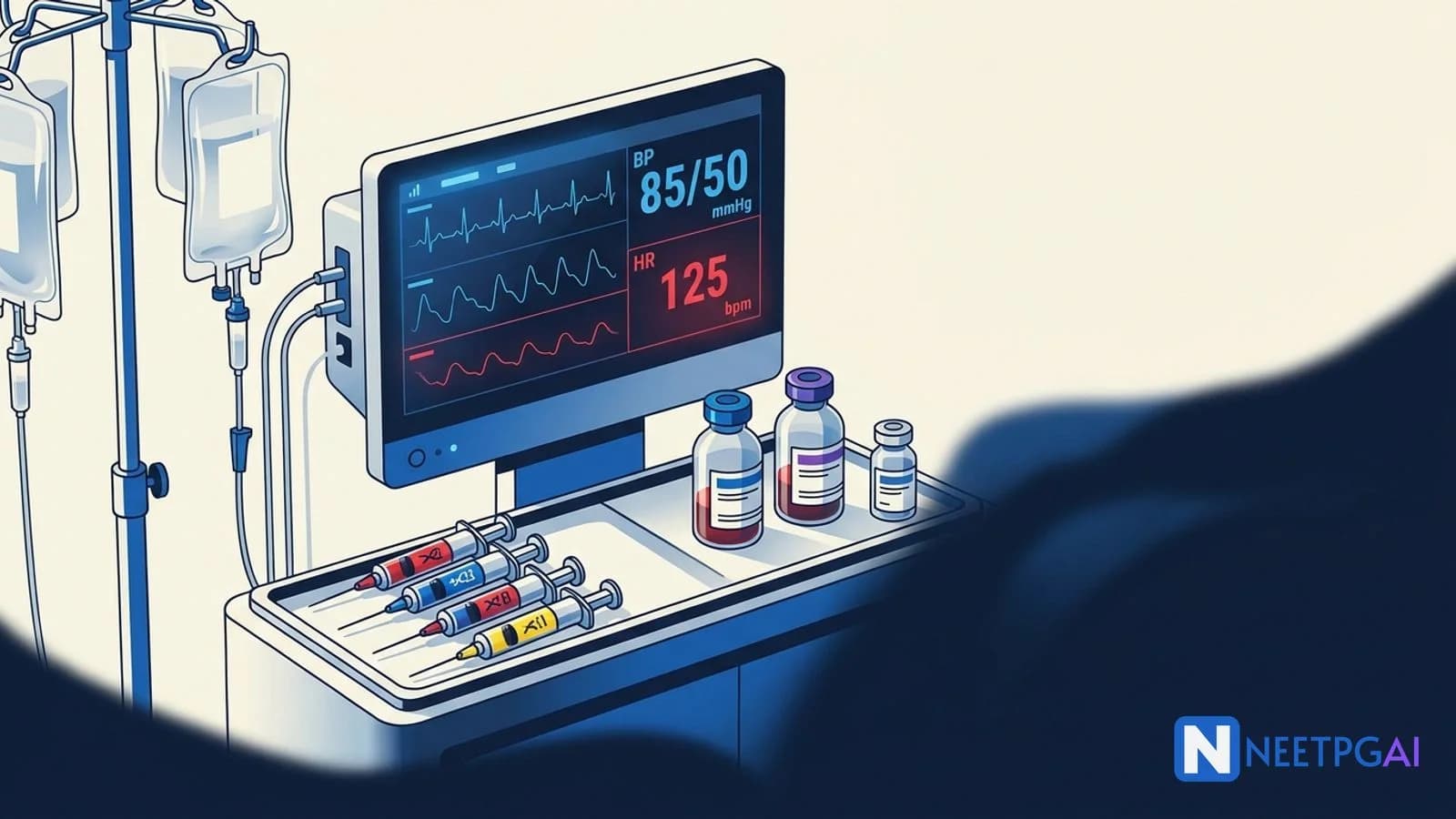
Master shock and sepsis for NEET PG 2027: types of shock (distributive, cardiogenic, hypovolemic, obstructive), Sepsis-3 and qSOFA definitions, hemodynamic parameters, fluid resuscitation, vasopressors, antibiotic timing, and Surviving Sepsis Campaign 2021.
NEETPGAI EditorialPublished 13 Jan 2026Updated 29 Sept 202618 min read
Share this article
This content is for educational purposes for NEET PG exam preparation. It is not a substitute for professional medical advice, diagnosis, or treatment. Clinical information has been reviewed by qualified medical professionals.
Ready to put this into practice?
Start practicing NEET PG MCQs with AI-powered explanations.
Comparison of the authorities that shape NEET PG, INI-CET, FMGE, and Indian medical education: NMC (regulator), NBEMS (exam conductor), MCC (AIQ counseling), DGHS (health services), AIIMS (INI-CET), plus state councils and FMG pathway — clarifies who does what.
Antibiotic timing — Within 1 hour for septic shock (each hour delay = ~7% excess mortality). Broad-spectrum empiric, de-escalate with cultures
MAP target — >=65 mmHg (higher 80–85 in chronic hypertensives per SEPSISPAM)
SSC 2021 bundle — 1-hour bundle: measure lactate, blood cultures before antibiotics, broad-spectrum antibiotics, 30 mL/kg crystalloid if hypotension or lactate >=4, vasopressors if MAP <65 after fluids
Shock is acute circulatory failure with cellular hypoxia — and sepsis is the most common cause of shock in hospital settings, carrying 30–50% mortality for septic shock. The student who masters shock classification, Sepsis-3 definitions, and the Surviving Sepsis Campaign bundle has covered 2–3 marks on medicine and pharmacology papers. Pair this guide with daily MCQ practice on the Medicine subject hub and cross-reference the high-yield medicine topics overview for adjacent critical care concepts.
Types of shock — the four categories
Shock is acute circulatory failure resulting in inadequate cellular oxygen delivery and organ dysfunction, classified into four types based on hemodynamic mechanism.
Mixed shock: Many patients have combinations (e.g., septic shock + myocardial depression with reduced CO; hypovolemic + distributive after trauma with SIRS).
Distributive shock
Distributive shock is inappropriate vasodilation with maldistribution of blood flow, most commonly caused by sepsis.
Septic shock: Covered in detail below.
Anaphylactic shock: IgE-mediated mast cell degranulation, urticaria, bronchospasm, airway edema, cardiovascular collapse. Treatment: IM epinephrine 0.3–0.5 mg (0.3–0.5 mL of 1:1000) into anterolateral thigh, repeat every 5–15 min. Adjuncts: IV fluids, H1 and H2 blockers, corticosteroids, inhaled beta-2 agonist.
Neurogenic shock: Loss of sympathetic tone after spinal cord injury (especially above T6). Triad: hypotension + bradycardia + warm extremities. Distinguished from spinal shock (which is temporary areflexia below the injury level). Treatment: IV fluids + vasopressors (norepinephrine or phenylephrine); atropine for bradycardia.
Adrenal crisis: Chronic adrenal insufficiency + stress (surgery, infection). Hypotension refractory to fluids and pressors. Treatment: IV hydrocortisone 100 mg bolus, then 50–100 mg q6h.
Cardiogenic shock
Cardiogenic shock is pump failure with CI <2.2 L/min/m² and hemodynamic signs of tissue hypoperfusion despite adequate preload.
Causes:
Acute MI with large infarct (most common — SHOCK trial)
Mechanical complications of MI (VSR, papillary muscle rupture, free wall rupture)
Acute decompensated heart failure
Myocarditis
Arrhythmia (VT, complete heart block)
Valvular disease (acute MR, AR)
Management:
Revascularization (primary PCI or CABG — SHOCK trial, mortality benefit at 6 months and 1 year)
Vasopressors: Norepinephrine preferred if hypotensive despite inotropes
Mechanical circulatory support: Intra-aortic balloon pump (decreases afterload, increases coronary perfusion — IABP-SHOCK II showed no mortality benefit but still used in select cases), Impella, VA-ECMO for refractory shock
Hypovolemic shock
Hypovolemic shock is volume deficit from hemorrhage or non-hemorrhagic losses.
Hemorrhagic shock classes (ATLS):
Class
Blood loss
HR
BP
Mental status
Treatment
I
<15% (<750 mL)
<100
Normal
Slight anxiety
Crystalloid only
II
15–30% (750–1500 mL)
100–120
Normal SBP, decreased PP
Mildly anxious
Crystalloid
III
30–40% (1500–2000 mL)
120–140
Decreased
Confused
Crystalloid + blood
IV
>40% (>2000 mL)
>140
Severely decreased
Lethargic
Massive transfusion protocol
Management:
Control bleeding source (surgical, endoscopic, interventional radiology)
Crystalloid resuscitation then blood products
Massive transfusion protocol: 1:1:1 ratio (PRBC:FFP:platelets) — PROPPR trial
Tranexamic acid within 3 hours of trauma — CRASH-2 trial showed mortality benefit
Permissive hypotension (target SBP 80–90) until bleeding is controlled in trauma (not in TBI)
Obstructive shock
Obstructive shock is mechanical obstruction to cardiac output — requiring emergency identification and reversal.
Passive leg raise (PLR) with CO increase >10% = fluid responsive
Inferior vena cava collapsibility >50% on ultrasound = fluid responsive
Lactate: Surrogate for tissue hypoxia. Normal <2 mmol/L. >4 = severe. Lactate clearance (decrease over 6 hours) correlates with outcome; failure to clear is a poor prognostic sign.
Fluid resuscitation
Fluid resuscitation is the initial intervention in hypotensive shock — delivered in a stepwise, measured way to restore perfusion without causing overload.
Vasopressors restore vascular tone and MAP when volume replacement alone fails — with a clear hierarchy of first, second, and third-line agents in septic shock.
Drug
Mechanism
First-line in
Adverse effects
Norepinephrine
Alpha-1 (primary) + beta-1 (modest)
Septic shock (1st line)
Arrhythmia, digital ischemia
Vasopressin
V1 receptor (non-adrenergic vasoconstriction)
Septic shock (add-on at 0.03 U/min)
Splanchnic and digital ischemia at higher doses
Epinephrine
Alpha-1 + beta-1 + beta-2
Anaphylaxis; septic shock 3rd line
Tachyarrhythmia, hyperglycemia, lactic acidosis
Dopamine
Dose-dependent (dopa → beta → alpha)
Avoided in sepsis (arrhythmia, worse outcomes — SOAP-II trial)
Tachyarrhythmia
Phenylephrine
Pure alpha-1
Septic shock with tachyarrhythmia
Reflex bradycardia, reduced CO
Dobutamine
Beta-1 (primary)
Cardiogenic shock; add-on for sepsis with low CO
Tachycardia, hypotension
Milrinone
PDE-3 inhibitor (inotrope + vasodilator)
Cardiogenic shock with high SVR
Hypotension, arrhythmia
Angiotensin II
AT1 receptor agonist
Vasodilatory shock refractory to norepinephrine + vasopressin
Add epinephrine (or increase norepinephrine) if target not achieved
Add dobutamine if evidence of cardiac dysfunction (low CO, elevated lactate despite adequate MAP)
Why norepinephrine over dopamine: SOAP-II trial (NEJM 2010) showed dopamine caused more arrhythmias and trend toward higher mortality in cardiogenic shock subgroup.
Antibiotic timing and choice
Antibiotic timing is one of the most evidence-based interventions in sepsis — each hour of delay associates with ~7% increased mortality (Kumar et al., CCM 2006).
Surviving Sepsis Campaign 2021 recommendations:
Septic shock: Antibiotics within 1 hour (strong recommendation)
Sepsis without shock, high infection probability: Within 1 hour
Sepsis without shock, uncertain diagnosis: Within 3 hours
Empiric regimen principles:
Broad-spectrum covering likely pathogens based on source and local antibiogram
Combination therapy for septic shock (e.g., beta-lactam + aminoglycoside or fluoroquinolone) for possible resistant organisms
Adjust dose for renal/hepatic function; consider extended infusion beta-lactams in septic shock
Common source-based empiric choices:
Source
First-line empiric
Urinary (community)
Ceftriaxone or piperacillin-tazobactam
Urinary (healthcare-associated)
Piperacillin-tazobactam or carbapenem
Abdominal (community)
Piperacillin-tazobactam or ceftriaxone + metronidazole
Abdominal (healthcare)
Carbapenem (meropenem/imipenem)
Pulmonary (community)
Ceftriaxone + azithromycin
Pulmonary (HAP/VAP)
Piperacillin-tazobactam or cefepime + vancomycin + antipseudomonal
Blood cultures: Obtain BEFORE antibiotics if this does not delay treatment by more than 45 minutes.
De-escalation: Narrow therapy once cultures and sensitivities available (typically 48–72 hours). Shortens antibiotic exposure and reduces resistance emergence.
Surviving Sepsis Campaign 2021 — the hour-1 bundle
The Surviving Sepsis Campaign is the international consensus guideline for sepsis management — updated in 2021 with a streamlined 1-hour bundle replacing the older 3- and 6-hour bundles.
1-hour bundle (for both sepsis and septic shock):
Measure lactate level. Re-measure if initial lactate >2 mmol/L.
Obtain blood cultures before administering antibiotics.
Administer broad-spectrum antibiotics.
Begin rapid administration of 30 mL/kg crystalloid for hypotension or lactate >=4 mmol/L.
Apply vasopressors if patient is hypotensive during or after fluid resuscitation to maintain MAP >=65 mmHg.
Additional SSC 2021 recommendations:
Target MAP >=65 mmHg (higher in chronic hypertensives — SEPSISPAM)
Use norepinephrine as first-line vasopressor; add vasopressin second
Use dynamic parameters to guide further fluid resuscitation
Sepsis survivors face significant long-term morbidity known as post-sepsis syndrome — physical, cognitive, and psychological impairments lasting months to years.
Acute complications:
ARDS (acute respiratory distress syndrome) — PaO2/FiO2 <=300 with bilateral infiltrates not explained by cardiac failure
Acute kidney injury — occurs in 40–50% of septic patients; highest mortality subgroup
Disseminated intravascular coagulation (DIC) — consumptive coagulopathy with bleeding and microthrombi
Multi-organ failure: 50–80% (mortality increases with each failing organ)
Prognostic scores:
SOFA score — organ dysfunction and mortality
APACHE-II — 24-hour ICU severity
MEWS — ward-based deterioration
Sources and references
Surviving Sepsis Campaign International Guidelines for Management of Sepsis and Septic Shock 2021 (Intensive Care Medicine, 2021; 47:1181-1247) — the global reference for sepsis protocols.
Singer M, Deutschman CS, Seymour CW, et al. — The Third International Consensus Definitions for Sepsis and Septic Shock (Sepsis-3) (JAMA 2016; 315:801-810).
Harrison's Principles of Internal Medicine, 21st Edition (Loscalzo et al., 2022) — Chapters on Shock and Sepsis.
Rivers E, Nguyen B, et al. — Early goal-directed therapy in the treatment of severe sepsis and septic shock (NEJM 2001; 345:1368-1377) — historical EGDT trial; subsequent ProCESS, ARISE, ProMISe trials showed similar outcomes with usual care.
De Backer D, Biston P, et al. — Comparison of dopamine and norepinephrine in the treatment of shock (NEJM 2010; 362:779-789; SOAP-II trial).
API Textbook of Medicine, 11th Edition (Munjal et al., 2019) — Indian-context critical care management.
Frequently asked questions
How many shock/sepsis questions appear in NEET PG?
Critical care topics contribute 2-3 direct questions per NEET PG paper across medicine, surgery, and pharmacology. Shock classification by hemodynamic parameters, Sepsis-3 definitions, and vasopressor choice are the three most frequently tested subtopics based on 2019-2025 pattern analysis.
What are the four types of shock?
Shock is classified into four types: distributive (septic, anaphylactic, neurogenic — low SVR, high CO), cardiogenic (MI, heart failure — low CO, high SVR, high PCWP), hypovolemic (hemorrhage, dehydration — low CO, high SVR, low CVP), and obstructive (PE, tension pneumothorax, tamponade — low CO, high SVR, variable filling pressures). Hemodynamic profile distinguishes them at the bedside.
What is Sepsis-3?
Sepsis-3 (2016 definition) defines sepsis as life-threatening organ dysfunction caused by a dysregulated host response to infection, identified clinically by a rise in SOFA score of 2 or more points from baseline. Septic shock is sepsis requiring vasopressors to maintain MAP greater than or equal to 65 mmHg despite adequate fluid resuscitation, plus serum lactate greater than 2 mmol/L. SIRS criteria are no longer part of the sepsis definition.
What is qSOFA?
qSOFA (quick SOFA) is a bedside screening tool for sepsis in non-ICU settings. Score 1 point for each: respiratory rate greater than or equal to 22/min, altered mentation (GCS less than 15), systolic BP less than or equal to 100 mmHg. Score greater than or equal to 2 suggests high risk of poor outcome. qSOFA is a screening tool, not a definitive sepsis diagnosis — missed sensitivity has been reported.
What is the first-line vasopressor in septic shock?
Norepinephrine is the first-line vasopressor in septic shock (Surviving Sepsis Campaign 2021). It increases SVR via alpha-1 agonism with modest inotropy via beta-1 agonism. Add vasopressin 0.03 U/min as second agent to reduce norepinephrine dose. Epinephrine is third-line (add-on). Dopamine is no longer recommended due to arrhythmogenicity. Phenylephrine is used selectively when tachyarrhythmia is an issue.
How much fluid should I give in septic shock?
Initial fluid resuscitation is 30 mL/kg crystalloid (balanced crystalloid preferred over normal saline per SMART and BaSICS trials) within the first 3 hours. After this, further fluid should be guided by dynamic parameters (pulse pressure variation, stroke volume variation, passive leg raise) rather than static (CVP, PCWP). Over-resuscitation causes pulmonary edema, abdominal compartment syndrome, and worse outcomes.
When should antibiotics be given in sepsis?
Antibiotics should be given within 1 hour of recognition of septic shock (Surviving Sepsis Campaign 2021, strong recommendation). For sepsis without shock, within 1 hour if high certainty of infection; within 3 hours if diagnosis is less certain. Each hour of delay is associated with approximately 7 percent increased mortality. Broad-spectrum coverage initially, then de-escalate based on cultures.
What are the hemodynamic parameters in different shocks?
In distributive shock (septic): CO is high or normal, SVR is low, PCWP is low or normal, CVP is low or normal. In cardiogenic shock: CO is low, SVR is high, PCWP is high, CVP is high. In hypovolemic shock: CO is low, SVR is high, PCWP is low, CVP is low. In obstructive shock (tamponade, PE): CO is low, SVR is high, PCWP variable, CVP is high (or equalized in tamponade).
What is the MAP target in septic shock?
The MAP target in septic shock is greater than or equal to 65 mmHg (Surviving Sepsis Campaign 2021). Higher targets (MAP 80-85) should be considered only in chronically hypertensive patients — the SEPSISPAM trial showed reduced need for RRT in this subgroup. Lower MAPs cause end-organ hypoperfusion; higher MAPs cause arrhythmia and vasopressor toxicity.
What is the crystalloid versus colloid debate?
Balanced crystalloids (Ringer lactate, Plasma-Lyte) are first-line resuscitation fluid in sepsis. Normal saline causes hyperchloremic metabolic acidosis (SMART trial). Albumin is a reasonable addition when large volumes of crystalloid have been given (ALBIOS trial). Hydroxyethyl starch (HES) is contraindicated in sepsis — increased AKI and mortality (CHEST, 6S trials). Gelatin colloids should also be avoided.
Ready to test your critical care knowledge? Pair this with the pharmacology MCQ strategy guide for vasopressor drug drills, and use the AI tutor to work through shock vignettes on demand.
Explore our pricing plans for unlimited practice across all 19 subjects, AI-powered doubt resolution, and personalized study plans.
This content is for educational purposes for NEET PG exam preparation. It is not a substitute for professional medical advice, diagnosis, or treatment. Clinical information has been reviewed by qualified medical professionals.
Written by: NEETPGAI Editorial Team
Reviewed by: Pending SME Review
Last reviewed: March 2026
This article is reviewed by qualified medical professionals for clinical accuracy and exam relevance. For corrections or updates, contact the editorial team.