NEETPGAI
FeaturesBlogComparePricing
Log inStart Free
NEETPGAI

AI-powered NEET PG preparation platform. Master all 19 subjects with adaptive MCQs, AI tutoring, and spaced repetition.

Product

  • Features
  • Subjects
  • Previous Year Questions
  • Compare
  • Pricing
  • Blog

Features

  • Adaptive MCQ Practice
  • AI Tutor
  • Mock Tests
  • Spaced Repetition

Resources

  • Blog
  • Study Guides
  • NEET PG Updates
  • Contact & support

Legal

  • Privacy Policy
  • Terms of Service

Stay updated

© 2026 NEETPGAI. All rights reserved.
    Study MaterialMedicineSeizures & Epilepsy Classification for NEET PG — Complete Guide 2026
    22 January 2026
    medicine
    neurology
    neet pg 2026

    Seizures & Epilepsy Classification for NEET PG — Complete Guide 2026

    Master seizures and epilepsy for NEET PG 2026: ILAE 2017 classification, semiology, status epilepticus algorithm, EEG patterns, AED selection by seizure type, AEDs in pregnancy, and driving rules.

    NEETPGAI EditorialPublished 22 Jan 202615 min read
    Seizures & Epilepsy Classification for NEET PG — Complete Guide 2026

    Version 1.0 — Published March 2026

    Quick Answer

    Seizures and epilepsy contribute 2–3 direct questions per NEET PG paper. Master these 10 high-yield areas:

    1. ILAE 2017 classification — Onset type first: focal (aware / impaired awareness), generalized (motor or non-motor), unknown. Replaces simple-partial / complex-partial terminology.
    2. Seizure semiology — Aura (focal aware onset), automatisms (lip-smacking, picking — temporal lobe), versive head turn (frontal), Jacksonian march (motor cortex)
    3. Status epilepticus definition — Seizure >=5 minutes OR >=2 seizures without recovery of consciousness between them
    4. Status management algorithm — IV lorazepam 0.1 mg/kg → IV fosphenytoin 20 mg PE/kg or levetiracetam 60 mg/kg or valproate 40 mg/kg → midazolam / propofol infusion if refractory
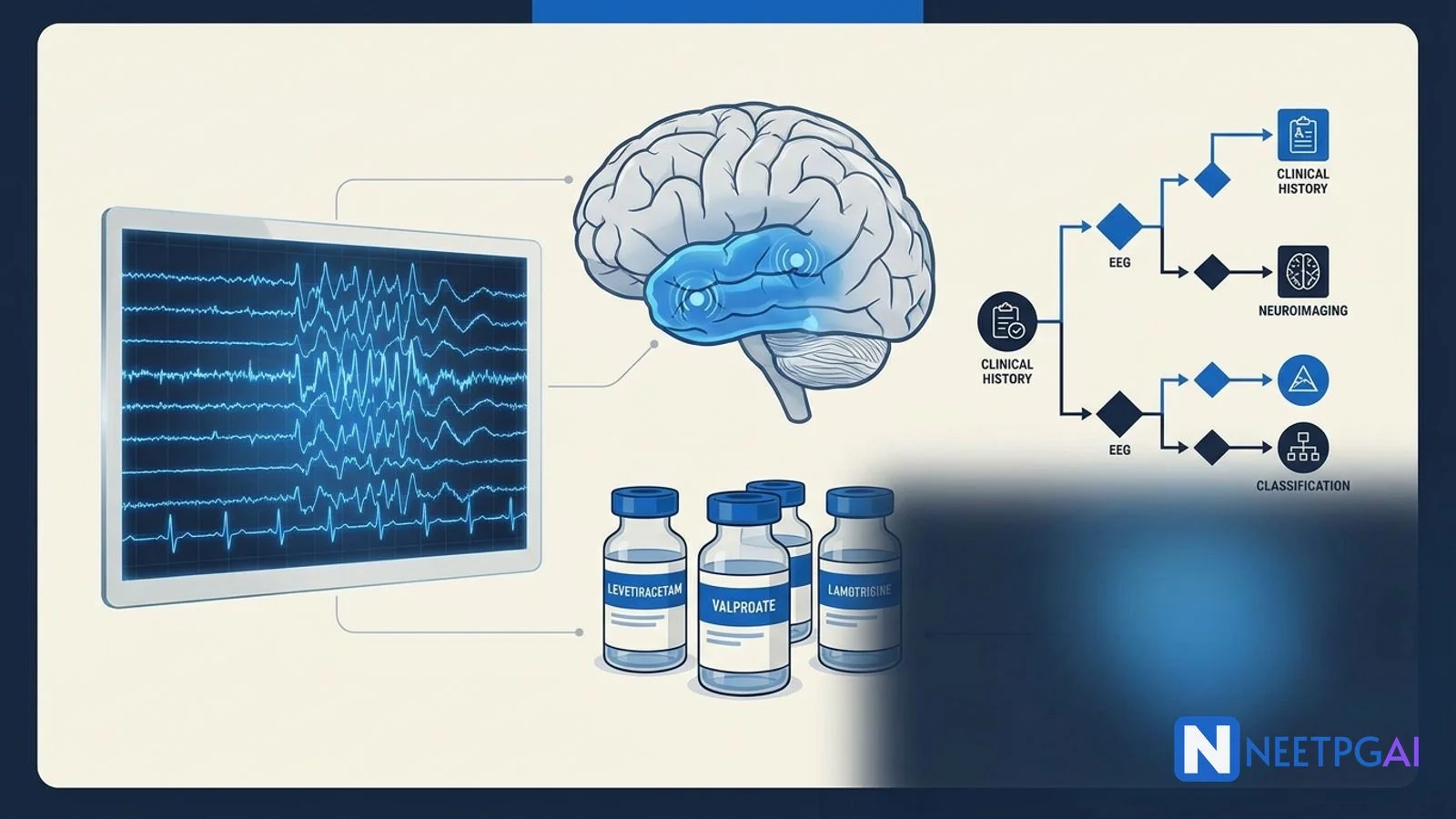
    5. EEG patterns — 3 Hz spike-wave (childhood absence), hypsarrhythmia (West syndrome), PLEDs (herpes encephalitis, stroke), burst suppression (coma / hypothermia)
    6. First-line AEDs by type — Focal: carbamazepine, lamotrigine, levetiracetam. Generalized tonic-clonic: valproate (men), levetiracetam / lamotrigine (women). Absence: ethosuximide. Myoclonic: valproate, levetiracetam.
    7. AEDs in pregnancy — Lamotrigine and levetiracetam are safest. Valproate contraindicated (neural tube defects, IQ reduction). Folic acid 5 mg daily preconception.
    8. Hypersensitivity — Carbamazepine, phenytoin, lamotrigine, phenobarbitone carry SJS / TEN risk. HLA-B*1502 test before carbamazepine in Asian patients.
    9. Cognitive side effects — Phenobarbitone, topiramate (word-finding), phenytoin (encephalopathy at toxic levels >20 mcg/mL). Levetiracetam behavioural (irritability).
    10. Driving rules (India) — 1-year seizure-free for private licence, 3-year for commercial vehicle per the Motor Vehicles Act.

    Epilepsy is a disorder of the brain characterised by an enduring predisposition to generate epileptic seizures — and it sits at the intersection of medicine, pharmacology, and pediatrics in NEET PG. The student who masters ILAE 2017 classification, status algorithm, and first-line AED by seizure type has covered the foundation for 2–3 marks across papers. Pair this guide with daily MCQ practice on the Medicine subject hub and cross-reference the high-yield medicine topics overview for context on how neurology sits within the broader medicine pattern.

    ILAE 2017 classification of seizures and epilepsy

    The ILAE 2017 framework is a two-tier system: it classifies each individual seizure by onset, then classifies the underlying epilepsy by type and etiology.

    Level 1 — Seizure type (onset-based):

    OnsetSubtypeExamples
    Focal onsetAware (old: simple partial)Focal motor (Jacksonian), focal sensory, focal autonomic
    Impaired awareness (old: complex partial)Temporal lobe with automatisms
    Motor or non-motorClonic, tonic, atonic, hyperkinetic / sensory, cognitive, emotional
    Focal to bilateral tonic-clonicOld: secondarily generalised
    Generalized onsetMotorTonic-clonic, clonic, tonic, myoclonic, atonic, myoclonic-atonic, epileptic spasms
    Non-motor (absence)Typical, atypical, myoclonic absence, absence with eyelid myoclonia
    Unknown onsetMotor / non-motor / unclassifiedWhen onset is unwitnessed

    Level 2 — Epilepsy type: Focal epilepsy, generalized epilepsy, combined generalized and focal epilepsy, unknown.

    Level 3 — Etiology (6 groups): Structural, genetic, infectious, metabolic, immune, unknown.

    NEET PG trap: The terms "simple partial" and "complex partial" are obsolete under ILAE 2017. Use "focal aware" and "focal with impaired awareness" instead. Examiners now expect the new terminology in single-best-answer stems.

    Seizure semiology — localising the lesion

    Semiology is the clinical description of a seizure — and it points to the lobe of origin, which is high-yield because it maps directly to structural epilepsy etiology.

    SemiologyLocalisationKey features
    Aura (epigastric rising, fear, déjà vu)Mesial temporalFocal aware onset; precedes impaired awareness
    Automatisms (lip-smacking, chewing, picking)Temporal (usually mesial)Postictal confusion common
    Versive head turn + arm posturingFrontal (contralateral)Fencer posture; brief, clusters at night
    Jacksonian marchPrimary motor cortexProgressive spread along homunculus
    Visual hallucinations (simple lights)OccipitalContralateral field
    Complex visual / auditoryTemporo-occipital junctionFormed images, music
    Gelastic seizure (laughter)Hypothalamic hamartomaPrecocious puberty in same child
    Todd paralysisAny focal motorPost-ictal weakness <24 hours; mimics stroke

    Differentiating seizure from syncope:

    • Seizure: Aura, tongue bite (lateral), cyanosis, postictal confusion >5 minutes, elevated prolactin at 10–20 minutes, incontinence
    • Syncope: Prodrome (lightheadedness), pallor, brief loss of consciousness, rapid recovery, situational trigger, no postictal state

    Psychogenic non-epileptic seizure (PNES) clues: Side-to-side head movement, closed eyes during event, pelvic thrusting, long duration (>5 minutes), no cyanosis, normal EEG during event.

    Practice now

    Seizures Epilepsy

    Put this section into practice with 3 NEET PG-style MCQs. Free, instant AI explanation on every answer.

    Practice Seizures Epilepsy MCQs

    Status epilepticus — definition and management

    Status epilepticus is a seizure lasting 5 minutes or longer, or two or more seizures without recovery of consciousness in between — a neurological emergency with mortality of 10–20%.

    Timeline-based staging (ILAE 2015):

    PhaseDurationAction
    Impending5–30 minStart benzodiazepine
    Established30–60 minSecond-line AED (fosphenytoin / levetiracetam / valproate)
    RefractorySeizure despite 2 agentsIV anaesthetic infusion (midazolam, propofol, thiopentone)
    Super-refractory>24 hr on anaesthesiaKetamine, ketogenic diet, immunotherapy if autoimmune cause

    First-line benzodiazepine (Stage 1, 0–20 min):

    1. IV lorazepam 0.1 mg/kg (max 4 mg per dose), repeat once at 5 min — gold standard
    2. IV diazepam 0.15–0.2 mg/kg (max 10 mg) — shorter duration
    3. IM midazolam 10 mg (adult) — use if no IV access (RAMPART trial)
    4. Buccal midazolam 10 mg or rectal diazepam 0.5 mg/kg — pre-hospital / pediatric

    Second-line (Stage 2, 20–40 min) — ESETT trial 2019 found all three equivalent:

    • Fosphenytoin 20 mg PE/kg IV at 150 mg/min (PE = phenytoin equivalent)
    • Levetiracetam 60 mg/kg IV (max 4500 mg) over 15 min
    • Valproate 40 mg/kg IV (max 3000 mg) over 10 min

    Third-line (refractory, >40 min): Continuous IV infusion under intubation and EEG monitoring.

    • Midazolam 0.2 mg/kg bolus + 0.05–2 mg/kg/hr infusion
    • Propofol 1–2 mg/kg bolus + 2–10 mg/kg/hr infusion
    • Thiopentone / pentobarbitone if above fail

    Target: Burst suppression on EEG for 24–48 hours, then taper.

    NEET PG traps:

    • Do not use phenytoin via normal saline alongside glucose-containing fluids (precipitates)
    • Fosphenytoin can be given IM (phenytoin cannot — causes purple glove syndrome)
    • Levetiracetam has no significant interactions — safer in polytherapy

    EEG patterns — the pattern-recognition questions

    EEG patterns are signature waveforms that point to specific syndromes, and the pattern-to-diagnosis match is classic NEET PG material.

    PatternDescriptionDiagnosis
    3 Hz generalised spike-and-waveSymmetric, bilateral, provoked by hyperventilationChildhood absence epilepsy
    4–6 Hz polyspike-and-waveGeneralisedJuvenile myoclonic epilepsy
    Slow spike-wave (<=2.5 Hz)Generalised, background slowingLennox-Gastaut syndrome
    HypsarrhythmiaChaotic, high-voltage, multifocal spikes, disorganised slow wavesWest syndrome (infantile spasms)
    PLEDs (periodic lateralised epileptiform discharges)Unilateral, 1–3 Hz sharp wavesHerpes simplex encephalitis, stroke, CJD
    Centrotemporal spikesBiphasic sharp waves, sleep-activatedBenign rolandic epilepsy (BECTS)
    Burst suppressionBursts of activity alternating with flat periodsAnaesthesia depth, hypoxic encephalopathy, Ohtahara syndrome
    Triphasic waves1–2 Hz, symmetricMetabolic (hepatic, uraemic) encephalopathy
    Generalised periodic sharp waves (1 Hz)Every 1 secondCreutzfeldt-Jakob disease
    Extreme delta brushDelta waves with superimposed fast activityAnti-NMDA receptor encephalitis

    Photic-paroxysmal response: Generalised spike-wave on photic stimulation at 15–20 Hz — classic for juvenile myoclonic epilepsy.

    First-line AEDs by seizure type

    AED selection is mechanism-matched to seizure type — choosing the wrong drug can worsen seizures (e.g., carbamazepine worsens absence).

    Seizure / syndromeFirst-lineAlternativesAvoid
    Focal (± bilateral TC)Carbamazepine, lamotrigine, levetiracetamOxcarbazepine, lacosamide, valproate, phenytoin—
    Generalised tonic-clonicValproate (males), levetiracetam / lamotrigine (females)Topiramate, zonisamide—
    Absence (typical)EthosuximideValproate, lamotrigineCarbamazepine, phenytoin, gabapentin, vigabatrin (worsen absence)
    Myoclonic (JME)Valproate, levetiracetamTopiramate, zonisamide, clonazepamCarbamazepine, phenytoin (worsen myoclonus)
    Tonic / atonic (LGS)ValproateLamotrigine, rufinamide, topiramate, felbamate—
    Infantile spasms (West)ACTH or oral prednisolone; vigabatrin if tuberous sclerosis——
    Benign rolandic (BECTS)Often no treatment; levetiracetam if neededCarbamazepine—
    Dravet syndromeValproate + clobazam; stiripentolCannabidiol, fenfluramineSodium channel blockers (carbamazepine, phenytoin, lamotrigine — worsen)

    Mechanism groups:

    • Sodium channel blockers: Phenytoin, carbamazepine, oxcarbazepine, lamotrigine, lacosamide
    • Calcium channel (T-type) blockers: Ethosuximide (absence-specific)
    • GABA enhancers: Benzodiazepines, phenobarbitone, vigabatrin (GABA-T inhibitor), tiagabine (GABA reuptake)
    • Multiple mechanisms: Valproate, topiramate, zonisamide, felbamate
    • SV2A binding: Levetiracetam, brivaracetam

    AEDs in pregnancy — the safety hierarchy

    AED teratogenicity follows a clear hierarchy, with valproate at the top of the risk list and lamotrigine at the bottom.

    AEDTeratogenic riskSpecific defects
    ValproateHIGHEST — 10% major malformation, 7–10 IQ point reductionNeural tube defects (1–2%), cardiac, craniofacial, limb
    PhenobarbitoneHigh — 6%Cleft lip/palate, cardiac, urogenital
    PhenytoinModerate — 6%Fetal hydantoin syndrome (cleft, digit hypoplasia, microcephaly)
    CarbamazepineModerate — 3%Neural tube defects (0.5–1%)
    TopiramateModerate — 4%Cleft lip/palate, small for gestational age
    LamotrigineLOW — 2% (background)Minimal
    LevetiracetamLOW — 2%Minimal

    Management principles:

    1. Preconception counselling is mandatory for every woman of childbearing age started on AED
    2. Folic acid 5 mg daily (not 0.4 mg) from 3 months before conception and throughout first trimester
    3. Monotherapy at lowest effective dose — polytherapy roughly doubles malformation risk
    4. Avoid valproate in women of childbearing potential unless no alternative works
    5. Lamotrigine levels fall 50% in pregnancy — monitor and up-titrate; drop back after delivery
    6. Breastfeeding is compatible with most AEDs; levetiracetam and lamotrigine transfer minimally

    Vitamin K: 10 mg oral daily in last month of pregnancy for enzyme-inducing AEDs (phenytoin, carbamazepine, phenobarbitone) — prevents neonatal haemorrhagic disease.

    AED side effects — the testable profiles

    AED side effects fall into two groups: dose-related (predictable toxicity) and idiosyncratic (hypersensitivity, hepatotoxicity).

    Phenytoin (dose-related at >20 mcg/mL):

    • Nystagmus, ataxia, dysarthria, encephalopathy at toxic levels
    • Gum hypertrophy, hirsutism, coarsening of features
    • Stevens-Johnson syndrome, hepatitis
    • Megaloblastic anaemia (folate antagonism)
    • Osteomalacia (vitamin D metabolism)
    • Zero-order kinetics above therapeutic range — small dose changes cause large level changes

    Carbamazepine:

    • SIADH and hyponatraemia (5–10%)
    • Agranulocytosis, aplastic anaemia (rare but classic)
    • SJS / TEN — test HLA-B*1502 in Asian patients
    • Diplopia, ataxia
    • Enzyme inducer (CYP3A4) — reduces OCP, warfarin, other AED levels

    Valproate:

    • Hepatotoxicity (highest risk <2 years of age)
    • Pancreatitis
    • Weight gain, hair loss, tremor
    • Thrombocytopenia, encephalopathy with hyperammonemia
    • Polycystic ovary syndrome
    • Teratogenic (see above)

    Lamotrigine:

    • Rash — SJS risk if titrated too fast or combined with valproate
    • Mild sedation, tremor

    Levetiracetam:

    • Behavioural — irritability, depression, aggression (esp. children)
    • Sedation at start

    Topiramate:

    • Weight loss, paresthesiae, word-finding difficulty
    • Nephrolithiasis (carbonic anhydrase inhibition)
    • Acute angle-closure glaucoma (idiosyncratic, 2 weeks of start)
    • Metabolic acidosis, oligohidrosis (heat stroke risk in children)

    Vigabatrin:

    • Visual field constriction (irreversible; 30–40% on chronic therapy) — screen with perimetry
    • First-line only for infantile spasms in tuberous sclerosis

    Phenobarbitone:

    • Sedation, cognitive slowing, paradoxical hyperactivity in children
    • Dupuytren contracture, frozen shoulder
    • Enzyme inducer

    Driving, employment, and counselling

    Epilepsy counselling is clinically and legally important — and the driving rule is a standard NEET PG single-best-answer item.

    Driving restrictions (India, Motor Vehicles Act):

    • Private (LMV): 1-year seizure-free period required
    • Commercial (HMV / transport / public service): 3-year seizure-free period required
    • Disclosure is mandatory during licence application / renewal
    • Physicians should document counselling in the patient record

    Lifestyle counselling:

    • Adequate sleep (sleep deprivation is a major trigger for JME)
    • Avoid alcohol binge and recreational drugs
    • Photic-triggered patients — avoid strobe lights, adjust TV / screen flicker
    • Swim only with a supervised companion; shower instead of bath (drowning risk)
    • Cook on the back burner; avoid open flames unattended

    Stopping AEDs:

    • Consider withdrawal after 2–3 years seizure-free
    • Taper over 3–6 months
    • Relapse rate 30–40% in adults, 20% in children
    • Do not stop AEDs in JME, Dravet, LGS — lifelong therapy

    SUDEP (sudden unexpected death in epilepsy):

    • Incidence 1 per 1000 patient-years overall, up to 1 per 150 in refractory epilepsy
    • Risk factors: generalised tonic-clonic seizures (especially nocturnal), polytherapy, poor adherence
    • Counsel patients and caregivers; consider seizure-detection devices

    Sources and references

    1. International League Against Epilepsy — Fisher RS et al. Operational classification of seizure types by the ILAE: Position paper of the ILAE Commission for Classification and Terminology. Epilepsia 2017; 58:522-530.
    2. Kapur J et al. Randomized trial of three anticonvulsant medications for status epilepticus (ESETT). New England Journal of Medicine 2019; 381:2103-2113.
    3. Harrison's Principles of Internal Medicine, 21st Edition (Loscalzo et al., 2022) — Chapter on Seizures and Epilepsy.
    4. NICE Guideline NG217 — Epilepsies in children, young people and adults (2022) — AED selection protocols.
    5. Tomson T, Battino D. Teratogenic effects of antiepileptic drugs. Lancet Neurology 2012; 11:803-813 — landmark EURAP data on AED-pregnancy outcomes.
    6. Indian Epilepsy Society Consensus Guidelines on Management of Epilepsy in India (2022).

    Frequently asked questions

    How many seizure and epilepsy questions appear in NEET PG?

    Seizures and epilepsy contribute 2-3 direct questions per NEET PG paper across medicine, pharmacology, and pediatrics. ILAE 2017 classification, status epilepticus management, and first-line AED by seizure type are the three most tested subtopics based on 2019-2025 pattern analysis.

    What is the ILAE 2017 seizure classification?

    The ILAE 2017 framework classifies seizures by onset into focal (aware or impaired awareness), generalized (motor — tonic-clonic, myoclonic, atonic, tonic, clonic; non-motor — absence), and unknown onset. It replaces the older partial or simple-complex terminology. Epilepsy is then classified by type (focal, generalized, combined, unknown) and by etiology (structural, genetic, infectious, metabolic, immune, unknown).

    What defines status epilepticus?

    Status epilepticus is a seizure lasting 5 minutes or longer, or two or more seizures without full recovery of consciousness in between. The older 30-minute definition is now obsolete because neuronal injury begins well before that. Refractory status epilepticus means seizure activity persists despite a benzodiazepine plus one second-line AED.

    What is the first-line treatment for status epilepticus?

    First-line therapy is IV lorazepam 0.1 mg/kg (max 4 mg per dose) or IV diazepam 0.15-0.2 mg/kg. If no IV access, use IM midazolam 10 mg (adult). Second-line agents after benzodiazepine failure include IV fosphenytoin 20 mg PE/kg, IV levetiracetam 60 mg/kg, or IV valproate 40 mg/kg — ESETT trial 2019 found all three roughly equivalent.

    Which AED is first-line for focal seizures?

    Carbamazepine and lamotrigine are traditional first-line agents for focal seizures. Levetiracetam is increasingly preferred because of minimal drug interactions, no hepatic enzyme induction, and safety in pregnancy. For focal-to-bilateral tonic-clonic seizures, the same agents apply. Phenytoin remains an option in resource-limited settings but has more side effects.

    Which AED is safest in pregnancy?

    Lamotrigine and levetiracetam are considered the safest AEDs in pregnancy. Valproate is strictly contraindicated — it carries the highest teratogenic risk (neural tube defects 1-2 percent, major congenital malformations 10 percent) and reduces childhood IQ by 7-10 points. All pregnant women on AEDs need folic acid 5 mg daily preconception and throughout pregnancy.

    What is the classic EEG finding in childhood absence epilepsy?

    Childhood absence epilepsy shows generalized 3 Hz spike-and-wave discharges on EEG, typically provoked by hyperventilation. Onset is between 4-10 years with brief staring spells (5-10 seconds), no postictal confusion, and frequent daily events. Ethosuximide is first-line; valproate or lamotrigine are alternatives.

    What is hypsarrhythmia and which syndrome does it indicate?

    Hypsarrhythmia is a chaotic high-voltage EEG pattern with disorganized slow waves and multifocal spikes. It is the hallmark of West syndrome (infantile spasms), which presents at 3-12 months of age with flexor or extensor spasms in clusters, developmental regression, and the classic hypsarrhythmia EEG. Treatment is ACTH, vigabatrin (first-line for tuberous sclerosis), or prednisolone.

    Which AEDs are most associated with Stevens-Johnson syndrome?

    Carbamazepine, phenytoin, lamotrigine, and phenobarbitone are the AEDs most associated with Stevens-Johnson syndrome and toxic epidermal necrolysis. HLA-B*1502 testing is recommended before starting carbamazepine in patients of Asian descent, because this allele increases SJS risk 10-fold. Lamotrigine rash risk rises with rapid dose titration — always titrate slowly.

    What are the driving restrictions for epilepsy patients in India?

    The Motor Vehicles Act (India) requires a seizure-free period of 1 year for private driving licence eligibility. For commercial driving (heavy vehicles, passenger transport), a 3-year seizure-free period is required. Patients must disclose the diagnosis during licence application or renewal. Physicians should document counselling in the medical record.

    Ready to test your seizure and epilepsy knowledge? Convert this guide into exam marks with active MCQ recall — cross-link to stroke management for NEET PG for adjacent neurology territory and use the AI tutor to drill EEG pattern recognition on demand.

    Start practicing neurology MCQs free →

    Explore our pricing plans for unlimited practice across all 19 subjects, AI-powered doubt resolution, and personalized study plans.

    This content is for educational purposes for NEET PG exam preparation. It is not a substitute for professional medical advice, diagnosis, or treatment. Clinical information has been reviewed by qualified medical professionals.


    Written by: NEETPGAI Editorial Team Reviewed by: Pending SME Review Last reviewed: March 2026

    This article is reviewed by qualified medical professionals for clinical accuracy and exam relevance. For corrections or updates, contact the editorial team.

    Share this article

    This content is for educational purposes for NEET PG exam preparation. It is not a substitute for professional medical advice, diagnosis, or treatment. Clinical information has been reviewed by qualified medical professionals.

    Ready to put this into practice?

    Start practicing NEET PG MCQs with AI-powered explanations.

    Start Free Practice

    Your Next Step

    Practice MCQs

    Test what you just learned with AI-powered questions.

    AI Tutor

    Ask the AI tutor about anything unclear.

    Study Plan

    Build your personalized study plan.

    Related Study Guides

    exam strategy
    neet pg 2026

    How to Revise Mistakes With AI Flashcards for NEET PG — A 10-Step Personal Mistake-Bank Protocol

    Build a personal NEET PG mistake-bank with AI flashcards: error taxonomy, mock-test extraction, Anki vs RemNote vs NEETPGAI, spaced repetition cadence, leech card management, last-week protocol.

    exam strategy
    neet pg 2026

    How to Build a Personalized NEET PG 2026 Study Plan With AI — A Practical 9-Step Guide

    Build a personalised AI-powered NEET PG study plan: diagnostic baseline, subject prioritisation by weightage, spaced repetition, AI tutor, mock analysis, 12/6/3/1-month templates.

    exam strategy
    neet pg 2026

    NEET PG 2026 Myth Busters: 18 Common Prep Misconceptions Debunked with Evidence

    Evidence-based debunking of 18 common NEET PG prep myths — Harrison page-by-page, Marrow vs PrepLadder, 12-hour days, mock predictions, coaching dependency, AI learning, sleep, AIQ counselling.

    Join our NEET PG community

    Daily MCQs, study tips, and topper strategies on Telegram.

    Join on Telegram →