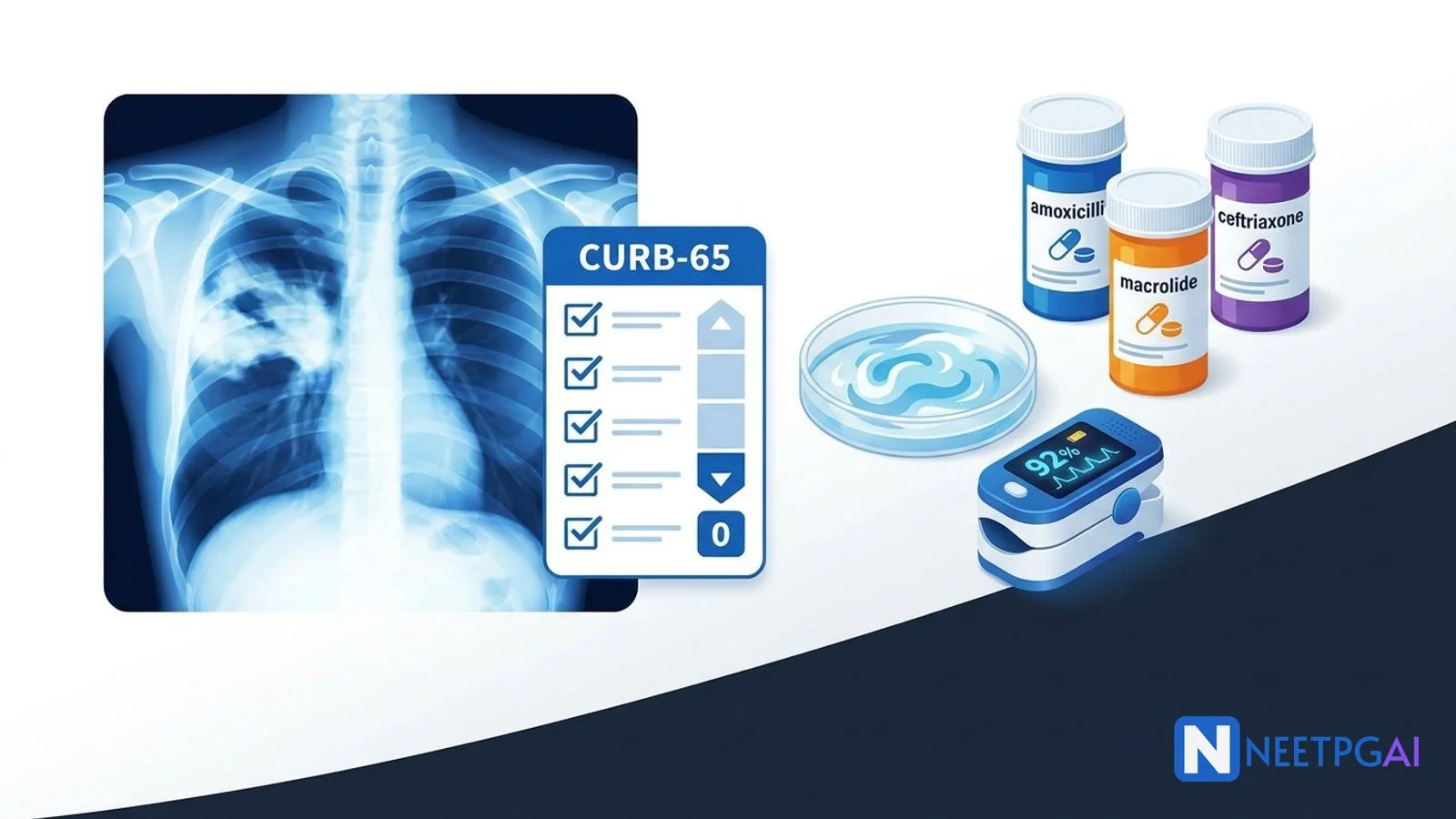
Master pneumonia for NEET PG 2027: CAP vs HAP vs VAP vs aspiration, typical vs atypical pathogens, CURB-65 and PSI scoring, sputum and urinary antigen workup, empirical antibiotics, duration of therapy, non-resolving pneumonia, and vaccination (PCV, PPSV).
NEETPGAI EditorialPublished 2 Feb 2026Updated 29 Sept 202619 min read
Share this article
This content is for educational purposes for NEET PG exam preparation. It is not a substitute for professional medical advice, diagnosis, or treatment. Clinical information has been reviewed by qualified medical professionals.
Ready to put this into practice?
Start practicing NEET PG MCQs with AI-powered explanations.
Comparison of the authorities that shape NEET PG, INI-CET, FMGE, and Indian medical education: NMC (regulator), NBEMS (exam conductor), MCC (AIQ counseling), DGHS (health services), AIIMS (INI-CET), plus state councils and FMG pathway — clarifies who does what.
Pneumonia contributes 2–3 NEET PG questions per paper across medicine, pulmonology, and ID. Master these 10 high-yield anchors:
Classification — CAP (outside hospital or <48 h of admission), HAP (>=48 h after admission), VAP (HAP in a patient ventilated >=48 h), aspiration pneumonia (macroaspiration — anaerobes, right lower lobe)
Typical CAP organisms — S. pneumoniae (most common), H. influenzae, Moraxella, Klebsiella (alcoholic, upper lobe, currant-jelly sputum), S. aureus (post-influenza)
Outpatient CAP — amoxicillin 1 g TID OR doxycycline OR macrolide (IDSA prefers amox/doxy — high macrolide resistance)
Inpatient non-severe CAP — beta-lactam + macrolide OR respiratory fluoroquinolone monotherapy (levo, moxi)
Severe CAP / ICU — beta-lactam + macrolide (mortality benefit) OR beta-lactam + respiratory fluoroquinolone; add anti-MRSA (vanco/linezolid) and anti-pseudomonal if risk factors
Duration — 5–7 days CAP (minimum 5 + 48–72 h clinical stability); 7 d HAP/VAP; 7–14 d Legionella; 4–6 weeks lung abscess
Pneumonia is a high-yield NEET PG chapter with predictable question patterns — CURB-65 cut-offs, atypical clues (hyponatraemia = Legionella, cold agglutinins = Mycoplasma), urinary antigen indications, empirical antibiotic tables, and vaccination schedules. This guide covers classification, severity scoring, workup, empirical regimens, duration, non-resolving pneumonia, and vaccination. Pair with the medicine subject hub, the asthma and COPD complete guide, and the tuberculosis diagnosis and treatment guide for complete pulmonology ID coverage.
Classification — CAP, HAP, VAP, aspiration
Pneumonia is an infection of the lung parenchyma classified by where it was acquired and predominant pathogen profile — correct classification drives empirical antibiotic choice.
Type
Definition
Common pathogens
CAP (community-acquired)
Acquired outside hospital OR within <48 h of admission
S. pneumoniae, H. influenzae, Moraxella, atypicals (Mycoplasma, Chlamydophila, Legionella), viral (influenza, RSV, SARS-CoV-2), S. aureus (post-flu)
HAP (hospital-acquired)
Develops >=48 h after admission, not incubating at admission
Gram-negatives (P. aeruginosa, Klebsiella, Acinetobacter, E. coli, Enterobacter), S. aureus (often MRSA), rarely S. pneumoniae
VAP (ventilator-associated)
HAP in a patient intubated >=48 h
Same as HAP with higher resistance rates; early VAP (<5 days) — lower resistance; late VAP (>=5 days) — MDR gram-negatives and MRSA
Aspiration pneumonia
Follows macroaspiration of oropharyngeal or gastric contents
Gram-negatives, anaerobes (if poor dentition, alcoholism, severe periodontal disease); right lower lobe (gravity dependent), right upper lobe if supine
Note: HCAP (healthcare-associated pneumonia) as a separate category is no longer recommended (IDSA/ATS 2016) — pathogen profiles overlap CAP; risk stratify individually.
Aspiration pneumonia vs aspiration pneumonitis:
Pneumonitis (Mendelson) — chemical injury from gastric acid; hours after event; supportive care; antibiotics not routinely required
Pneumonia — bacterial superinfection 48–72 h later; antibiotics needed
Typical vs atypical organisms
Atypical pneumonia is a clinical-pathogen category of organisms that lack a cell wall or are intracellular — they do not respond to beta-lactams and require macrolides, doxycycline, or fluoroquinolones.
Feature
Typical
Atypical
Classic pathogens
S. pneumoniae, H. influenzae, Moraxella, Klebsiella, S. aureus
Mycoplasma, Chlamydophila, Legionella, Coxiella
Onset
Acute
Subacute
Fever
High (>39°C)
Low-grade
Cough
Productive, purulent sputum
Dry, non-productive
Pleuritic pain
Common
Uncommon
Chest X-ray
Lobar consolidation
Patchy / interstitial
WBC
High (neutrophilic)
Normal / mildly elevated
Respiratory response to beta-lactam
Yes
No
Typical organism clues (NEET PG vignettes):
Pathogen
Clue
S. pneumoniae
Rusty-coloured sputum, single rigor, lobar consolidation
Diffuse bilateral interstitial infiltrates; ground-glass on CT
Post-influenza bacterial superinfection is a NEET PG favourite — S. aureus (MSSA or MRSA), S. pneumoniae
CURB-65 and PSI severity scoring
CURB-65 and PSI are complementary CAP severity scores — CURB-65 is bedside and fast, PSI is more accurate and comprehensive. Both guide outpatient vs inpatient vs ICU triage.
CURB-65 — 0 to 5 points:
Letter
Criterion
C
Confusion (new onset) — AMTS <=8 or disorientation
U
Urea >7 mmol/L (> BUN 19 mg/dL)
R
Respiratory rate >=30
B
BP — SBP <90 OR DBP <=60
65
Age >=65
Interpretation:
Score
30-day mortality
Disposition
0
0.7%
Outpatient
1
3.2%
Outpatient (consider short stay)
2
13%
Ward admission
3
17%
Ward; consider ICU
4–5
41%
ICU
CRB-65 (without urea) — suitable for primary care where labs aren't available; scores 0 outpatient, 1–2 consider admission, 3–4 admit.
Class I — <50, no comorbidity, normal vitals → outpatient
Class II–III (<=90 points) → outpatient or short stay
Class IV (91–130) → admit
Class V (>130) → ICU
Validated in ~14,000 patients; more accurate than CURB-65
Clinical judgment: Both scores supplement — not replace — clinical judgement. Hypoxia (SaO2 <90%), social concerns (homelessness, alcoholism, no home support, unreliable follow-up), and unstable comorbidities may warrant admission irrespective of score.
IDSA/ATS severe CAP criteria (ICU threshold):
Major (1 qualifies): mechanical ventilation, septic shock needing vasopressors
Workup of pneumonia confirms the clinical diagnosis, identifies the pathogen when possible, and establishes severity — chest radiography is the cornerstone with adjuncts selected by severity.
Imaging:
Modality
When to use
Chest X-ray PA + lateral
First-line for all suspected pneumonia; lobar, multilobar, bronchopneumonic, interstitial patterns
Outpatient healthy — empirical, no microbiology needed
Inpatient non-severe — blood cultures + sputum if available
Severe / ICU — all above plus urinary antigens
Empirical antibiotic regimens
Empirical antibiotic choice for pneumonia depends on setting (outpatient vs inpatient vs ICU), comorbidity, local resistance, and risk factors for MRSA or Pseudomonas — and the IDSA/ATS 2019 CAP guideline is the NEET PG reference standard.
Community-acquired pneumonia
Outpatient — healthy, no comorbidity, no prior antibiotics (90 days):
Option
Dose
Amoxicillin
1 g PO TID (preferred in areas of high macrolide resistance — India)
Doxycycline
100 mg PO BD
Macrolide (if local pneumococcal macrolide resistance <25%)
Azithromycin 500 mg day 1, 250 mg days 2–5; clarithromycin 500 mg BD × 7 d
Hospital-acquired and ventilator-associated pneumonia
Empirical (IDSA 2016):
Cover S. aureus (including MRSA in high-risk units) and gram-negatives including Pseudomonas
Preferred: piperacillin-tazobactam OR cefepime OR meropenem PLUS vancomycin or linezolid
In units with >10% gram-negative resistance: dual anti-pseudomonal (e.g., pip-tazo + aminoglycoside or fluoroquinolone)
De-escalate based on cultures
Aspiration pneumonia
Community-acquired aspiration: amoxicillin-clavulanate or ampicillin-sulbactam
Hospital-acquired aspiration: piperacillin-tazobactam or meropenem
Severe periodontal disease / alcoholic / foul sputum → anaerobic coverage (clindamycin or metronidazole added)
Pure chemical pneumonitis → supportive; antibiotics only if superinfection evident after 48–72 h
Duration of therapy
Duration of antibiotic therapy in pneumonia has shortened over the last decade — the rule of thumb is 5 days for uncomplicated CAP provided clinical stability, 7 days for HAP/VAP, and longer for specific organisms or complications.
Scenario
Duration
Uncomplicated CAP
Minimum 5 days, with clinical stability for 48–72 h; typical 5–7 days
CAP with bacteraemia
7 days
Legionella pneumonia
7–14 days (azithromycin 7–10 d; fluoroquinolone 7–14 d)
Staphylococcus aureus bacteraemic pneumonia
2–4 weeks
Pseudomonas pneumonia
10–14 days
HAP / VAP
7 days (shorter than traditional 14, per IDSA 2016)
Aspiration bacterial pneumonia
7 days
Lung abscess / necrotising pneumonia
4–6 weeks, guided by imaging and cultures
Empyema
2–6 weeks + drainage
TB pneumonia
6 months (HRZE 2 m + HR 4 m) per RNTCP/NTEP
Clinical stability criteria:
Temperature <=37.8°C
HR <=100
RR <=24
SBP >=90
SpO2 >=90% on room air
Tolerating oral intake
Normal mental status
IV to oral switch as soon as clinical stability achieved — same agent or equivalent class.
Non-resolving pneumonia
Non-resolving pneumonia is failure of clinical or radiographic improvement despite 7–10 days of appropriate antibiotics, OR worsening after initial response — it triggers a structured differential that separates wrong bug, wrong drug, wrong diagnosis, and host factors.
Definitions:
Slow-resolving: radiographic improvement lags behind clinical (normal at 4 weeks in 60%, 8 weeks in 85%)
Non-resolving: absence of clinical improvement in 7–10 days
Progressive: clinical or radiographic deterioration
Differential — the classic 4 buckets:
Wrong bug / wrong drug (resistance)
MRSA, MDR gram-negatives
Atypicals not covered (no macrolide or fluoroquinolone)
Lung biopsy (transbronchial or surgical) — for unexplained persistent disease or suspected malignancy / COP / vasculitis
Pneumonia prevention — vaccination
Vaccination is the single highest-impact preventive intervention for pneumonia — pneumococcal, influenza, COVID-19, Hib, measles, and pertussis vaccines each reduce pneumonia incidence.
Harrison's Principles of Internal Medicine, 21st Edition (Loscalzo et al., 2022) — Chapter on Pneumonia.
Metlay JP et al. Diagnosis and Treatment of Adults with Community-Acquired Pneumonia. An Official Clinical Practice Guideline of the American Thoracic Society and Infectious Diseases Society of America. Am J Respir Crit Care Med 2019; 200:e45-e67.
Kalil AC et al. Management of Adults With Hospital-acquired and Ventilator-associated Pneumonia: 2016 Clinical Practice Guidelines by the Infectious Diseases Society of America and the American Thoracic Society. Clin Infect Dis 2016; 63:e61-e111.
Lim WS et al. Defining community acquired pneumonia severity on presentation to hospital: an international derivation and validation study. Thorax 2003; 58:377-382 (CURB-65).
Fine MJ et al. A prediction rule to identify low-risk patients with community-acquired pneumonia. N Engl J Med 1997; 336:243-250 (PSI).
Pneumonia contributes 2-3 direct questions per NEET PG paper across medicine, pulmonology, pediatrics and infectious disease. The most tested subtopics are CAP vs HAP vs VAP definitions, CURB-65 scoring, atypical vs typical pathogens, urinary antigen tests for Legionella and pneumococcus, empirical antibiotic choice by setting, duration of therapy, and vaccination schedules based on 2019-2025 pattern analysis.
What is the difference between CAP, HAP, VAP, and aspiration pneumonia?
CAP (community-acquired pneumonia) is pneumonia acquired outside hospital or within 48 hours of admission — common pathogens are Streptococcus pneumoniae, Haemophilus influenzae, atypicals (Mycoplasma, Chlamydophila, Legionella), and viral. HAP (hospital-acquired pneumonia) develops greater than or equal to 48 hours after admission — gram-negatives (Pseudomonas, Klebsiella, E. coli) and MRSA dominate. VAP (ventilator-associated pneumonia) is HAP in a patient intubated for greater than or equal to 48 hours — similar pathogens with high resistance rates. Aspiration pneumonia follows macroaspiration of oropharyngeal or gastric contents — anaerobes (in dentate patients or severe periodontal disease) and gram-negatives; right lower lobe is classic.
What is CURB-65 and how is it used?
CURB-65 is a 5-point bedside severity score for CAP. C — Confusion (new onset), U — Urea greater than 7 mmol/L (greater than 19 mg/dL BUN), R — Respiratory rate greater than or equal to 30, B — Blood pressure (SBP less than 90 OR DBP less than or equal to 60), 65 — Age greater than or equal to 65. Score 0-1 outpatient, Score 2 short-stay / ward admission, Score greater than or equal to 3 ICU consideration. 30-day mortality: 0 — 0.7 percent, 1 — 3.2 percent, 2 — 13 percent, 3 — 17 percent, 4-5 — 41 percent. CRB-65 omits urea and is useful in primary care.
What is the Pneumonia Severity Index (PSI)?
PSI (PORT score) is a 20-variable prognostic score stratifying CAP into 5 risk classes. Class I (age less than 50, no comorbidity, normal vitals) is very low risk — outpatient. Classes II-III low-moderate risk — mostly outpatient or short-stay. Class IV moderate-high risk — admit. Class V (greater than 130 points) high risk — ICU consideration. PSI is more accurate than CURB-65 but complex; CURB-65 is easier at bedside. Use PSI when you have labs; CURB-65 when triage is urgent. Neither replaces clinical judgment.
What are atypical versus typical organisms in CAP?
Typical CAP organisms are Streptococcus pneumoniae (most common overall), Haemophilus influenzae (COPD), Moraxella catarrhalis, Klebsiella pneumoniae (alcoholics, diabetics — currant jelly sputum, upper lobe), Staphylococcus aureus (post-influenza). Atypicals are Mycoplasma pneumoniae (young adults, walking pneumonia, cold agglutinins, bullous myringitis), Chlamydophila pneumoniae and Chlamydophila psittaci (bird exposure), Legionella pneumophila (water exposure, hyponatremia, diarrhea, transaminitis, severe disease), Coxiella burnetii (Q fever — cattle, sheep). Atypicals do NOT grow on standard media, do NOT respond to beta-lactams, require macrolide, doxycycline, or fluoroquinolone.
What is the empirical antibiotic regimen for CAP?
Outpatient healthy adult CAP — amoxicillin 1 g TID OR doxycycline 100 mg BD OR macrolide (azithromycin 500 mg day 1 then 250 mg days 2-5) — IDSA prefers amoxicillin or doxycycline due to high macrolide resistance. Outpatient with comorbidity — amoxicillin-clavulanate OR cephalosporin PLUS macrolide OR doxycycline; OR respiratory fluoroquinolone (levofloxacin 750 mg, moxifloxacin 400 mg). Inpatient non-severe — IV beta-lactam (ceftriaxone 1-2 g daily or ampicillin-sulbactam) PLUS macrolide, OR respiratory fluoroquinolone monotherapy. Inpatient severe/ICU — beta-lactam PLUS macrolide OR beta-lactam PLUS respiratory fluoroquinolone. Cover MRSA (vancomycin or linezolid) and Pseudomonas if risk factors present.
What is the duration of antibiotic therapy in pneumonia?
Minimum duration for CAP is 5 days provided clinical stability criteria are met for 48-72 hours (afebrile, stable vitals, tolerating oral, normal mental status). Typical course is 5-7 days for most CAP. Legionella pneumonia requires 7-14 days (azithromycin 7-10 days; fluoroquinolone 7-14 days). Bacteremic Staphylococcus aureus pneumonia requires 2-4 weeks. Lung abscess or necrotizing pneumonia requires 4-6 weeks (often guided by cultures). HAP/VAP requires 7 days in most cases (shorter than the traditional 14 days — IDSA 2016). Aspiration pneumonia (bacterial) is 7 days.
What vaccines prevent pneumonia?
Pneumococcal vaccines include PCV13 (13-valent conjugate), PCV15 (adds 22F and 33F), PCV20 (adds 5 more serotypes), and PPSV23 (polysaccharide). In adults in India and globally, current CDC/ACIP recommendation (2022) is: age greater than or equal to 65 or younger with immunocompromise/chronic disease — PCV20 alone OR PCV15 followed by PPSV23 greater than or equal to 1 year later. Influenza vaccine (annual — inactivated or live) reduces pneumonia risk and post-flu bacterial pneumonia. Children receive PCV13/PCV15 in infancy (6, 10, 14 weeks in Indian UIP since 2021). Adults with HIV, asplenia, sickle cell, CKD, transplant — PCV plus PPSV23.
What is the workup of non-resolving pneumonia?
Non-resolving pneumonia is failure of clinical or radiographic response despite 7-10 days of appropriate antibiotics (no improvement) OR worsening after initial response (deterioration). Differential includes wrong antibiotic (resistant organism, atypical, viral, fungal, TB), wrong diagnosis (pulmonary embolism, vasculitis, BOOP/COP, organizing pneumonia, eosinophilic pneumonia, lung cancer, heart failure, ARDS), complications (empyema, lung abscess), immunosuppression (HIV, malignancy). Workup includes repeat imaging (CT chest), sputum AFB and mycobacterial culture, HIV test, ANA/ANCA/eosinophils, BAL with differential cell count and cultures (fungal, mycobacterial, nocardia), and biopsy if needed (transbronchial or surgical lung biopsy).
What are the IDSA criteria for severe CAP?
IDSA/ATS severe CAP criteria — 1 major OR 3 minor criteria qualify for ICU admission. Major criteria: mechanical ventilation, septic shock requiring vasopressors. Minor criteria: respiratory rate greater than or equal to 30, PaO2/FiO2 less than or equal to 250, multilobar infiltrates, confusion/disorientation, uremia (BUN greater than or equal to 20 mg/dL), leukopenia (WBC less than 4000), thrombocytopenia (platelets less than 100,000), hypothermia (less than 36 C), hypotension requiring aggressive fluid resuscitation. Important because severe CAP mandates combination therapy (beta-lactam plus macrolide or respiratory fluoroquinolone) and ICU-level monitoring.
Explore our pricing plans for unlimited practice across all 19 subjects, AI-powered doubt resolution, and personalized study plans.
This content is for educational purposes for NEET PG exam preparation. It is not a substitute for professional medical advice, diagnosis, or treatment. Clinical information has been reviewed by qualified medical professionals.
Written by: NEETPGAI Editorial Team
Reviewed by: Pending SME Review
Last reviewed: February 2026
This article is reviewed by qualified medical professionals for clinical accuracy and exam relevance. For corrections or updates, contact the editorial team.