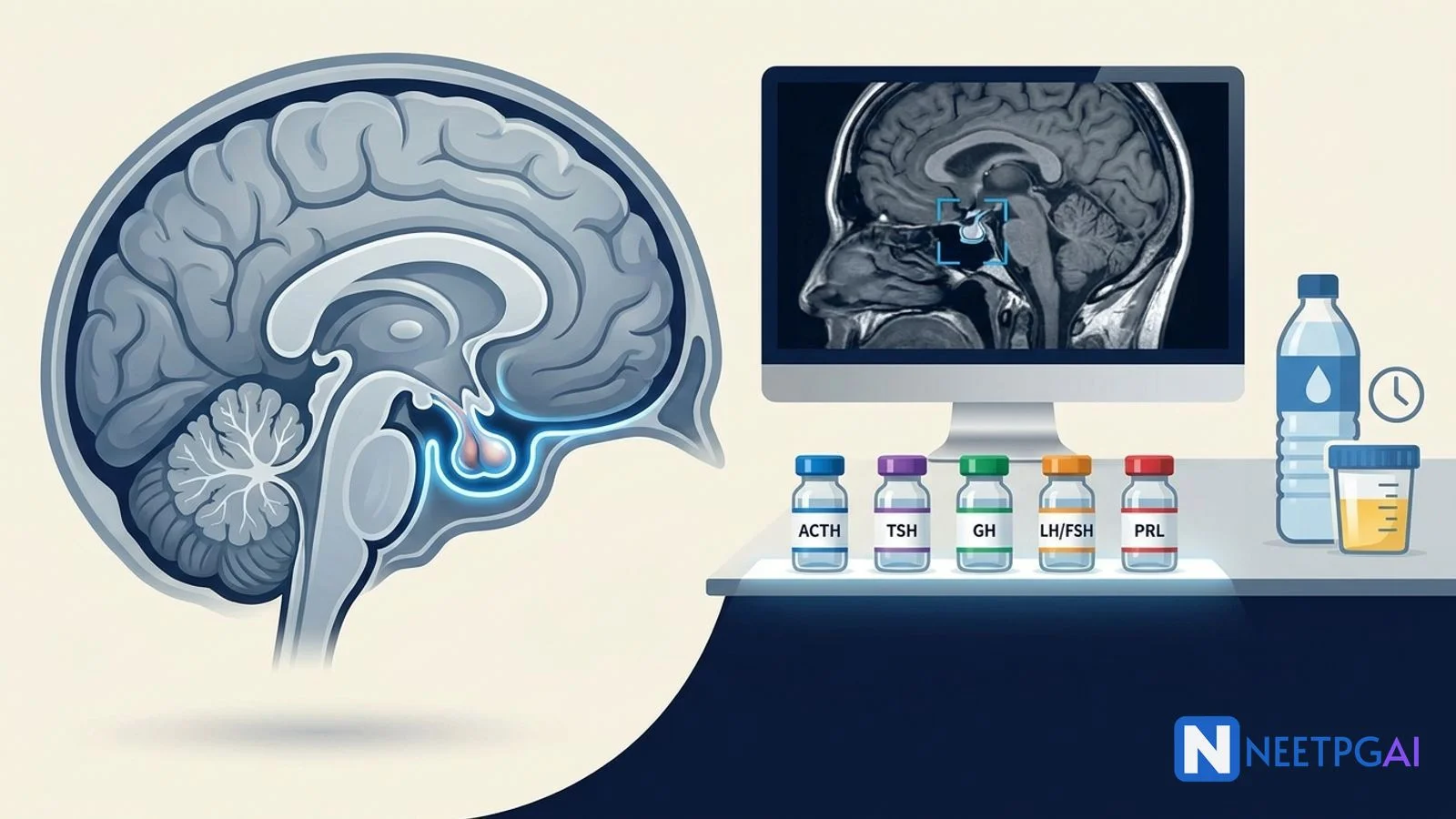
Pituitary Disorders for NEET PG — Complete Guide 2027
Master pituitary disorders for NEET PG 2027: HPA axis anatomy, hypopituitarism, prolactinoma, acromegaly, Cushing disease, diabetes insipidus, and SIADH with diagnostic workflows and first-line management.
NEETPGAI EditorialPublished 14 Feb 2026Updated 29 Sept 202618 min read
Share this article
This content is for educational purposes for NEET PG exam preparation. It is not a substitute for professional medical advice, diagnosis, or treatment. Clinical information has been reviewed by qualified medical professionals.
Ready to put this into practice?
Start practicing NEET PG MCQs with AI-powered explanations.
Comparison of the authorities that shape NEET PG, INI-CET, FMGE, and Indian medical education: NMC (regulator), NBEMS (exam conductor), MCC (AIQ counseling), DGHS (health services), AIIMS (INI-CET), plus state councils and FMG pathway — clarifies who does what.
TSH-secreting adenoma — high T4 with inappropriately non-suppressed TSH (unlike Graves); transsphenoidal surgery
Central DI — low urine osmolality, responds to desmopressin; nephrogenic DI does not respond (lithium, hypercalcaemia)
SIADH — euvolaemic hyponatraemia, urine osm >100, urine Na >40; fluid restriction first; correct Na <8–10 mEq/L per 24 h
Pituitary disorders are high-yield NEET PG vignettes — the post-partum woman who cannot lactate, the 35-year-old with widening shoe size, the headache with bitemporal visual loss — and recognising the pattern plus the first-line drug separates marks. This guide covers pituitary anatomy and the HPA axis, hypopituitarism, pituitary adenoma subtypes and management, diabetes insipidus, and SIADH. Pair it with the medicine subject hub, the thyroid disorders guide, and the common mistakes in medicine NEET PG article for endocrine integration.
Anatomy and the hypothalamic–pituitary axis
The pituitary gland is a pea-sized endocrine organ sitting in the sella turcica of the sphenoid bone, connected to the hypothalamus by the infundibulum — and its two lobes have distinct embryological origins and secretory control.
Anatomy overview:
Anterior pituitary (adenohypophysis) — from Rathke's pouch (ectoderm of oral cavity); ~80% of gland mass; secretes six trophic hormones
Posterior pituitary (neurohypophysis) — neural tissue from the diencephalon; stores ADH and oxytocin synthesised in the hypothalamus (supraoptic and paraventricular nuclei)
Blood supply — hypothalamic–hypophyseal portal system carries releasing hormones from the median eminence to the anterior pituitary; the posterior pituitary is supplied directly by the inferior hypophyseal artery
Neighbours — optic chiasm superiorly (bitemporal hemianopia on expansion), cavernous sinus laterally (cranial nerves III, IV, V1, V2, VI — ophthalmoplegia and facial sensation), sphenoid sinus inferiorly (transsphenoidal surgical route)
Hypothalamic releasing and inhibiting hormones:
Hypothalamic hormone
Pituitary target
Effect
TRH (thyrotropin-releasing hormone)
TSH
Stimulates TSH release
CRH (corticotropin-releasing hormone)
ACTH
Stimulates ACTH release
GnRH (gonadotropin-releasing hormone)
LH, FSH
Pulsatile stimulation
GHRH (growth-hormone-releasing hormone)
GH
Stimulates GH release
Somatostatin
GH, TSH
Inhibits GH and TSH
Dopamine
Prolactin
Inhibits prolactin
Anterior pituitary hormones and targets:
Hormone
Cell
Target
Key action
TSH
Thyrotroph
Thyroid
T3/T4 synthesis
ACTH
Corticotroph
Adrenal cortex
Cortisol synthesis
FSH / LH
Gonadotroph
Ovary / testis
Sex steroids, gametes
GH
Somatotroph
Liver
IGF-1 → growth and metabolism
Prolactin
Lactotroph
Breast
Lactation; tonic dopamine inhibition
Posterior pituitary hormones:
ADH (vasopressin) — water reabsorption via V2 receptors on collecting duct (aquaporin-2 insertion); vasoconstriction via V1a
Oxytocin — uterine contraction, milk ejection, social bonding
Clinical anchor: stalk compression from a pituitary macroadenoma disconnects dopamine inhibition → mild prolactin elevation (usually <150 ng/mL). A prolactin level >200 ng/mL in the setting of a sellar mass strongly suggests a true prolactinoma, not stalk effect.
Hypopituitarism
Hypopituitarism is partial or complete deficiency of anterior pituitary hormones — its sequence of hormone loss, causes, and hormone-replacement order are high-yield.
Visual fields (Humphrey or Goldmann perimetry) if macroadenoma or close to chiasm
Dynamic testing as indicated — OGTT (acromegaly), dexamethasone suppression (Cushing), water deprivation (DI)
Prolactinoma
Prolactinoma is the most common functioning pituitary adenoma — dopamine agonists are first-line for both micro- and macroadenomas, including most visual-field defects.
Clinical features:
Women (usually micro) — amenorrhoea, galactorrhoea, infertility, low libido
Men (usually macro) — low libido, erectile dysfunction, infertility, mass effect (headache, bitemporal hemianopia), gynaecomastia
Bone loss — from hypogonadism (oestrogen/testosterone deficiency)
Prolactin levels and interpretation:
Normal: <20 ng/mL (women), <15 ng/mL (men)
>200 ng/mL → strongly suggests prolactinoma (macro usually >250 ng/mL)
Hook effect — very large prolactinomas with extremely high prolactin can falsely read low on immunoassay; dilute sample if big tumour but mildly elevated level
Longer t1/2, better tolerated, 80–90% normalise prolactin and shrink tumour
Alternative
Bromocriptine 2.5–15 mg/day in divided doses
Preferred in pregnancy (longer safety data)
Second
Transsphenoidal surgery
Dopamine-agonist intolerance / resistance, CSF leak, persistent visual loss
Adjunct
Radiotherapy
Refractory / aggressive disease
Pregnancy:
Microadenoma — stop DA once pregnancy confirmed (tumour enlargement risk very low)
Macroadenoma — continue DA or switch to bromocriptine; serial visual fields; do NOT do routine prolactin levels during pregnancy
Breastfeeding safe if tumour stable
Acromegaly and gigantism
Acromegaly is GH excess in adults (after epiphyseal closure) presenting with coarsened features and organomegaly, while gigantism is GH excess in children with open epiphyses — both are almost always from a somatotroph adenoma.
First-line — transsphenoidal surgery (remission 70–90% microadenoma, 50% macroadenoma)
Medical — ketoconazole, metyrapone, mitotane, osilodrostat (cortisol synthesis inhibitors); pasireotide (somatostatin analogue acting on pituitary); mifepristone (glucocorticoid-receptor antagonist, for steroid-induced diabetes)
Bilateral adrenalectomy — refractory cases; risk of Nelson syndrome (ACTH tumour enlargement post-adrenalectomy)
Radiotherapy — adjunct if surgery fails
Diabetes insipidus and SIADH
Diabetes insipidus (DI) and SIADH are posterior-pituitary disorders of ADH — DI causes dilute polyuria, SIADH causes euvolaemic hyponatraemia — and both are classic NEET PG scenarios.
Severe symptomatic hyponatraemia (seizures, coma, Na <120) — hypertonic 3% saline 100–150 mL bolus(es); target Na rise 4–6 mEq/L in first 6 h
Correction speed — do NOT exceed 8–10 mEq/L per 24 h (osmotic demyelination / central pontine myelinolysis risk, especially in chronic hyponatraemia, alcoholism, malnutrition)
Treat underlying cause — SCLC chemotherapy, drug withdrawal, infection treatment
Cerebral salt wasting (CSW) differential: similar labs to SIADH but hypovolaemic (raised urea, low CVP, weight loss, orthostasis). Treat with salt and fluid replacement (opposite of SIADH fluid restriction). Seen in SAH, neurosurgery.
Sources and references
Harrison's Principles of Internal Medicine, 21st Edition (Loscalzo, Fauci, Kasper, Hauser, Longo, Jameson, Eds., 2022) — Chapters on pituitary disorders, hyponatraemia, and diabetes insipidus.
Williams Textbook of Endocrinology, 14th Edition (Melmed, Auchus, Goldfine, Koenig, Rosen, Eds., 2019) — Chapters on anterior and posterior pituitary physiology and disease.
Melmed S et al. Diagnosis and Treatment of Hyperprolactinemia: An Endocrine Society Clinical Practice Guideline. J Clin Endocrinol Metab 2011; 96:273-288.
Katznelson L et al. Acromegaly: An Endocrine Society Clinical Practice Guideline. J Clin Endocrinol Metab 2014; 99:3933-3951.
Nieman LK et al. Treatment of Cushing's Syndrome: An Endocrine Society Clinical Practice Guideline. J Clin Endocrinol Metab 2015; 100:2807-2831.
Fleseriu M et al. Consensus on diagnosis and management of Cushing's disease: a guideline update. Lancet Diabetes Endocrinol 2021; 9:847-875.
Verbalis JG et al. Diagnosis, evaluation, and treatment of hyponatremia: expert panel recommendations. Am J Med 2013; 126(10 Suppl 1):S1-S42.
Frequently asked questions
How many pituitary disorder questions appear in NEET PG?
Pituitary disorders contribute 2-3 direct questions per NEET PG paper, mostly from medicine and endocrinology. High-yield subtopics include prolactinoma first-line therapy, acromegaly diagnostic test (OGTT suppression of GH), Sheehan syndrome in a post-partum woman with failure of lactation, central vs nephrogenic diabetes insipidus, and the sequence of hormone loss in hypopituitarism (GH first, ACTH last).
What is the sequence of hormone loss in hypopituitarism?
The classic sequence of anterior pituitary hormone loss is GH first, then gonadotropins (LH, FSH), then TSH, then ACTH, and finally prolactin. The mnemonic Go Look For The Adenoma captures it. ACTH loss is the most life-threatening (adrenal crisis) and is the last axis to fail — making GH deficiency and hypogonadism the earliest clinical clues in slowly progressive pituitary disease.
What is the first-line therapy for prolactinoma?
Dopamine agonists are first-line for prolactinomas of all sizes, including macroadenomas. Cabergoline 0.25-0.5 mg twice weekly is preferred over bromocriptine because it is longer-acting, more effective at normalising prolactin, better tolerated, and causes tumour shrinkage in up to 80-90 percent. Bromocriptine is used in pregnancy-related prolactinoma. Transsphenoidal surgery is reserved for dopamine-agonist intolerance, resistance, CSF leak, or visual compromise not improving on medical therapy.
How is acromegaly diagnosed?
Acromegaly is diagnosed by elevated serum IGF-1 (age and sex matched) as the screening test, confirmed by failure of GH to suppress below 1 ng/mL (0.4 ng/mL by sensitive assay) during a 75 g oral glucose tolerance test. MRI pituitary localises the adenoma. Random GH is unreliable due to pulsatile secretion. Adjuncts include colonoscopy (colon polyp risk), echo (cardiomyopathy), sleep study (OSA), and fasting glucose (diabetes).
What is Sheehan syndrome?
Sheehan syndrome is post-partum pituitary necrosis from hypotension and infarction of an enlarged gravid pituitary, usually after obstetric haemorrhage. Failure of lactation is the earliest and most classic feature (prolactin loss), followed by amenorrhoea and loss of pubic and axillary hair. Later features include hypothyroidism, adrenal insufficiency, and GH deficiency. MRI shows empty sella. Replace hormones in order — cortisol FIRST, then thyroxine — to avoid precipitating adrenal crisis.
How do you distinguish central from nephrogenic diabetes insipidus?
The water deprivation test followed by desmopressin is diagnostic. In central DI, urine osmolality fails to concentrate with dehydration but rises by greater than 50 percent after desmopressin. In nephrogenic DI, urine osmolality fails to rise despite desmopressin (less than 10 percent rise) because the kidney is unresponsive. Causes of central DI include trauma, surgery, tumour, Sheehan, autoimmune; nephrogenic causes include lithium, hypercalcaemia, hypokalaemia, and congenital AVPR2/AQP2 defects.
What is the workflow for Cushing disease?
Workflow has three steps: SCREEN, CONFIRM, LOCALISE. Screening uses any two of — 24-hour urinary free cortisol, late-night salivary cortisol, or 1 mg overnight dexamethasone suppression test. Confirm hypercortisolism if two abnormal. Measure ACTH to split ACTH-dependent (Cushing disease, ectopic ACTH) from ACTH-independent (adrenal). For ACTH-dependent, high-dose dexamethasone suppression and MRI pituitary separate Cushing disease from ectopic; inferior petrosal sinus sampling is confirmatory when imaging is equivocal.
What is pituitary apoplexy?
Pituitary apoplexy is acute haemorrhagic infarction of a pituitary adenoma presenting with sudden severe headache, visual field loss (classically bitemporal hemianopia), ophthalmoplegia (cranial nerves III, IV, VI in cavernous sinus), and acute adrenal insufficiency. It is a neuroendocrine emergency — give IV hydrocortisone 100 mg immediately (before confirmatory imaging), stabilise haemodynamics, and do urgent MRI. Transsphenoidal decompression is indicated for visual compromise or depressed consciousness.
What are the features of SIADH?
SIADH is hyponatraemia with euvolaemia, inappropriately concentrated urine (urine osmolality greater than 100 mOsm/kg), urine sodium greater than 40 mEq/L, low serum uric acid, and normal adrenal and thyroid function. Causes include small cell lung cancer, CNS disorders, drugs (SSRIs, carbamazepine, cyclophosphamide), and pulmonary infections. Treatment is fluid restriction (first-line), hypertonic saline for severe symptomatic hyponatraemia (correct less than 8-10 mEq/L per 24 h to avoid osmotic demyelination), tolvaptan for chronic cases.
When is transsphenoidal surgery indicated for pituitary adenoma?
Transsphenoidal surgery is first-line for all pituitary adenomas EXCEPT prolactinoma (which is medical). Indications include GH-secreting adenoma (acromegaly), ACTH-secreting adenoma (Cushing disease), TSH-secreting adenoma, non-functioning macroadenoma with visual compromise, pituitary apoplexy with vision loss, dopamine-agonist resistant or intolerant prolactinoma, and CSF leak. Remission rates are 80-90 percent for microadenomas and 50-70 percent for macroadenomas. Complications include hypopituitarism, diabetes insipidus, CSF leak, and meningitis.
Explore our pricing plans for unlimited practice across all 19 subjects, AI-powered doubt resolution, and personalized study plans.
This content is for educational purposes for NEET PG exam preparation. It is not a substitute for professional medical advice, diagnosis, or treatment. Clinical information has been reviewed by qualified medical professionals.
Written by: NEETPGAI Editorial Team
Reviewed by: Pending SME Review
Last reviewed: January 2026
This article is reviewed by qualified medical professionals for clinical accuracy and exam relevance. For corrections or updates, contact the editorial team.