Leukemias and Lymphomas for NEET PG — Complete Guide 2027 | NEETPGAI
medicinehematologyoncologyneet pg 2027
Leukemias and Lymphomas for NEET PG — Complete Guide 2027
Master leukemias and lymphomas for NEET PG 2027: ALL vs AML, CML Philadelphia chromosome, CLL, APL, Hodgkin lymphoma Ann Arbor, DLBCL and Burkitt, febrile neutropenia, and tumor lysis syndrome.
NEETPGAI EditorialPublished 19 Feb 2026Updated 29 Sept 202622 min read
Share this article
This content is for educational purposes for NEET PG exam preparation. It is not a substitute for professional medical advice, diagnosis, or treatment. Clinical information has been reviewed by qualified medical professionals.
Ready to put this into practice?
Start practicing NEET PG MCQs with AI-powered explanations.
Comparison of the authorities that shape NEET PG, INI-CET, FMGE, and Indian medical education: NMC (regulator), NBEMS (exam conductor), MCC (AIQ counseling), DGHS (health services), AIIMS (INI-CET), plus state councils and FMG pathway — clarifies who does what.
Burkitt — t(8;14) MYC-IgH; starry-sky histology; Ki-67 ~100%; high TLS risk; CODOX-M/IVAC or DA-EPOCH-R + CNS prophylaxis
MALT lymphoma — gastric, H. pylori-driven; eradication cures t(11;18)-negative; t(11;18) API2-MALT1 is antibiotic-resistant
Febrile neutropenia — T >=38.3°C or sustained >38.0 with ANC <500; empirical piperacillin-tazobactam or cefepime within 1 h; add vancomycin for indications
Tumor lysis syndrome — hyperK, hyperPO4, hyperuric, hypoCa, AKI; Burkitt, ALL; prevent with IV fluids + allopurinol (low risk) or rasburicase (high risk)
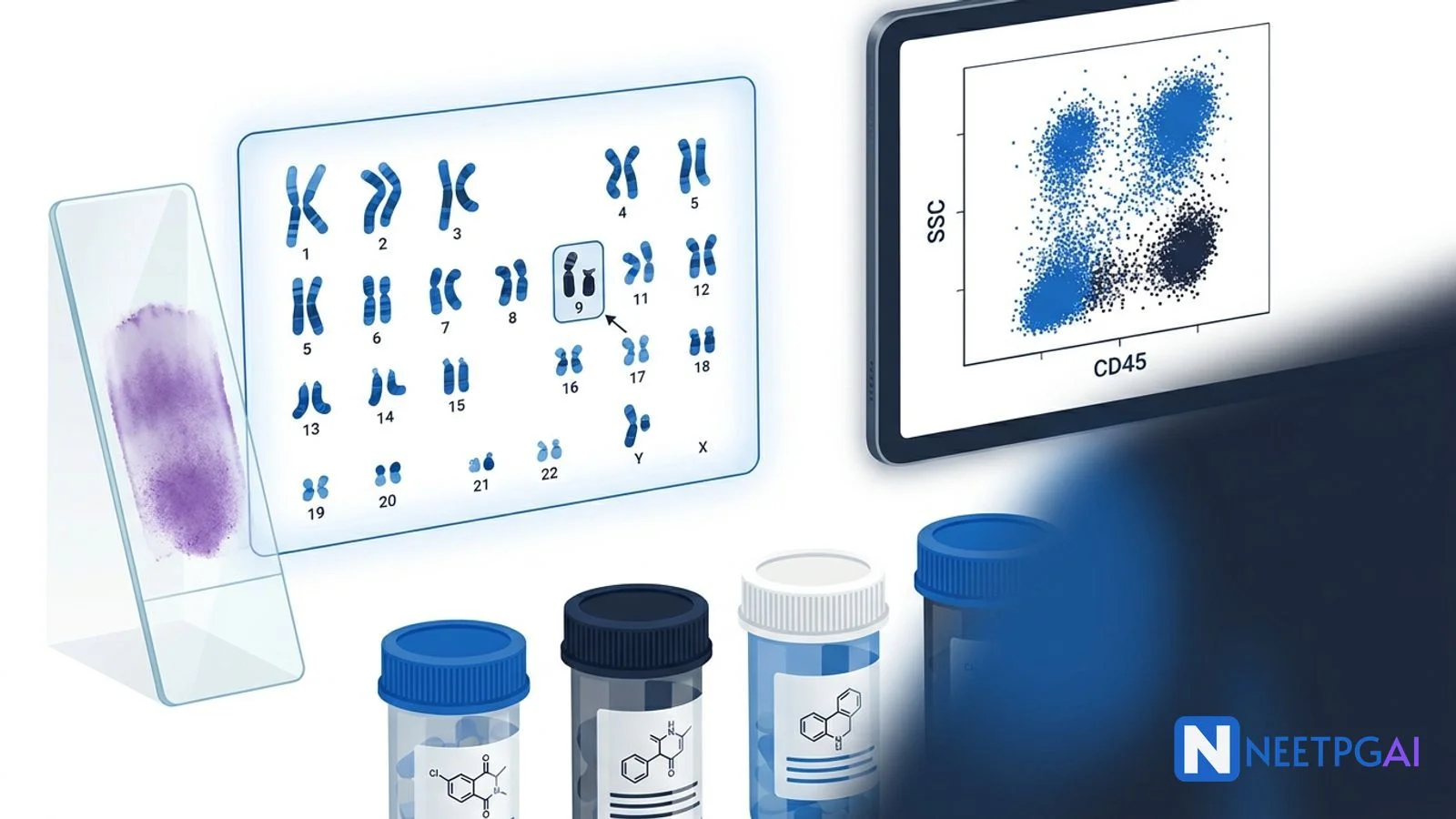
Haematology-oncology questions are NEET PG staples — the child with pancytopenia, the CML patient in chronic phase, the young adult with mediastinal mass and cervical lymphadenopathy, the alcoholic with DIC and circulating promyelocytes. Recognising the cytogenetic signature (Philadelphia chromosome, t(15;17), t(8;14), t(14;18)) plus the named first-line therapy separates marks. This guide covers acute leukemia classification, CML/CLL, APL, Hodgkin and non-Hodgkin lymphoma, febrile neutropenia, and tumour lysis syndrome. Pair with the medicine subject hub, the anaemia classification guide, and the peripheral smear image-MCQ walkthrough for integrated revision.
Acute leukemias — ALL vs AML
Acute leukemia is defined by ≥20% blasts in bone marrow or peripheral blood (WHO) with differentiation arrest and clonal expansion — splitting into acute lymphoblastic (ALL) and acute myeloid (AML) by lineage.
Epidemiology and presentation:
Feature
ALL
AML
Age
Peak 2–5 years; second peak >50 y
Median 65 years (most common adult acute leukemia)
Presentation
BM failure: anaemia, infection (neutropenia), bleeding (thrombocytopenia); hepatosplenomegaly, lymphadenopathy, bone pain, CNS and testicular involvement
AML (non-APL) — "7+3" induction (cytarabine 7 d + anthracycline 3 d) → consolidation (high-dose cytarabine ± allo-HSCT for intermediate/poor risk) → targeted agents (midostaurin for FLT3, ivosidenib for IDH1, enasidenib for IDH2, venetoclax + azacitidine in unfit older patients)
Paediatric ALL cure ~85–90%; adult ALL cure ~40%; AML cure ~30–40% overall (higher with HSCT)
CML and CLL
Chronic myeloid leukemia (CML) and chronic lymphocytic leukemia (CLL) are chronic leukemias — differing in lineage, cytogenetics, and targeted therapy — and both are high-yield NEET PG vignettes.
Chronic myeloid leukemia (CML):
Myeloproliferative neoplasm; BCR-ABL1 fusion from t(9;22) Philadelphia chromosome → constitutively active tyrosine kinase
Incidence 1–2/100,000; median age 55–65
Three phases — chronic (85%, asymptomatic or fatigue/splenomegaly), accelerated (10–19% blasts), blast crisis (>=20% blasts — behaves like acute leukemia)
Labs — leukocytosis with full myeloid spectrum (neutrophils, myelocytes, metamyelocytes, promyelocytes, basophilia, eosinophilia); low leukocyte alkaline phosphatase (LAP) score (vs high in leukemoid reaction); splenomegaly
Diagnosis — bone marrow hypercellular; cytogenetics t(9;22); FISH or RT-PCR for BCR-ABL1 (quantitative PCR for monitoring)
Asciminib — myristoyl pocket inhibitor for resistant disease
Monitoring — BCR-ABL1 IS (international scale) every 3 months; goals: CHR (3 mo), CCyR (6 mo), MMR <0.1% (12 mo), DMR <0.0032%
Allo-HSCT reserved for TKI-resistant / blast crisis
Treatment-free remission possible in sustained DMR for >=2 years
Chronic lymphocytic leukemia (CLL):
Indolent mature B-cell neoplasm; identical to small lymphocytic lymphoma (SLL) — nodal form
Commonest adult leukemia in the West; median age 70; rare in East Asia
Often asymptomatic lymphocytosis on routine check; fatigue, lymphadenopathy, splenomegaly, recurrent infections (hypogammaglobulinaemia), autoimmune complications (AIHA, ITP, PRCA)
Diagnosis — absolute B-lymphocyte count ≥5,000/μL with typical immunophenotype
Immunophenotype — CD5+, CD19+, CD20 (dim), CD23+, kappa or lambda light-chain restricted; CD5+ B-cell is the key
Peripheral smear — mature small lymphocytes, smudge cells (basket cells)
Cytogenetics / prognosis (FISH panel):
Abnormality
Prognosis
del(13q) isolated
Best
Trisomy 12
Intermediate
del(11q) (ATM)
Poor
del(17p) / TP53 mutation
Very poor, chemoresistant
Unmutated IGHV
Worse than mutated
Staging:
Rai stage
Features
Binet stage
Features
0
Lymphocytosis alone
A
<3 lymphoid areas
I
+ lymphadenopathy
B
>=3 lymphoid areas
II
+ spleno/hepatomegaly
C
Anaemia OR thrombocytopenia
III
+ anaemia (Hb <11)
—
—
IV
+ thrombocytopenia (<100)
—
—
Treatment:
Watch-and-wait for early asymptomatic disease (no survival benefit to early treatment)
First-line (symptomatic) — BTK inhibitors (ibrutinib, acalabrutinib, zanubrutinib) or venetoclax + obinutuzumab (fixed duration); chemoimmunotherapy (FCR, BR) less used except in young fit IGHV-mutated without TP53 abnormality
TP53-aberrant or del(17p) — targeted agents only (BTK/BCL2); do NOT use chemoimmunotherapy
Richter transformation (5–10%) — to DLBCL; poor prognosis; treat like aggressive NHL
Acute promyelocytic leukemia
Acute promyelocytic leukemia (APL) is a subtype of AML (formerly M3) with t(15;17)(q22;q12) creating the PML-RARA fusion — it is a haematological emergency because of catastrophic bleeding from DIC before treatment takes effect.
Why APL is special:
Released granules contain tissue factor and annexin II → overwhelming DIC
Intracranial haemorrhage is the leading cause of early death (before and during induction)
Unique responsiveness to differentiation therapy (ATRA + arsenic trioxide) — chemotherapy may not be needed in low-risk disease
Differentiation syndrome (~25%) — fever, dyspnoea, weight gain, pulmonary infiltrates, pleural/pericardial effusion, hypotension. Treat with dexamethasone 10 mg IV BD; continue ATRA/ATO if mild, interrupt if severe
Monitor PML-RARA by RT-PCR after consolidation — goal: undetectable at completion
Hodgkin lymphoma
Hodgkin lymphoma (HL) is a B-cell lymphoma defined by Reed-Sternberg (RS) cells — binucleate or multinucleate giant cells with "owl-eye" nucleoli — in a minority of the tumour amid an inflammatory background.
Epidemiology:
Bimodal age distribution — 20–30 years (peak) and >55 years
EBV-associated in ~40% of classical HL (higher in developing countries)
Male:female ~1.4:1
Subtypes:
Subtype
%
Features
Classical HL
95%
RS cells CD30+, CD15+, CD45−, PAX5+; EBV-associated in some
↳ Nodular sclerosis (NS)
~70%
Most common; young women; mediastinal mass; lacunar cells
Ann Arbor staging (Cotswolds modification, now Lugano 2014):
Stage
Definition
I
Single lymph node region OR single extralymphatic site (IE)
II
≥2 nodal regions on same side of diaphragm
III
Nodal regions on both sides of diaphragm
IV
Diffuse / disseminated extranodal involvement
Suffixes — A (no B symptoms), B (B symptoms), X (bulk >10 cm), E (extranodal extension from nodal site), S (splenic).
Favourable vs unfavourable early-stage HL: bulky disease (>=10 cm or >1/3 mediastinal diameter), >=3 nodal areas, high ESR, B symptoms, and extranodal extension make early-stage HL unfavourable (German Hodgkin Study Group / EORTC criteria).
Non-Hodgkin lymphomas (NHL) are a heterogeneous group of mature B-, T-, or NK-cell malignancies — classified by the WHO 5th edition (2022) — with DLBCL and follicular lymphoma together accounting for about half of cases.
High-yield subtypes:
Lymphoma
Cell / genetics
Classic features
First-line
Diffuse large B-cell (DLBCL)
Large B cells; GCB or ABC subtypes; double/triple hit = MYC + BCL2/6
Commonest NHL (~30%); nodal or extranodal; aggressive
R-CHOP × 6 (or pola-R-CHP for high-risk per POLARIX)
Follicular lymphoma
t(14;18) IGH-BCL2; CD10+, BCL6+, BCL2+
Indolent; waxing-waning lymphadenopathy
Watch-and-wait; R-CHOP or R-bendamustine; obinutuzumab
Burkitt lymphoma
t(8;14) MYC-IgH (or t(2;8), t(8;22)); Ki-67 ~100%
Starry-sky on histology; jaw mass (endemic), abdominal (sporadic)
Febrile neutropenia and tumor lysis syndrome are the two oncology emergencies NEET PG tests most often — both demand protocolised, time-critical management.
Febrile neutropenia (FN):
Definition — single oral/core temperature ≥38.3 °C OR sustained ≥38.0 °C for ≥1 h, AND ANC <500/μL (or <1000 with expected fall <500 within 48 h)
Risk — Gram-negative bacteraemia (Pseudomonas, E. coli, Klebsiella), Gram-positive (coag-neg staph from CVCs, Staph aureus, viridans strep); fungal (Candida, Aspergillus) in prolonged neutropenia
Initial assessment:
Full history — chemotherapy date, neutrophil trajectory, prior infections, prophylaxis, indwelling lines, symptoms
Examination — every site (ports, lines, skin, perineum, oral mucosa — avoid rectal exam in neutropenic patients)
Cultures — 2 sets of blood cultures (peripheral + central line), urine culture, stool if diarrhoea, throat swab; chest X-ray
CBC, U&E, LFT, CRP, lactate, ABG, coagulation
MASCC score (Multinational Association for Supportive Care in Cancer) — identifies low-risk FN eligible for oral outpatient therapy:
Total score (max 26); ≥21 = low-risk
Components — no hypotension, no COPD, solid tumour/no prior fungal infection, no dehydration, outpatient status, age <60, symptom burden
Empirical antibiotics (within 1 hour of presentation):
Scenario
First-line
Low-risk (MASCC ≥21, no hypotension, oral intake intact)
Oral amoxicillin-clavulanate + ciprofloxacin as outpatient (observe 4 h in hospital first)
High-risk — stable
IV piperacillin-tazobactam 4.5 g every 6 h OR cefepime 2 g every 8 h OR meropenem (if ESBL prevalent)
High-risk — severe sepsis / septic shock
IV meropenem + vancomycin + aminoglycoside (consider)
Persistent fever >=4–7 days on broad-spectrum antibiotics, or clinical/imaging signs — caspofungin, voriconazole, liposomal amphotericin
G-CSF (filgrastim): not routinely for FN treatment but used for prophylaxis in high-risk chemotherapy regimens (>20% FN risk) and secondary prophylaxis after prior FN.
Prophylaxis: fluoroquinolone for prolonged neutropenia (>7 days), anti-PCP (cotrimoxazole), antifungal (posaconazole in AML induction, allo-HSCT), antiviral (acyclovir in allogeneic HSCT).
Tumor lysis syndrome (TLS):
Metabolic consequence of rapid tumour cell lysis; hyperuricaemia, hyperkalaemia, hyperphosphataemia, secondary hypocalcaemia, AKI
Highest risk — Burkitt lymphoma, ALL (high WBC), high-grade lymphoma, bulky / high-proliferative index disease; less commonly CLL post-venetoclax (ramp-up), solid tumours (rare)
Cairo-Bishop criteria:
Laboratory TLS — ≥2 abnormalities within 3 days before to 7 days after chemotherapy start:
Uric acid >8 mg/dL or 25% rise
Potassium >6 mEq/L or 25% rise
Phosphate >4.5 mg/dL (adult) or >6.5 (child) or 25% rise
Calcium <7 mg/dL or 25% fall
Clinical TLS — lab TLS + one of AKI (creatinine >=1.5× ULN), seizure, cardiac arrhythmia, sudden death
Rasburicase (recombinant urate oxidase) — converts urate to soluble allantoin; contraindicated in G6PD deficiency (risk of haemolysis and methaemoglobinaemia)
Renal replacement therapy if refractory AKI, severe acidosis, or life-threatening electrolytes
Sources and references
Harrison's Principles of Internal Medicine, 21st Edition (Loscalzo, Fauci, Kasper, Hauser, Longo, Jameson, Eds., 2022) — Chapters on acute and chronic leukemias, Hodgkin and non-Hodgkin lymphoma, and oncology emergencies.
DeVita, Hellman, and Rosenberg's Cancer: Principles and Practice of Oncology, 12th Edition (DeVita, Rosenberg, Lawrence, Eds., 2022) — Detailed sections on leukemia and lymphoma subtypes.
WHO Classification of Tumours: Haematolymphoid Tumours, 5th Edition (WHO, 2022).
Alaggio R et al. The 5th edition of the World Health Organization Classification of Haematolymphoid Tumours: Lymphoid Neoplasms. Leukemia 2022; 36:1720-1748.
Freifeld AG et al. IDSA Clinical Practice Guideline for the Use of Antimicrobial Agents in Neutropenic Patients with Cancer. Clin Infect Dis 2011; 52:e56-e93.
Coiffier B et al. Guidelines for the management of pediatric and adult tumor lysis syndrome: an evidence-based review. J Clin Oncol 2008; 26:2767-2778.
Frequently asked questions
How many haematology-oncology questions appear in NEET PG?
Leukemias and lymphomas contribute 4-6 questions per NEET PG paper across medicine, pathology, and oncology. Recurring themes include ALL vs AML cytochemistry (MPO positive in AML, PAS positive in ALL), CML Philadelphia chromosome and imatinib, APL t(15;17) and all-trans retinoic acid (ATRA), Reed-Sternberg cells in Hodgkin lymphoma, DLBCL as the commonest NHL, Burkitt starry-sky pattern with t(8;14), and empirical piperacillin-tazobactam or cefepime for febrile neutropenia.
How do you distinguish ALL from AML?
ALL and AML are both acute leukemias with more than 20 percent blasts in bone marrow, but they differ in age, morphology, and markers. ALL is commoner in children (peak 2-5 years) — blasts are smaller with scant cytoplasm, PAS-positive, MPO-negative, and immunophenotype CD19/CD10/TdT (B-ALL) or CD3/CD7/TdT (T-ALL). AML is commoner in adults (median 65 years) — blasts are larger with cytoplasmic Auer rods, MPO-positive (myeloid lineages), non-specific esterase positive (M4/M5 monocytic), and CD13/CD33/CD34/MPO immunophenotype. ALL is often cured in children (85 percent); AML has worse prognosis except APL.
What is the Philadelphia chromosome?
The Philadelphia chromosome is a reciprocal translocation t(9;22)(q34;q11) that creates the BCR-ABL1 fusion gene encoding a constitutively active tyrosine kinase. It is pathognomonic for chronic myeloid leukemia (CML) — found in more than 95 percent of cases. It is also found in about 25 percent of adult and 3 percent of paediatric B-cell ALL, where it signals a very high-risk disease. The target therapy is tyrosine kinase inhibitors — imatinib (first-generation), dasatinib, nilotinib, bosutinib, and ponatinib (for T315I mutations). Deep molecular response (BCR-ABL less than 0.0032 percent on PCR) is the treatment goal.
Why is APL a haematological emergency?
Acute promyelocytic leukemia (APL, AML-M3) is defined by t(15;17)(q22;q12) creating the PML-RARA fusion. It is a haematological emergency because the promyelocytic granules release tissue factor and annexin, causing severe disseminated intravascular coagulation (DIC) and fatal bleeding — especially intracranial haemorrhage — often before the diagnosis is confirmed. Start all-trans retinoic acid (ATRA) immediately on morphological suspicion, before waiting for molecular confirmation. Arsenic trioxide plus ATRA (chemotherapy-free for low-risk) achieves cure rates over 90 percent. Watch for differentiation syndrome (fever, oedema, pulmonary infiltrates, hypotension — treat with dexamethasone).
What is Hodgkin lymphoma and how is it staged?
Hodgkin lymphoma is a B-cell malignancy characterised by Reed-Sternberg cells (CD15+, CD30+, CD45-, PAX5+) in a background of inflammatory cells. Bimodal age distribution (20-30 years and greater than 55). Classic subtypes — nodular sclerosis (commonest, young women), mixed cellularity, lymphocyte-rich, lymphocyte-depleted; plus nodular lymphocyte-predominant HL (CD20+, LP cells). Ann Arbor staging — I (single nodal region), II (two or more regions same side of diaphragm), III (both sides of diaphragm), IV (extranodal). Suffix A (no B symptoms) or B (fever greater than 38 degrees, night sweats, weight loss greater than 10 percent). Treatment — ABVD chemotherapy (doxorubicin, bleomycin, vinblastine, dacarbazine) plus radiation for early stage; brentuximab vedotin and checkpoint inhibitors in relapsed/refractory disease.
What is the commonest non-Hodgkin lymphoma?
Diffuse large B-cell lymphoma (DLBCL) is the commonest non-Hodgkin lymphoma, accounting for about 30 percent of cases in adults. Median age is 65. Aggressive but potentially curable. Immunophenotype — CD20+, CD45+, and either germinal-centre B-cell-like (GCB) or activated B-cell (ABC) by gene expression. Double-hit lymphoma (MYC plus BCL2 or BCL6) is a high-risk variant. Treatment is R-CHOP (rituximab, cyclophosphamide, doxorubicin, vincristine, prednisolone) every 21 days for 6 cycles. Cure rate 60-70 percent. Polatuzumab-R-CHP (pola-R-CHP) is the newer first-line for high-risk DLBCL per POLARIX.
What is Burkitt lymphoma?
Burkitt lymphoma is an aggressive B-cell NHL with translocation t(8;14)(q24;q32) juxtaposing MYC to the IgH enhancer in greater than 80 percent of cases (or variants t(2;8), t(8;22)). Three forms — endemic (African, EBV-associated, jaw/facial mass in children), sporadic (abdominal, ileocaecal), immunodeficiency-associated (HIV-related). Histology shows starry-sky appearance (scattered tingible-body macrophages engulfing apoptotic debris). Ki-67 proliferation index approaches 100 percent — doubling time less than 24 hours, making it the fastest-growing human tumour. Treatment is intensive short-course chemotherapy (CODOX-M/IVAC, or DA-EPOCH-R); prophylactic tumour lysis precautions and CNS prophylaxis are essential.
How do you manage febrile neutropenia?
Febrile neutropenia is a single temperature greater than or equal to 38.3 degrees or sustained greater than 38.0 for at least 1 hour, with absolute neutrophil count (ANC) less than 500 cells/microL (or less than 1000 with expected fall less than 500). It is a medical emergency — risk of Gram-negative bacteraemia and sepsis. Initial management — cultures (two sets including central line), chest X-ray, urinalysis; start empirical IV broad-spectrum antipseudomonal beta-lactam (piperacillin-tazobactam 4.5 g every 6 h, or cefepime 2 g every 8 h, or meropenem in severe sepsis) within 1 hour. Add vancomycin for catheter-related, soft-tissue, mucositis, hypotension, pneumonia, or MRSA colonisation. MASCC score greater than or equal to 21 identifies low-risk patients who may receive oral therapy outpatient.
What is tumor lysis syndrome?
Tumor lysis syndrome (TLS) is a cluster of metabolic abnormalities from rapid malignant cell death — hyperuricaemia, hyperkalaemia, hyperphosphataemia, secondary hypocalcaemia, and acute kidney injury (urate or calcium-phosphate crystal nephropathy). Occurs most often in Burkitt lymphoma, ALL, high-grade lymphoma, and bulky disease after chemotherapy initiation. Cairo-Bishop criteria define laboratory and clinical TLS. Prevention — vigorous IV fluids (2-3 L/m^2/day), allopurinol for low/moderate-risk, rasburicase (recombinant urate oxidase) for high-risk. Treatment — continue hydration, control potassium (insulin-dextrose, calcium gluconate for cardiac protection), rasburicase, haemodialysis if refractory AKI or life-threatening biochemistry.
What are the named translocations in haematological malignancies?
Classic NEET PG translocations — CML and Ph+ ALL t(9;22) BCR-ABL1 (targeted by imatinib). APL t(15;17) PML-RARA (targeted by ATRA + arsenic). Burkitt t(8;14) MYC-IgH. Follicular lymphoma t(14;18) IGH-BCL2. Mantle cell lymphoma t(11;14) CCND1-IGH. MALT lymphoma t(11;18) API2-MALT1 (gastric, H. pylori resistant). Ewing sarcoma t(11;22) EWSR1-FLI1 (not haematological but tested). AML good-prognosis markers include t(8;21) RUNX1-RUNX1T1 and inv(16) CBFB-MYH11. Poor prognosis include monosomy 5, monosomy 7, complex karyotype, FLT3-ITD.
Explore our pricing plans for unlimited practice across all 19 subjects, AI-powered doubt resolution, and personalized study plans.
This content is for educational purposes for NEET PG exam preparation. It is not a substitute for professional medical advice, diagnosis, or treatment. Clinical information has been reviewed by qualified medical professionals.
Written by: NEETPGAI Editorial Team
Reviewed by: Pending SME Review
Last reviewed: February 2026
This article is reviewed by qualified medical professionals for clinical accuracy and exam relevance. For corrections or updates, contact the editorial team.