HIV/AIDS Management for NEET PG — Complete Guide 2027
Master HIV/AIDS for NEET PG 2027: pathophysiology, WHO staging, ELISA and PCR testing, opportunistic infections by CD4 count, NACO TLD first-line ART, ART side effects, PEP, PrEP, and PPTCT.
NEETPGAI EditorialPublished 21 Jan 2026Updated 29 Sept 202620 min read
Share this article
This content is for educational purposes for NEET PG exam preparation. It is not a substitute for professional medical advice, diagnosis, or treatment. Clinical information has been reviewed by qualified medical professionals.
Ready to put this into practice?
Start practicing NEET PG MCQs with AI-powered explanations.
Comparison of the authorities that shape NEET PG, INI-CET, FMGE, and Indian medical education: NMC (regulator), NBEMS (exam conductor), MCC (AIQ counseling), DGHS (health services), AIIMS (INI-CET), plus state councils and FMG pathway — clarifies who does what.
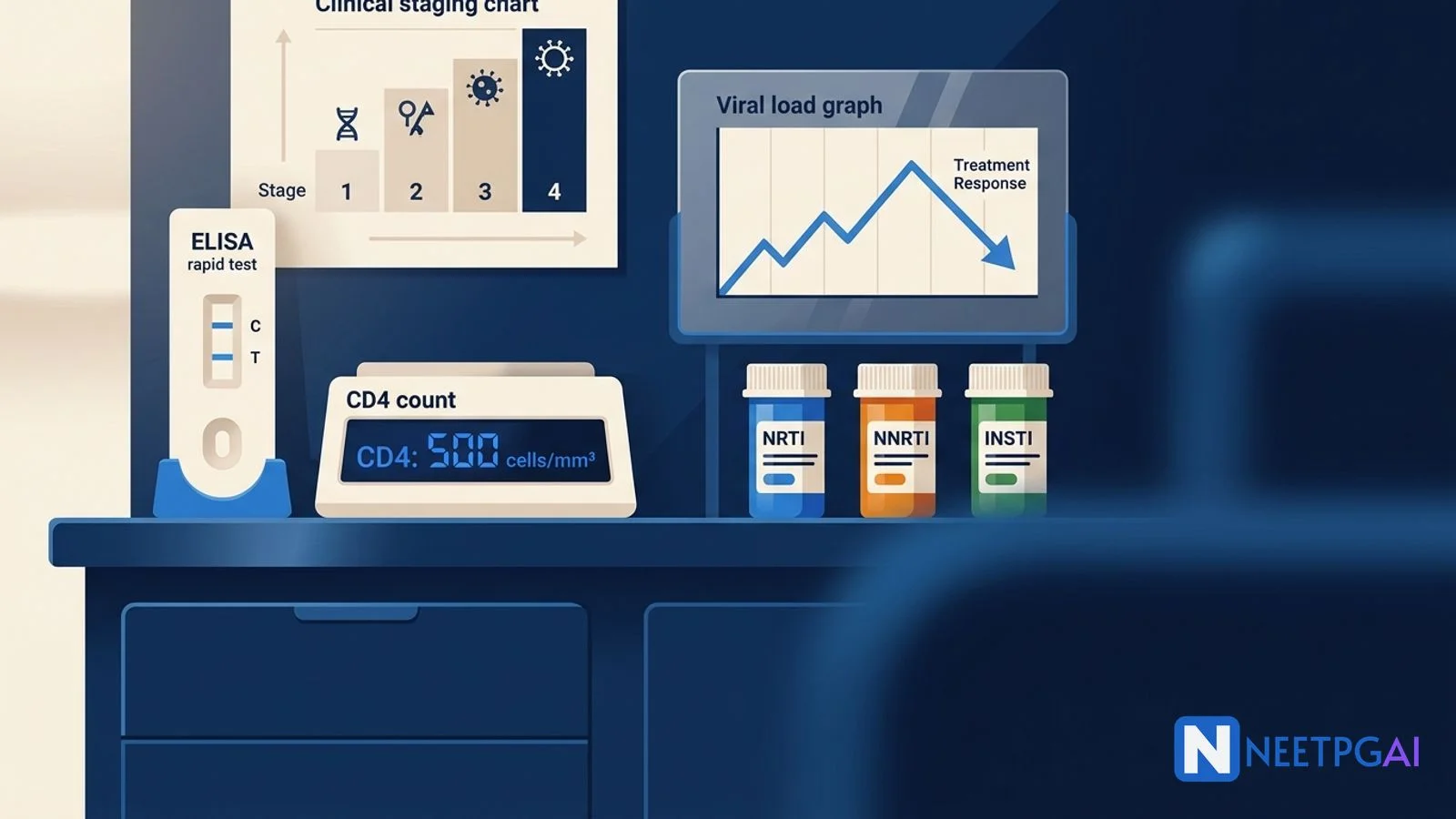
Testing algorithm — ELISA (screening) → second ELISA or rapid test with different antigens → Western blot (confirmatory in some settings) OR 3-test strategy. PCR / viral load for acute HIV, neonates, viral load monitoring
CD4 thresholds for OIs — CD4 <200: PJP. CD4 <100: toxoplasma, cryptococcus. CD4 <50: CMV, MAC
OI prophylaxis — Cotrimoxazole (PJP + toxo) at CD4 <200; INH preventive therapy (IPT) if no active TB; fluconazole if CD4 <50 and endemic cryptococcosis
PEP — Within 72 hours of exposure: TDF + 3TC + DTG (or raltegravir) × 28 days. HIV test at 0, 6 weeks, 3 months, 6 months
PrEP — Daily TDF + FTC (or TDF alone) in high-risk HIV-negative individuals. ~99% reduction with high adherence
HIV is a retrovirus that causes progressive destruction of CD4+ T-lymphocytes, leading to AIDS if untreated — and its management is a flagship NEET PG topic because it integrates medicine, pharmacology, microbiology, and community medicine. The student who masters opportunistic infections by CD4 count, NACO TLD regimen, and ART side effects has covered the foundation for 3–4 marks across papers. Pair this guide with daily MCQ practice on the Medicine subject hub, cross-reference the high-yield medicine topics overview, and revise high-yield microbiology topics for virology fundamentals.
Pathophysiology — CD4 depletion and viral load
HIV is a single-stranded enveloped RNA retrovirus of the Lentivirus genus, with two species (HIV-1 worldwide, HIV-2 mainly in West Africa) and a well-characterised entry mechanism.
Viral entry sequence:
gp120 on viral envelope binds CD4 on helper T cell / macrophage / dendritic cell
Conformational change exposes co-receptor binding site
Binding to CCR5 (macrophage-tropic R5 virus — early disease) or CXCR4 (T-cell-tropic X4 virus — late disease)
gp41 mediates fusion of viral + cell membranes
Release of viral RNA + reverse transcriptase + integrase into cytoplasm
Post-entry steps (ART drug targets):
6. Reverse transcription of viral RNA → proviral DNA (NRTI / NNRTI target)
7. Nuclear translocation; integration into host genome (INSTI target)
8. Transcription + translation of viral proteins (long polyprotein)
9. Protease cleaves polyprotein into mature structural proteins (PI target)
10. Viral assembly and budding → new virions
CCR5 delta-32 mutation: 1% of Northern Europeans are homozygous and resistant to R5-HIV (source of the "Berlin patient" cure via CCR5-negative stem cell transplant).
Natural history without ART:
Acute HIV (2–4 weeks post-infection): flu-like illness, pharyngitis, rash, lymphadenopathy (mononucleosis-like). Very high viral load (10^6–10^7 copies/mL).
Clinical latency (median 8–10 years): viral set point established. Gradual CD4 decline ~50–80 cells/μL per year.
AIDS: CD4 <200 cells/μL or AIDS-defining illness.
Median survival from AIDS without ART: 1–3 years.
With modern ART, life expectancy approaches normal in patients who start early and maintain virologic suppression.
WHO clinical staging of HIV
WHO clinical staging is a standardised framework that stages HIV disease by clinical findings alone — essential where CD4 testing is unavailable.
ARS is often misdiagnosed as mononucleosis. Diagnosis requires HIV RNA PCR or p24 antigen — ELISA may be negative in window period.
Diagnostic tests — ELISA, Western blot, PCR
HIV diagnosis in adults uses a multi-test strategy because a single test cannot meet both sensitivity and specificity standards required for a lifelong diagnosis.
Test
Detects
Use
ELISA (3rd gen)
Anti-HIV IgG antibodies
Screening; window 3–12 weeks
ELISA (4th gen)
Anti-HIV antibodies + p24 antigen
Screening; shorter window (~2–4 weeks)
Rapid antibody test
Anti-HIV antibodies
Point-of-care; finger-prick or oral fluid
Western blot
Specific antibodies to viral proteins (gp160, gp120, gp41, p24, p17, p31)
Older confirmatory test
HIV RNA PCR (viral load)
Viral RNA copies/mL
Acute HIV, infants, monitoring
HIV DNA PCR
Proviral DNA in infected cells
Diagnosis in infants <18 months
p24 antigen
Viral capsid protein
Acute HIV window period
India (NACO) 3-test strategy:
Test 1: ELISA or rapid test (highest sensitivity)
Test 2: Different ELISA or rapid test (different antigen / principle)
Test 3: Third ELISA or rapid test (if the first two disagree)
Two concordant positives → HIV-positive reported
Discordant → repeat after 4–6 weeks or do HIV RNA PCR
Western blot positivity (CDC criteria): Bands of >=2 of gp160 / gp120, gp41, p24.
Neonatal / infant diagnosis (<18 months):
Maternal IgG antibodies cross placenta — ELISA can stay positive till 15–18 months
Use HIV DNA PCR or HIV RNA PCR at:
48 hours of birth (rule out in-utero transmission)
2 weeks
6 weeks
4–6 months
Two positive PCRs confirm infection; two negative PCRs after 4 months with no breastfeeding rule out
Viral load monitoring:
Baseline before ART
6 months after ART start, then every 6–12 months
Virologic failure: two consecutive VL >1000 copies/mL after 6 months on ART with confirmed adherence
Drug interactions: decrease metformin dose; take 2 hours before / 6 hours after antacids (chelation)
Maraviroc: Requires tropism assay (effective only against R5-tropic virus).
Opportunistic infection prophylaxis
Opportunistic infection prophylaxis is added based on CD4 count and endemic exposure, and stopping criteria require sustained immune reconstitution on ART.
OI
Indication to start
Regimen
Stop when
PJP
CD4 <200 OR oropharyngeal candidiasis OR WHO stage 3/4
Cotrimoxazole 960 mg once daily
CD4 >200 × 6 months on ART
Toxoplasma
CD4 <100 + positive toxo IgG
Cotrimoxazole 960 mg once daily
CD4 >200 × 6 months
TB (latent)
Positive Mantoux / IGRA, no active TB; HIV-positive contacts of TB patients
6H or 9H or 3HP
After completion
MAC
CD4 <50 and no effective ART
Azithromycin 1200 mg weekly
ART-responsive, CD4 >100 × 3 months
Cryptococcus
Cryptococcal antigen-positive screening in high-prevalence settings; CD4 <100
Fluconazole 800 mg
After cryptococcal antigen negative + CD4 recovery
CMV
Not routine; pre-emptive treatment for viraemia in select cases
—
—
Vaccines
All HIV-positive
Pneumococcal (PCV13 + PPSV23), annual influenza, HBV, HPV, tetanus; avoid live vaccines if CD4 <200
Paradoxical worsening of pre-existing OI or unmasking of latent OI after ART start
Most common with TB, cryptococcus, CMV, hepatitis
Timing: weeks to months after ART start, especially if baseline CD4 was very low
Management: continue ART; treat the underlying OI; add steroids if severe (especially TB-IRIS, PJP-IRIS)
Mitigation: start OI therapy first, defer ART by 2 weeks in cryptococcal meningitis and 8 weeks in TBM
PEP, PrEP, and PPTCT
Post-exposure prophylaxis, pre-exposure prophylaxis, and prevention of parent-to-child transmission are the three preventive pillars — each has specific regimens and timing.
Post-exposure prophylaxis (PEP)
Indications:
Occupational: percutaneous, mucosal, or non-intact skin exposure to HIV-positive or unknown-source blood / body fluid
Non-occupational: unprotected intercourse with HIV-positive partner, sexual assault, needle sharing
Timing: Start within 72 hours (ideally within 2 hours); no benefit after 72 hours.
Alternative: event-based "2-1-1" dosing for MSM (2 tablets 2–24 h before, 1 at 24 h after, 1 at 48 h after)
Long-acting injectable cabotegravir every 8 weeks — highly effective in HPTN 083 and 084; not yet widespread in India
Efficacy: >99% reduction in HIV acquisition with high adherence.
Baseline + monitoring:
HIV test before starting and every 3 months
HBV serology at baseline (TDF active against HBV — ensure status)
eGFR baseline and every 6–12 months
STI screen every 3–6 months
PPTCT — prevention of parent-to-child transmission
PPTCT is the set of interventions that reduce HIV transmission from mother to infant during pregnancy, delivery, or breastfeeding.
India PPTCT components (NACO):
Universal antenatal HIV testing at first antenatal visit (opt-out)
Lifelong ART (Option B+) for all HIV-positive pregnant women from time of diagnosis — regardless of CD4 or stage. Regimen: TLD.
Safe delivery: vaginal delivery acceptable if viral load <1000 copies/mL at delivery; elective LSCS at 38 weeks if VL >1000
Infant ART prophylaxis: nevirapine daily × 6–12 weeks (12 weeks if breastfed)
Infant feeding: exclusive breastfeeding × 6 months while mother is on ART, then mixed feeding / weaning. Avoid mixed feeding in first 6 months (higher transmission than either exclusive breast or formula).
Early infant diagnosis (EID): HIV DNA PCR at 6 weeks (after cessation of prophylaxis) and repeat as needed till 18 months
With full PPTCT: <2% transmission (and <1% in high-income countries)
Sources and references
National AIDS Control Organisation (NACO), Ministry of Health & Family Welfare, Government of India — National Guidelines for HIV Care and Treatment (2021 edition) including ART Technical Guidelines and PPTCT guidelines.
WHO Consolidated Guidelines on HIV Prevention, Testing, Treatment, Service Delivery and Monitoring: Recommendations for a Public Health Approach (2021 update).
Harrison's Principles of Internal Medicine, 21st Edition (Loscalzo et al., 2022) — Chapter on HIV infection and AIDS.
DHHS Panel on Antiretroviral Guidelines for Adults and Adolescents — Guidelines for the Use of Antiretroviral Agents in Adults and Adolescents Living with HIV (2023 update).
Havlir DV et al. Opportunistic infections in the era of antiretroviral therapy. New England Journal of Medicine 2011; 365:1922-1931.
INSIGHT START Study Group. Initiation of antiretroviral therapy in early asymptomatic HIV infection. New England Journal of Medicine 2015; 373:795-807 — evidence base for "treat all".
Frequently asked questions
How many HIV questions appear in NEET PG?
HIV/AIDS contributes 3-4 direct questions per NEET PG paper across medicine, pharmacology, microbiology, and community medicine. Opportunistic infections by CD4 count, NACO TLD first-line regimen, ART side effects, and PEP protocol are the most tested subtopics based on 2019-2025 pattern analysis.
What is the first-line ART regimen in India?
Under NACO guidelines (2021 update), the first-line regimen for all adults and adolescents is TLD — tenofovir 300 mg plus lamivudine 300 mg plus dolutegravir 50 mg, given as a single once-daily fixed-dose combination. Dolutegravir replaced efavirenz as the preferred third agent because of higher virologic suppression, higher genetic barrier to resistance, and better tolerability.
Which opportunistic infection occurs at CD4 less than 200?
At CD4 less than 200 cells per microlitre, the hallmark opportunistic infection is Pneumocystis jirovecii pneumonia (PJP), which presents with progressive dyspnoea, dry cough, and a chest X-ray showing bilateral perihilar interstitial infiltrates. Prophylaxis with cotrimoxazole (TMP-SMX) 960 mg once daily is started at CD4 less than 200 and continued until CD4 is sustained above 200 for 6 months on ART.
What is the CD4 cutoff for toxoplasma prophylaxis?
Toxoplasma encephalitis prophylaxis is initiated at CD4 less than 100 cells per microlitre in patients with positive toxoplasma IgG serology. Cotrimoxazole 960 mg daily provides dual prophylaxis against both PJP and toxoplasma. Patients present with ring-enhancing lesions on MRI brain with predilection for basal ganglia.
What is the CD4 threshold for CMV and MAC prophylaxis?
CMV and MAC (Mycobacterium avium complex) become threats at CD4 less than 50 cells per microlitre. CMV retinitis presents with painless vision loss and pizza-pie fundus appearance — treatment is IV ganciclovir or oral valganciclovir. MAC causes disseminated infection with fever, weight loss, and hepatosplenomegaly — prophylaxis with azithromycin 1200 mg weekly is recommended only if CD4 stays below 50 and ART has failed.
What are the classes of antiretroviral drugs?
ART drug classes are NRTIs (nucleoside reverse transcriptase inhibitors — tenofovir, zidovudine, lamivudine, emtricitabine, abacavir), NNRTIs (efavirenz, nevirapine, rilpivirine), PIs (protease inhibitors — lopinavir/ritonavir, atazanavir/ritonavir, darunavir/ritonavir), INSTIs (integrase strand transfer inhibitors — dolutegravir, raltegravir, bictegravir), entry inhibitors (maraviroc — CCR5 antagonist), and fusion inhibitors (enfuvirtide).
What are tenofovir, efavirenz, and zidovudine side effects?
Tenofovir causes renal tubular toxicity (Fanconi syndrome) and decreased bone mineral density — monitor creatinine and eGFR before and during therapy. Efavirenz causes CNS side effects (vivid dreams, dizziness, insomnia, depression) peaking at 2-4 weeks and teratogenicity (neural tube defects — avoided in first trimester). Zidovudine causes macrocytic anaemia and myopathy.
What is the PEP regimen for occupational HIV exposure?
Post-exposure prophylaxis for HIV is indicated within 72 hours of significant percutaneous or mucosal exposure to HIV-positive or unknown-status source blood. The current recommended regimen is tenofovir plus lamivudine plus dolutegravir (or raltegravir) for 28 days. Baseline HIV test at time 0, then repeat at 6 weeks, 3 months, and 6 months. Earlier start equals higher efficacy; delay beyond 72 hours is not effective.
What is PrEP and who should receive it?
Pre-exposure prophylaxis (PrEP) is daily tenofovir plus emtricitabine (or tenofovir alone) given to HIV-negative people at high risk of HIV acquisition. Indicated for serodiscordant partners, men who have sex with men with multiple partners, injection drug users, and sex workers. Reduces HIV acquisition by approximately 99 percent if adherence is high. HIV test required before initiation and every 3 months thereafter.
How do we prevent mother-to-child transmission?
PPTCT (Prevention of Parent-to-Child Transmission) under NACO has three pillars. First: universal antenatal HIV testing and counselling. Second: lifelong ART from the time of diagnosis in pregnancy (Option B+) — TLD is the preferred regimen. Third: infant prophylaxis with nevirapine daily for 6-12 weeks and exclusive breastfeeding for 6 months while mother is on ART. This reduces vertical transmission from 25-40 percent to less than 2 percent.
Ready to test your HIV/AIDS knowledge? Convert this guide into exam marks with active MCQ recall — revise virology fundamentals with high-yield microbiology topics and use the AI tutor to drill OI-by-CD4 mapping on demand.
Explore our pricing plans for unlimited practice across all 19 subjects, AI-powered doubt resolution, and personalized study plans.
This content is for educational purposes for NEET PG exam preparation. It is not a substitute for professional medical advice, diagnosis, or treatment. Clinical information has been reviewed by qualified medical professionals.
Written by: NEETPGAI Editorial Team
Reviewed by: Pending SME Review
Last reviewed: April 2026
This article is reviewed by qualified medical professionals for clinical accuracy and exam relevance. For corrections or updates, contact the editorial team.