Quick Answer
Genetics contributes 3–5 NEET PG questions per paper across pediatrics, medicine, OBG, and pathology. Master these 8 high-yield areas:
- Autosomal dominant — vertical transmission, 50% offspring affected; Marfan (FBN1), Huntington (HTT, CAG), neurofibromatosis 1 (NF1), achondroplasia (FGFR3), Von Hippel-Lindau, polycystic kidney (PKD1, PKD2)
- Autosomal recessive — horizontal pattern, 25% affected; cystic fibrosis (CFTR, ΔF508), sickle cell (HBB), thalassemia, Wilson (ATP7B), Tay-Sachs, PKU
- X-linked recessive — male predominance, no male-male transmission; hemophilia A/B, DMD/BMD, G6PD, color blindness, Lesch-Nyhan, Wiskott-Aldrich
- X-linked dominant — Vitamin D-resistant rickets, Alport syndrome (most common), Rett (male-lethal), incontinentia pigmenti (male-lethal)
- Mitochondrial — maternal only, heteroplasmy; LHON, MELAS, MERRF, Kearns-Sayre, Leigh, Pearson syndrome
- Imprinting — Prader-Willi (paternal 15q11-q13 loss), Angelman (maternal 15q11-q13 loss), Beckwith-Wiedemann (11p15)
- Trinucleotide repeats — Huntington (CAG), DM1 (CTG), fragile X (CGG), Friedreich (GAA), SCA1-7 (CAG), DRPLA (CAG)
- Counseling — Hardy-Weinberg, recurrence risk, prenatal testing (CVS at 10–13 wk, amniocentesis at 15+ wk, NIPT, PGD)
Genetics is a deceptively high-yield NEET PG topic — questions land in pediatrics (Down syndrome, fragile X), medicine (Huntington, Marfan, hemochromatosis), OBG (Turner, Klinefelter, prenatal diagnosis), and pathology (cancer genetics, BRCA, Li-Fraumeni). Examiners love pedigree analysis and "name the inheritance pattern" stems. This NEETPGAI deep dive reduces the entire syllabus to memorable rules and disease prototypes.
Use this guide alongside the pediatrics high-yield topics for chromosomal disorders and the biochemistry topic guide for inborn errors of metabolism. Consistent MCQ practice through the Pathology hub cements genetic syndrome recognition.
Mendelian inheritance — the four classic patterns
Mendelian disorders follow predictable single-gene transmission. The four classic patterns are autosomal dominant, autosomal recessive, X-linked dominant, and X-linked recessive. Recognizing them on a pedigree is a guaranteed NEET PG skill.
Autosomal dominant (AD)
One mutant allele on an autosome is sufficient to cause disease.
Pedigree clues:
- Vertical transmission — disease appears in every generation
- Both sexes equally affected
- Male-to-male transmission possible (rules out X-linked)
- Affected parent + unaffected parent → 50% offspring affected
Classic AD diseases:
| Disease | Gene | Protein / mechanism |
|---|
| Marfan syndrome | FBN1 (15q21) | Fibrillin-1; aortic root dilation, ectopia lentis, tall stature |
| Huntington disease | HTT (4p16) | Huntingtin, CAG expansion (40+); chorea, dementia, anticipation |
| Neurofibromatosis 1 | NF1 (17q11) | Neurofibromin (tumor suppressor); cafe-au-lait, Lisch nodules, optic glioma |
| Neurofibromatosis 2 | NF2 (22q12) | Merlin/schwannomin; bilateral vestibular schwannoma |
| Achondroplasia | FGFR3 (4p16) | Gain-of-function; rhizomelic dwarfism, frontal bossing |
| Adult polycystic kidney disease | PKD1 (16p13), PKD2 (4q21) | Polycystin-1, polycystin-2; bilateral renal cysts, berry aneurysms |
| Hereditary spherocytosis | ANK1, SPTB, SPTA1 | Membrane skeleton; splenomegaly, gallstones, MCHC elevated |
| Familial hypercholesterolemia | LDLR | LDL receptor; tendon xanthomas, premature CAD |
| Tuberous sclerosis | TSC1 (9q34), TSC2 (16p13) | Hamartin/tuberin; ash-leaf macules, cortical tubers, rhabdomyomas |
| Von Hippel-Lindau | VHL (3p25) | HIF-degradation; hemangioblastomas, renal cell carcinoma, pheochromocytoma |
Key concepts:
- Penetrance — proportion of mutation carriers expressing the phenotype (e.g., BRCA1 has ~80% penetrance for breast cancer)
- Variable expressivity — different severities among carriers (NF1 ranges from cafe-au-lait spots to plexiform neurofibromas)
- Pleiotropy — single gene affecting multiple systems (Marfan: cardiac + ocular + skeletal)
Autosomal recessive (AR)
Both alleles must be mutant. Carriers (heterozygotes) are clinically unaffected.
Pedigree clues:
- Horizontal pattern — affected siblings, unaffected parents
- May skip generations
- Consanguinity increases risk (cousin marriages — relevant in Indian populations)
- 25% offspring affected from carrier × carrier; 50% carriers; 25% normal
Classic AR diseases:
| Disease | Gene | Notes |
|---|
| Cystic fibrosis | CFTR (7q31) | ΔF508 most common (70%); chloride channel; pancreatic insufficiency, lung disease, sweat chloride >60 mmol/L |
| Sickle cell anemia | HBB (11p15) | Glu→Val at codon 6 of beta-globin; HbS polymerization; vaso-occlusion |
| Beta-thalassemia | HBB | Reduced beta-globin synthesis; HbA2 elevated; transfusion-dependent in major form |
| Tay-Sachs disease | HEXA | Hexosaminidase A; cherry-red spot, neurodegeneration; Ashkenazi Jewish |
| Phenylketonuria (PKU) | PAH | Phenylalanine hydroxylase; mental retardation if untreated; newborn screening |
| Wilson disease | ATP7B (13q14) | Copper transport ATPase; Kayser-Fleischer ring, hepatolenticular degeneration |
| Hemochromatosis (classical) | HFE (C282Y) | Iron overload; bronze diabetes, cirrhosis, cardiomyopathy |
| Friedreich ataxia | FXN (9q21), GAA repeat | Frataxin deficiency; ataxia + cardiomyopathy + diabetes; AR exception with anticipation |
| Galactosemia | GALT | Cataracts, jaundice, mental retardation; lactose-free formula |
| Alpha-1 antitrypsin deficiency | SERPINA1 (PiZZ) | Panacinar emphysema + liver cirrhosis |
X-linked recessive (XR)
Mutation on X chromosome; males (XY) have no second X to compensate.
Pedigree clues:
- Males predominantly affected
- No male-to-male transmission (a father transmits Y to sons)
- Affected fathers → all daughters carriers
- Carrier mothers → 50% sons affected, 50% daughters carriers
Classic XR diseases:
| Disease | Gene | Notes |
|---|
| Hemophilia A | F8 | Factor VIII deficiency; hemarthrosis, prolonged aPTT |
| Hemophilia B (Christmas disease) | F9 | Factor IX deficiency |
| Duchenne / Becker muscular dystrophy | DMD (Xp21) | Dystrophin; calf pseudohypertrophy, Gower sign; DMD = frameshift, BMD = in-frame |
| G6PD deficiency | G6PD | Hemolysis with oxidative stress; Heinz bodies, bite cells |
| Color blindness | OPN1LW, OPN1MW | Red-green most common |
| Lesch-Nyhan | HPRT1 | Hyperuricemia, self-mutilation, choreoathetosis |
| Wiskott-Aldrich | WAS | Eczema + thrombocytopenia + immunodeficiency |
| Bruton agammaglobulinemia | BTK | Recurrent bacterial infections, absent B cells |
| Fabry disease | GLA | Alpha-galactosidase A; angiokeratomas, renal/cardiac disease (heterozygous females may also manifest) |
X-linked dominant (XD)
Single mutant X allele causes disease in heterozygotes.
Pedigree clues:
- Affected fathers → ALL daughters affected, no sons affected
- Affected mothers → 50% offspring affected (regardless of sex)
- Some XD disorders are male-lethal (Rett, incontinentia pigmenti)
Examples:
- X-linked hypophosphatemic rickets (vitamin D-resistant rickets, PHEX)
- Alport syndrome (most common form, COL4A5) — hematuria, sensorineural deafness, anterior lenticonus
- Rett syndrome (MECP2) — male-lethal in utero typically; girls present at 6–18 months with regression, hand-wringing
- Incontinentia pigmenti (IKBKG/NEMO) — male-lethal; skin lesions in Blaschko lines
Mitochondrial inheritance
Mitochondria are inherited exclusively from the mother (sperm mitochondria are typically destroyed post-fertilization). mtDNA encodes 37 genes including 13 OXPHOS subunits.
Pedigree clues:
- Affected mothers → ALL children affected (variable severity)
- Affected fathers → NO children affected
- Both sexes affected equally
- Heteroplasmy (mix of mutant and wild-type mtDNA) explains variable expression and threshold effect
Classic mitochondrial diseases:
| Disease | Mutation | Clinical |
|---|
| Leber's hereditary optic neuropathy (LHON) | mtND1, mtND4, mtND6 | Painless central vision loss in young men, women relatively spared |
| MELAS | mtTL1 (A3243G most common) | Mitochondrial Encephalopathy, Lactic Acidosis, Stroke-like episodes |
| MERRF | mtTK (A8344G) | Myoclonic Epilepsy with Ragged Red Fibers |
| Kearns-Sayre syndrome | Large mtDNA deletions | External ophthalmoplegia, retinitis pigmentosa, heart block (onset <20 yr) |
| Leigh disease | Multiple genes (often nuclear-encoded) | Subacute necrotizing encephalomyelopathy in infants |
| Pearson syndrome | mtDNA deletion | Sideroblastic anemia + exocrine pancreatic insufficiency |
Tissues with high energy demand are preferentially affected: brain (encephalopathy, seizures, stroke-like episodes), retina (pigmentary retinopathy), cochlea (deafness), heart (cardiomyopathy, conduction defects), skeletal muscle (myopathy, ragged-red fibers).
Trinucleotide repeat expansion disorders
Unstable trinucleotide repeats expand during meiosis (especially paternal in some, maternal in others), causing anticipation — earlier onset and greater severity in successive generations.
| Disease | Repeat | Location | Inheritance | Anticipation |
|---|
| Huntington disease | CAG | HTT exon 1 | AD | Strong, paternal |
| Myotonic dystrophy 1 | CTG | DMPK 3'UTR | AD | Strong, maternal |
| Fragile X syndrome | CGG | FMR1 5'UTR | XD (with reduced penetrance) | Maternal transmission expansion |
| Friedreich ataxia | GAA | FXN intron 1 | AR | Mild |
| Spinocerebellar ataxias (SCA1-17) | CAG (most) | Various | AD | Paternal |
| Dentatorubral-pallidoluysian atrophy (DRPLA) | CAG | ATN1 | AD | Paternal |
| Spinal and bulbar muscular atrophy (Kennedy) | CAG | AR (androgen receptor) | XR | Paternal |
Memory aid (location of repeat): "Try Hunting For My Fragile Cap" — Try (Trinucleotide), Hunting (HD = exon), For (Friedreich = intron), My (Myotonic = 3'UTR), Fragile (Fragile X = 5'UTR), Cap (CAG most common cause of AD ataxias).
Fragile X syndrome: the most common inherited cause of intellectual disability in males. Premutation (55–200 CGG) → fragile X-associated tremor/ataxia (FXTAS) in older males and POI in females. Full mutation (>200) → mental retardation, long face, large ears, macroorchidism.
Genomic imprinting
Imprinting is parent-of-origin-specific gene expression — certain genes are silenced when inherited from one parent. Loss of the active copy causes disease.
| Syndrome | Locus | Mechanism | Phenotype |
|---|
| Prader-Willi | 15q11-q13 paternal loss | Paternal deletion (70%), maternal UPD (25%), imprinting defect (5%) | Hypotonia in infancy, hyperphagia/obesity, hypogonadism, mild ID |
| Angelman | 15q11-q13 maternal loss | Maternal deletion (70%), paternal UPD (5%), UBE3A mutation | "Happy puppet": ataxia, seizures, severe ID, inappropriate laughter |
| Beckwith-Wiedemann | 11p15 (IGF2/H19) | Paternal UPD or imprinting defect | Macrosomia, macroglossia, omphalocele, hypoglycemia, Wilms tumor risk |
| Russell-Silver | 11p15 / 7p | Maternal UPD of chr 7 (10%), 11p15 hypomethylation | Pre/postnatal growth restriction, asymmetry, triangular face |
Pedigree analysis — quick decision rules
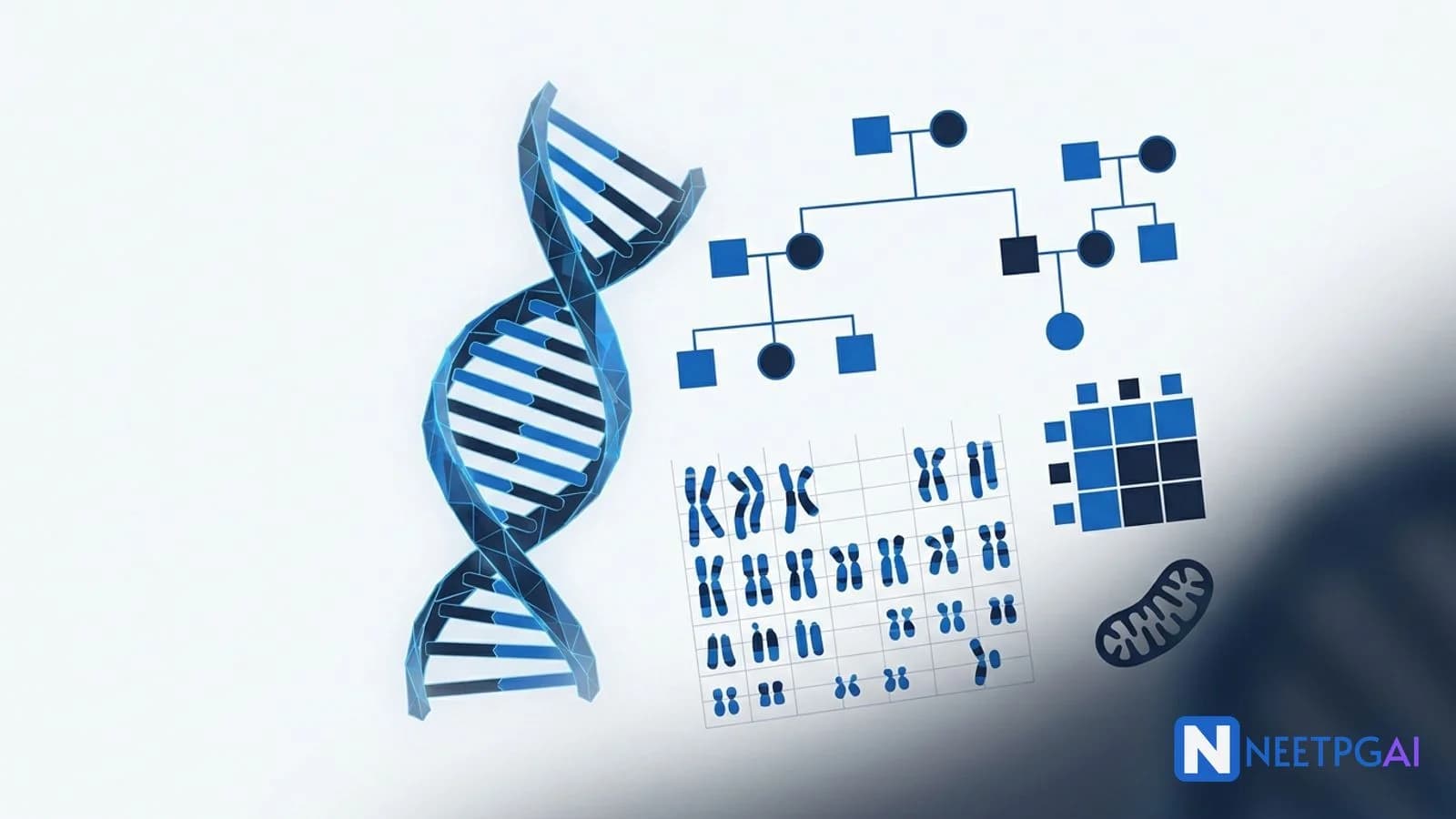
Standard pedigree symbols: square = male, circle = female, filled = affected, horizontal line = mating, vertical line = offspring, slash = deceased.
Decision algorithm
- Affected in every generation, both sexes, M-to-M transmission? → Autosomal dominant
- Skips generations, often in consanguineous unions, both sexes? → Autosomal recessive
- Predominantly males, no M-to-M, carrier mothers? → X-linked recessive
- Affected father → all daughters affected, NO sons affected? → X-linked dominant
- Affected mother → all children affected, affected father → no children affected? → Mitochondrial
Hardy-Weinberg equilibrium
Allele frequencies are stable across generations under five assumptions: large population, no mutation, no migration, no selection, random mating.
Equations:
- p + q = 1 (allele frequencies)
- p² + 2pq + q² = 1 (genotype frequencies)
- p² = homozygous dominant; 2pq = heterozygous; q² = homozygous recessive
NEET PG application: If 1 in 10,000 newborns has PKU (q² = 1/10,000), then q = 1/100. Carrier frequency 2pq ≈ 2 × 1/100 = 1/50.
Cancer genetics
| Syndrome | Gene | Tumors |
|---|
| Hereditary breast-ovarian cancer (HBOC) | BRCA1 (17q), BRCA2 (13q) | Breast, ovarian; BRCA2 also pancreatic, prostate, male breast |
| Li-Fraumeni | TP53 (17p) | Sarcoma, breast, brain, leukemia, adrenocortical |
| Lynch syndrome (HNPCC) | MLH1, MSH2, MSH6, PMS2 | Colon (right-sided), endometrial, ovarian; microsatellite instability |
| FAP | APC (5q) | Hundreds of colonic adenomas → CRC by 40 |
| MEN 1 | MEN1 | "3 Ps" — Pituitary, Parathyroid, Pancreatic islet |
| MEN 2A | RET | Medullary thyroid Ca + pheochromocytoma + hyperparathyroidism |
| MEN 2B | RET | MTC + pheo + mucosal neuromas + marfanoid habitus |
| Retinoblastoma | RB1 (13q) | Hereditary form: bilateral, early; sporadic: unilateral, later |
| Peutz-Jeghers | STK11 | Mucocutaneous pigmentation + GI hamartomas + cancer risk |
| Cowden syndrome | PTEN | Breast, thyroid, endometrial, hamartomas |
Knudson two-hit hypothesis: classic for retinoblastoma — hereditary cases inherit one mutant RB1 allele (germline first hit) and acquire a second somatic mutation; sporadic cases require both hits in one cell, hence later and unilateral.
Genetic counseling and prenatal testing
Prenatal diagnostic tools
| Test | Timing | What it tests | Risk |
|---|
| NIPT (cell-free fetal DNA) | 10+ weeks | Aneuploidy (T21, T18, T13), sex | Non-invasive, screening only |
| Chorionic villus sampling (CVS) | 10–13 weeks | Karyotype, FISH, microarray, single-gene | 1 in 100 miscarriage |
| Amniocentesis | 15+ weeks | Karyotype, microarray, AFP for NTD | 1 in 200 miscarriage |
| Cordocentesis (PUBS) | 18+ weeks | Fetal blood for hemoglobinopathy, infection | 1 in 50 fetal loss |
| Maternal serum screening (triple/quad) | 15–20 weeks | T21, T18, NTD risk | Screening only |
| First-trimester combined screening | 11–13+6 weeks | NT + PAPP-A + free β-hCG | Screening only |
| Preimplantation genetic diagnosis (PGD) | Pre-implantation IVF | Single-gene, aneuploidy | Requires IVF |
Genetic counseling principles
- Non-directive approach — provide information; let the family decide
- Confidentiality — disclose only with consent (with exceptions for serious harm)
- Informed consent — clear explanation of test purpose, limitations, implications
- Right not to know — patients can decline testing for late-onset diseases (e.g., Huntington's)
- Predictive testing in minors — generally deferred for adult-onset disorders without childhood preventive interventions
Indian-context considerations
- Pre-conception and Pre-natal Diagnostic Techniques (PCPNDT) Act 1994 — prohibits sex determination during prenatal diagnosis; mandates registration of all genetic clinics, ultrasound clinics
- High consanguinity rates in some regions (south India, Muslim communities) increase AR disease prevalence
- Hemoglobinopathies (sickle cell, beta-thalassemia) are high-yield in Indian context — premarital and antenatal screening programs exist in many states
- Indian Council of Medical Research (ICMR) Guidelines for Genetic Testing 2021 — frame the regulatory landscape
Recent updates and high-yield trends
- CRISPR-Cas9 therapeutics — Casgevy (exa-cel) approved 2023 for sickle cell disease and beta-thalassemia (first CRISPR therapy globally).
- Gene therapy advances — Zolgensma (onasemnogene abeparvovec) for spinal muscular atrophy; Luxturna for RPE65-mediated retinal dystrophy.
- Polygenic risk scores (PRS) — increasingly used in cancer and cardiovascular risk stratification; not yet standard of care.
- NIPT — sensitivity >99% for trisomy 21; expanded to microdeletions but with reduced positive predictive value.
- Indian government initiatives — National Newborn Screening for IEM (PKU, congenital hypothyroidism, CAH, G6PD) being scaled in select states.
- Pharmacogenomics — CYP2C19 testing for clopidogrel response; HLA-B5701 for abacavir hypersensitivity; HLA-B1502 for carbamazepine SJS in Asian populations (high-yield NEET PG).
High-yield NEET PG MCQ traps
- Mitochondrial inheritance — affected fathers transmit to NO children (sperm mitochondria destroyed). NEVER X-linked recessive in disguise.
- Friedreich ataxia is the AR exception with anticipation (GAA expansion in intron 1 of FXN).
- Anticipation is most pronounced in paternal Huntington and maternal myotonic dystrophy.
- Prader-Willi = paternal loss; Angelman = maternal loss (both at 15q11-q13).
- Knudson two-hit classically for retinoblastoma; bilateral and early = hereditary form.
- Lyonization (random X-inactivation in females) explains why female carriers of XR disorders may have variable manifestations (e.g., Fabry, DMD).
- Klinefelter (47,XXY) is hypogonadism + tall stature + gynecomastia + infertility — not Mendelian, chromosomal.
- Down syndrome — 95% trisomy 21 (nondisjunction, maternal age), 4% Robertsonian translocation (recurrence risk!), 1% mosaic.
- HLA-B*1502 = carbamazepine SJS in South/Southeast Asians — high-yield Indian context.
- Imprinting through UPD — uniparental disomy (both copies of a chromosome from one parent) can mimic deletion for imprinted regions.
Frequently asked questions
What is the difference between autosomal dominant and autosomal recessive inheritance?
Autosomal dominant traits affect every generation, with one affected parent producing 50% affected offspring (vertical pedigree pattern). Autosomal recessive traits often skip generations, require both parents as carriers, produce 25% affected offspring, and are more common in consanguineous unions (horizontal pattern). AD examples include Marfan, Huntington; AR examples include cystic fibrosis, sickle cell.
How is mitochondrial inheritance recognized on a pedigree?
Mitochondrial inheritance is exclusively maternal — affected mothers transmit to all children, but affected fathers transmit to none. Heteroplasmy (mix of normal and mutant mtDNA) explains variable expression. Classic examples: Leber's hereditary optic neuropathy (LHON), MELAS, MERRF, Kearns-Sayre syndrome, Leigh disease. Tissues with high energy demand (brain, muscle, retina) are most affected.
What is anticipation in genetic disease?
Anticipation is the phenomenon where a disease appears at progressively earlier ages and with greater severity in successive generations — caused by trinucleotide repeat expansion. Classic examples: Huntington disease (CAG), myotonic dystrophy (CTG), fragile X (CGG), Friedreich ataxia (GAA — exception, autosomal recessive).
What is genomic imprinting and which diseases illustrate it?
Genomic imprinting is parent-of-origin-specific gene expression. Prader-Willi syndrome results from loss of the paternal copy of 15q11-q13 (or maternal uniparental disomy); Angelman syndrome from loss of the maternal copy. Beckwith-Wiedemann (11p15) and Russell-Silver syndromes are other classic imprinting disorders.
How does X-linked inheritance differ from autosomal inheritance?
X-linked recessive disorders predominantly affect males (no second X to compensate), with carrier mothers transmitting to half their sons. Affected fathers transmit to all daughters as carriers (no male-to-male transmission). Examples: hemophilia A/B, DMD, G6PD deficiency, color blindness. X-linked dominant: Vitamin D-resistant rickets (X-linked hypophosphatemia), Rett syndrome (lethal in males).
This content is for educational purposes for NEET PG exam preparation. It is not a substitute for professional medical advice, diagnosis, or treatment. Clinical information has been reviewed by qualified medical professionals.
Written by: NEETPGAI Editorial Team
Reviewed by: Pending SME Review
Last reviewed: April 2026