Quick Answer
Vesiculobullous and papulosquamous disorders contribute 4–6 NEET PG questions per paper across Dermatology, Medicine and Pathology. The exam-ready framework:
- Bullous level — intraepidermal (pemphigus, SSSS) vs subepidermal (pemphigoid, DH, EBA, linear IgA).
- Nikolsky sign — positive in pemphigus, SSSS, TEN; negative in pemphigoid, DH.
- Immunofluorescence — fishnet IgG (PV); linear IgG/C3 BMZ (BP); granular IgA at papillae (DH); linear IgA BMZ (LAD).
- Papulosquamous — psoriasis, lichen planus, pityriasis rosea, secondary syphilis, seborrheic dermatitis.
- Treatment — pemphigus needs systemic steroids + rituximab; psoriasis follows mild-moderate-severe ladder.
Vesiculobullous and papulosquamous diseases sit at the intersection of dermatopathology and immunology — every disease has a target antigen, a histological level of cleavage, and an immunofluorescence pattern. NEET PG examiners reward precision: knowing where in the skin the disease attacks, which antibody mediates it, and what clinical sign confirms it. Once those three questions are answered, the diagnosis writes itself.
This NEETPGAI deep dive covers every major bullous and papulosquamous disorder on the syllabus, the immunofluorescence patterns that separate them, the SJS-TEN spectrum, the modern psoriasis treatment ladder, and the highest-yield MCQ traps. Pair this with the autoimmune connective tissue diseases primer for crossover topics.
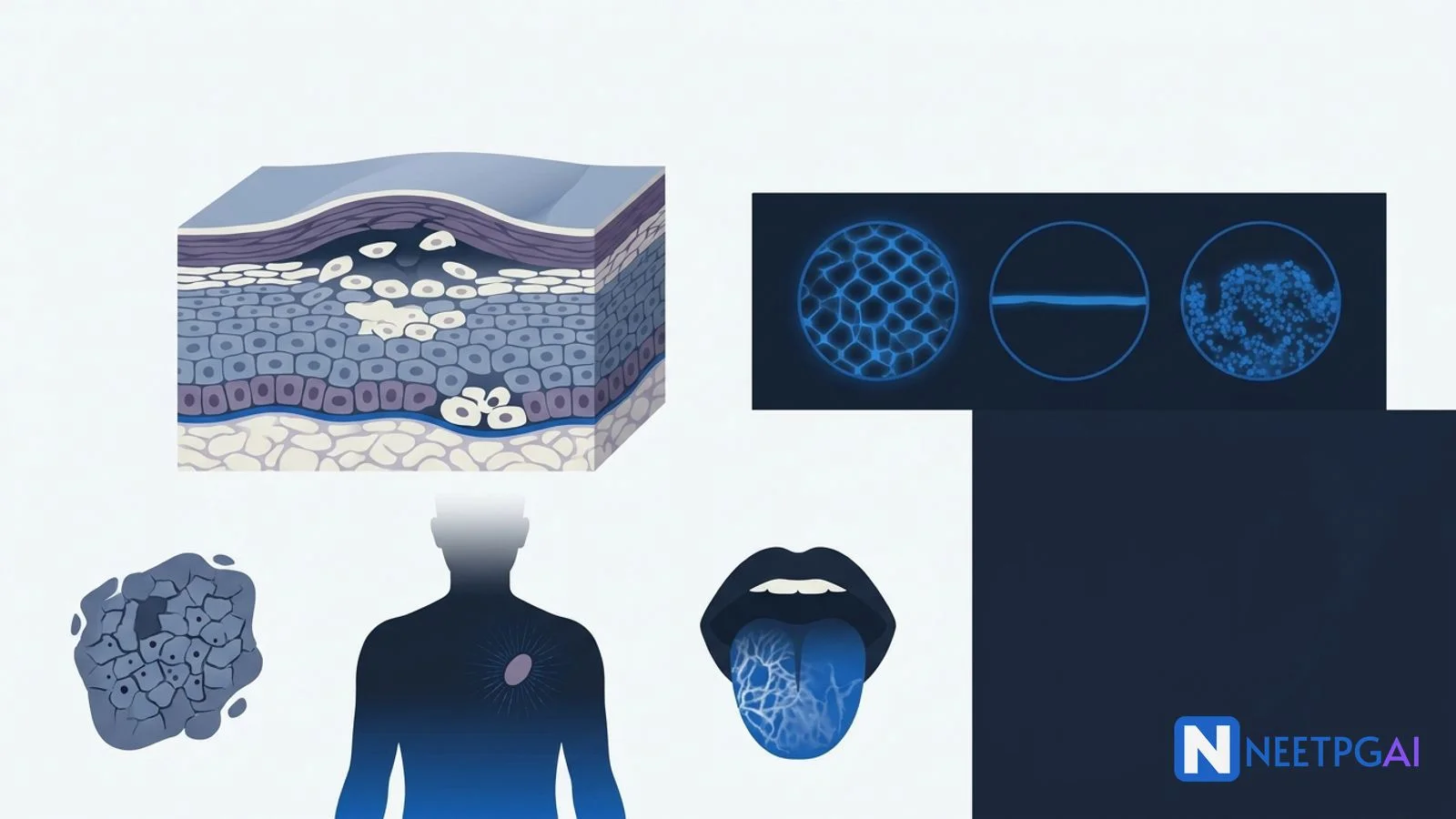
Skin layers — where do the blisters form?
| Level of cleavage | Diseases |
|---|
| Subcorneal (just below stratum corneum) | Pemphigus foliaceus, SSSS, IgA pemphigus, impetigo |
| Suprabasal (just above basal cell layer) | Pemphigus vulgaris, Hailey-Hailey, Darier disease |
| Subepidermal (basement membrane zone) | Bullous pemphigoid, dermatitis herpetiformis, EBA, linear IgA disease, porphyria cutanea tarda, EM/SJS/TEN |
Vesiculobullous disorders
Pemphigus vulgaris (PV)
- Antigen: desmoglein-3 (mucocutaneous form also desmoglein-1).
- Level: suprabasal acantholysis ("tombstone" basal cells).
- Clinical: flaccid bullae that rupture quickly, painful erosions, prominent oral mucosal involvement (often the first site), Nikolsky sign positive.
- DIF: intraepidermal IgG and C3 in a "fishnet" or "chicken-wire" pattern around keratinocytes.
- IIF: circulating IgG against monkey oesophagus.
- Treatment: systemic corticosteroids (prednisolone 1 mg/kg/day) + steroid-sparing agents (azathioprine, mycophenolate); rituximab is first-line for moderate-severe disease (FDA approved 2018, NMC 2024 syllabus emphasis).
Pemphigus foliaceus
- Antigen: desmoglein-1 only.
- Level: subcorneal cleavage; "cornflake" scales.
- Clinical: crusted erosions on seborrheic areas; no oral involvement.
- Variants: fogo selvagem (Brazilian endemic), pemphigus erythematosus (Senear-Usher).
Bullous pemphigoid (BP)
- Antigen: BP180 (BPAG2, hemidesmosome) and BP230.
- Level: subepidermal.
- Clinical: elderly patient, tense bullae on flexures and trunk, intensely pruritic, Nikolsky negative, oral involvement rare (~10–20%).
- DIF: linear IgG and C3 along the basement membrane zone.
- Salt-split skin: IgG on the roof (epidermal side).
- Treatment: topical clobetasol (mild–moderate); systemic steroids + steroid-sparing agents (severe); dupilumab emerging.
Dermatitis herpetiformis (DH)
- Antigen: epidermal transglutaminase (TG3) — cousin of tissue transglutaminase.
- Level: subepidermal (papillary dermis).
- Clinical: intensely pruritic grouped vesicles on extensor surfaces (elbows, knees, buttocks, scalp); strongly associated with coeliac disease (anti-tTG, anti-endomysial).
- DIF: granular IgA at the tips of dermal papillae — pathognomonic.
- HLA: DQ2 / DQ8.
- Treatment: dapsone (rapid relief, check G6PD first) + strict gluten-free diet (definitive, allows dapsone tapering).
Linear IgA bullous dermatosis (LAD)
- Antigen: LABD97 (a fragment of BP180).
- Level: subepidermal.
- Clinical: "string-of-pearls" or "cluster-of-jewels" annular vesicles in children (chronic bullous disease of childhood); drug-induced (vancomycin) in adults.
- DIF: linear IgA at the BMZ.
- Treatment: dapsone, sulfapyridine; stop offending drug.
Epidermolysis bullosa acquisita (EBA)
- Antigen: type VII collagen (anchoring fibrils).
- Clinical: trauma-induced blisters on extensor surfaces; scarring, milia. Mimics dystrophic EB.
- Salt-split skin: IgG on the dermal floor (vs roof in BP).
Erythema multiforme / SJS / TEN
A spectrum of severe mucocutaneous reactions:
| Feature | EM minor | EM major | SJS | SJS-TEN overlap | TEN |
|---|
| Trigger | HSV (most common) | HSV, mycoplasma | Drugs (sulfa, AEDs, allopurinol, NSAIDs) | Drugs | Drugs |
| Target lesions | Typical 3-zone | Typical | Atypical (2-zone) | Atypical | Atypical |
| Mucosa | Minimal | 1 site | 2+ sites | 2+ sites | 2+ sites |
| BSA detachment | None | None | <10% | 10–30% | >30% |
| Mortality | <5% | <5% | 5–10% | 10–25% | 25–35% |
- Histology: full-thickness epidermal necrosis with subepidermal split.
- Nikolsky: positive in SJS/TEN.
- SCORTEN score — 7 variables (age >40, malignancy, HR >120, BSA >10%, urea >10 mmol/L, glucose >14 mmol/L, HCO3 <20); predicts mortality.
- Treatment: stop drug, supportive care in burns/ICU unit; cyclosporine (4 mg/kg/day) and IVIG most-used disease-modifying agents in India.
Herpes infections — eczema herpeticum
- HSV-1/2 vesicles on erythematous base; positive Tzanck smear (multinucleated giant cells).
- Eczema herpeticum — disseminated HSV in atopic dermatitis; medical emergency. Treat with IV acyclovir.
- Varicella zoster — dermatomal vesicles. Post-herpetic neuralgia in elderly. Treat within 72 hours of rash onset (acyclovir, valacyclovir, famciclovir).
Papulosquamous disorders
Psoriasis
- Pathogenesis: TNF-alpha → IL-23 → Th17 → IL-17 axis driving keratinocyte hyperproliferation.
- Clinical: well-demarcated erythematous plaques with silvery scales on extensors (elbows, knees, scalp, lower back); Auspitz sign (pinpoint bleeding on scale removal); Koebner phenomenon (lesions at trauma sites).
- Histology: parakeratosis, neutrophilic Munro microabscesses, regular acanthosis with elongated rete ridges, thinning of suprapapillary plates.
- Variants: chronic plaque (most common), guttate (post-streptococcal), pustular (von Zumbusch — life-threatening), erythrodermic, inverse, palmoplantar, nail (pitting, oil drops, onycholysis).
- Comorbidities: psoriatic arthritis (10–30%), metabolic syndrome, IBD.
- Treatment ladder:
- Mild (BSA <3%): topical corticosteroids + vitamin D analogues (calcipotriol), tar, salicylic acid.
- Moderate: phototherapy (NB-UVB first line; PUVA second line).
- Moderate-severe (BSA >10%, PASI >10, DLQI >10): methotrexate, cyclosporine, acitretin, apremilast.
- Severe / refractory: biologics — TNF-alpha (etanercept, adalimumab, infliximab); IL-17 (secukinumab, ixekizumab, brodalumab); IL-23 (guselkumab, risankizumab, tildrakizumab).
Lichen planus
- Mnemonic — 6 P's: Purple, Pruritic, Polygonal, Planar (flat-topped), Papules, Plaques.
- Distribution: flexor wrists, ankles, lower back, oral mucosa (Wickham striae — lacy white network).
- Histology: "saw-tooth" rete ridges, hypergranulosis, band-like lymphocytic infiltrate, Civatte bodies.
- Associations: hepatitis C (especially oral LP), Wilson disease (penicillamine-induced), graft-versus-host disease.
- Treatment: topical corticosteroids; oral prednisolone for severe; phototherapy.
Pityriasis rosea
- Cause: HHV-6/HHV-7 reactivation.
- Clinical: herald patch (single oval salmon plaque on trunk) precedes a "Christmas tree" distribution along Langer lines, 1–2 weeks later.
- Self-limiting: resolves in 6–8 weeks.
- DDx: secondary syphilis — always check VDRL/RPR if palms/soles involved.
Seborrheic dermatitis
- Greasy, yellow scales on scalp, eyebrows, nasolabial folds, central chest.
- Cause: Malassezia yeast overgrowth.
- Treatment: ketoconazole shampoo, topical steroids (short course), topical calcineurin inhibitors.
- NEET PG association: severe in HIV (AIDS-defining when extensive) and Parkinson disease.
Secondary syphilis
- 6 weeks–6 months after primary chancre.
- Maculopapular rash including palms and soles (mimicker of pityriasis rosea); condylomata lata in moist areas; mucous patches; patchy alopecia ("moth-eaten").
- Diagnosis: VDRL/RPR (non-treponemal, used for screening and treatment monitoring); FTA-ABS / TPHA (treponemal, confirmatory).
- Treatment: benzathine penicillin G 2.4 MU IM weekly × 2–3 doses.
Immunofluorescence patterns — high-yield summary
| Disease | DIF pattern |
|---|
| Pemphigus vulgaris/foliaceus | Intraepidermal IgG + C3 in fishnet/chicken-wire pattern |
| Bullous pemphigoid | Linear IgG + C3 at BMZ |
| Dermatitis herpetiformis | Granular IgA at tips of dermal papillae |
| Linear IgA disease | Linear IgA at BMZ |
| EBA | Linear IgG at BMZ (dermal side on salt-split) |
| Lupus (DLE/SLE) | "Lupus band" — granular IgG/IgM/C3 at BMZ in lesional and (in SLE) non-lesional skin |
| Vasculitis (HSP) | Granular IgA in vessel walls of papillary dermis |
Nikolsky sign — when is it positive?
| Disease | Nikolsky |
|---|
| Pemphigus vulgaris | Positive |
| SSSS | Positive |
| Toxic epidermal necrolysis (TEN) | Positive |
| Bullous pemphigoid | Negative |
| Dermatitis herpetiformis | Negative |
| Bullous impetigo | Variable |
Pseudo-Nikolsky (Asboe-Hansen) — extension of an already-formed blister on pressure — is positive in pemphigoid.
NEET PG MCQ traps (high-yield list)
- PV affects oral mucosa first (>50% of cases); BP rarely involves oral mucosa.
- Tombstone basal cells = pemphigus vulgaris (suprabasal acantholysis).
- DH = granular IgA at papillae; LAD = linear IgA at BMZ. Different diseases, similar names.
- Salt-split DIF — BP on roof; EBA on floor.
- Auspitz sign — psoriasis (pinpoint bleeding on scale removal).
- Koebner phenomenon — psoriasis, lichen planus, vitiligo, vitiligo, viral warts.
- Wickham striae — oral lichen planus.
- Herald patch + Christmas tree = pityriasis rosea; palms + soles rash = secondary syphilis.
- TEN >30% BSA; SJS <10% BSA.
- Eczema herpeticum — IV acyclovir, not topical steroid escalation.
- Rituximab is first-line for moderate-severe pemphigus vulgaris (post-2018 evidence).
- Dapsone before G6PD test is contraindicated — always check G6PD first.
Recent updates (2025–2026)
- Pemphigus 2024 guidelines: rituximab + tapered prednisolone preferred over high-dose monotherapy steroids — fewer relapses, lower cumulative steroid burden.
- IL-23 inhibitors (risankizumab, guselkumab) achieving PASI 90/100 in >70% at 16 weeks; preferred over older TNF-alpha agents in many Indian dermatology centres.
- Dupilumab has emerging evidence in bullous pemphigoid; trials ongoing in pemphigus.
- NMC 2024 dermatology continues to emphasise immunofluorescence patterns and SJS-TEN management as Phase 3 must-knows.
Frequently Asked Questions
How do you differentiate pemphigus vulgaris from bullous pemphigoid?
Pemphigus vulgaris is intraepidermal (suprabasal) with flaccid bullae, positive Nikolsky sign, prominent oral involvement, IgG against desmoglein-3 (and desmoglein-1 in mucocutaneous form), and a 'fishnet' or 'chicken-wire' direct immunofluorescence pattern. Bullous pemphigoid is subepidermal with tense bullae, negative Nikolsky, rare oral lesions, IgG against BP180/BP230, and a linear DIF pattern at the basement membrane zone.
What is Nikolsky sign and what is pseudo-Nikolsky?
Nikolsky sign is the lateral extension of a blister or shearing of normal-looking skin with sliding pressure — positive in pemphigus vulgaris, SSSS and toxic epidermal necrolysis (TEN). Pseudo-Nikolsky (Asboe-Hansen sign) is extension of an existing blister edge on direct pressure — seen in pemphigoid. Nikolsky reflects acantholysis or full epidermal detachment; pseudo-Nikolsky reflects fluid spread.
What is the immunofluorescence pattern in dermatitis herpetiformis?
Dermatitis herpetiformis shows granular IgA deposits in the dermal papillae on direct immunofluorescence — often described as 'granular IgA at tips of dermal papillae.' It is associated with coeliac disease (anti-tissue transglutaminase, anti-endomysial antibodies), HLA-DQ2/DQ8, and presents as intensely pruritic grouped vesicles on extensor surfaces. First-line treatment is dapsone plus a strict gluten-free diet.
What is the treatment ladder for chronic plaque psoriasis?
Mild (under 3% BSA): topical corticosteroids + vitamin D analogues (calcipotriol), tar, or salicylic acid. Moderate: phototherapy (NB-UVB, PUVA). Moderate-severe (over 10% BSA, PASI over 10, DLQI over 10): systemic methotrexate, cyclosporine, acitretin, or apremilast. Refractory or severe: biologics — TNF-alpha inhibitors (etanercept, adalimumab, infliximab), IL-17 inhibitors (secukinumab, ixekizumab), or IL-23 inhibitors (guselkumab, risankizumab).
How do you distinguish SJS from TEN clinically?
Stevens-Johnson syndrome involves under 10% body surface area (BSA) of epidermal detachment; SJS-TEN overlap is 10–30% BSA; toxic epidermal necrolysis is over 30% BSA. Both share mucosal involvement (more than 2 sites), positive Nikolsky sign, and full-thickness epidermal necrosis on histology. Mortality rises with BSA — TEN mortality reaches 25–35%. SCORTEN score predicts mortality based on 7 clinical variables.
This content is for educational purposes for NEET PG exam preparation. It is not a substitute for professional medical advice, diagnosis, or treatment. Clinical information has been reviewed by qualified medical professionals.
Written by: NEETPGAI Editorial Team
Reviewed by: Pending SME Review
Last reviewed: May 2026